Japan Airlines Takes Stake in Korean Air Parent Hanjin KAL as Partnership Deepens
Key Takeaways
- •Japan Airlines acquired an undisclosed stake in Hanjin KAL, describing the move as an independent investment based on the company's long-term market value.
- •Hoban Group raised its Hanjin KAL stake to 20.15 percent in July, narrowing the gap with Chair Walter Cho and affiliates, who hold 20.57 percent.
- •JAL's purchase follows Delta Air Lines, which holds 14.9 percent of Hanjin KAL as a strategic partner of Korean Air.
- •Korean Air and JAL signed a memorandum to expand codeshare and mileage cooperation once the Asiana merger is finalized in December, with Japan routes rising from about 250 to roughly 400 weekly flights.
- •The carriers are also exploring cooperation in maintenance, ground handling, crew training, cargo, joint procurement, and sustainable aviation fuel.
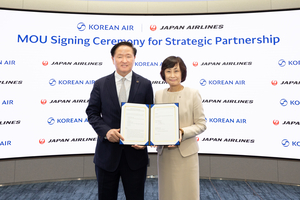
Japan Airlines has acquired shares in Hanjin KAL, the holding company that controls Korean Air, as the two carriers announced a renewed and wide-ranging partnership, industry sources said Friday.
JAL disclosed the stake purchase on Wednesday alongside the partnership announcement, but did not reveal the size of the holding or the price paid. "It is an independent investment decision based on Hanjin KAL's long-term market value," JAL said. No regulatory filing has surfaced disclosing a stake of 5 percent or more.
The purchase comes at a sensitive moment in Hanjin KAL's ownership structure. Hanjin Group Chair Walter Cho and affiliates held 20.57 percent of the company as of its latest half-year report, while Korean construction company Hoban Group held 19.83 percent. Hoban narrowed the gap to 0.42 percentage point after raising its stake to 20.15 percent in July.
Although Hoban has not formally sought management control, its continued stake-building since becoming KAL's second-largest shareholder in 2022 has fueled speculation of a potential power struggle. JAL's investment could strengthen Cho's friendly shareholder base, which already includes Korean Air's long-standing strategic partner holding 14.9 percent of KAL — a stake held by Delta Air Lines, which along with Korean Air and JAL forms part of the transpacific airline partnerships that have deepened through joint ventures and equity ties in recent years.
Other major shareholders include the state-run Korea Development Bank, at 10.58 percent, which backed Korean Air's acquisition of Asiana Airlines, and the National Pension Service, which holds 5.11 percent.
"It's worth watching whether JAL, which follows Delta as another of Korean Air's global strategic partners to hold Hanjin KAL shares, expands its stake in the coming days," an industry official said.
Separately, the two airlines signed a memorandum to broaden codeshare flights and mileage ties once Korean Air finalizes its merger with Asiana Airlines in December, when Japan routes are set to increase from about 250 weekly flights to roughly 400. The merger, cleared after a lengthy global regulatory review that included divestiture remedies at several airports, consolidates South Korea's two largest full-service carriers under Korean Air.
Korean Air and JAL have operated joint flights since the 1960s and launched formal codeshare operations in 2004. The carriers are also exploring shared use of aircraft maintenance, ground handling, and cabin crew training facilities, along with a joint cargo business, and plan to discuss joint procurement and investment in sustainable aviation fuel — an area where airlines worldwide have been pursuing alliances to share the cost of scarce and expensive fuel supplies.
"Combining the infrastructure and know-how of both companies should let us maximize benefits for customers," a Korean Air official said.
Source: Korea Herald Business
