Hyundai Motor Group Executive Chair Chung Euisun Reaffirms Strategic Commitment to Brazil
Key Takeaways
- •Chung Euisun inspected Hyundai's Piracicaba manufacturing facility, which has produced over 2.5 million vehicles since 2012 and operates with an annual capacity of 200,000 units.
- •Hyundai intends to introduce flexible-fuel hybrid SUVs designed for Brazil's ethanol-gasoline market and pursue localized production of compact electric vehicles.
- •Brazil holds the world's second-largest rare earth reserves and more than one-fifth of global graphite deposits, positioning it as a key node in EV battery and renewable energy supply chains.
- •Hyundai sold 96,723 vehicles in Brazil during the first half of 2026, a 12.1 percent year-on-year increase that gave the company a 7.1 percent market share as the nation's fifth-largest auto brand.
- •The group plans to develop hydrogen-based businesses in Brazil covering commercial vehicles, trams, fuel-cell systems, and renewable power generation while expanding research partnerships with institutions such as the University of Sao Paulo.
Hyundai Motor Group Executive Chair Chung Euisun Reaffirms Strategic Commitment to Brazil
Group plans localized EV production, ethanol hybrids, and expanded hydrogen businesses
Hyundai Motor Group Executive Chair Chung Euisun has reaffirmed Brazil's strategic importance to the automaker's long-term global expansion, pledging group-wide support for what he described as another major milestone in the country.
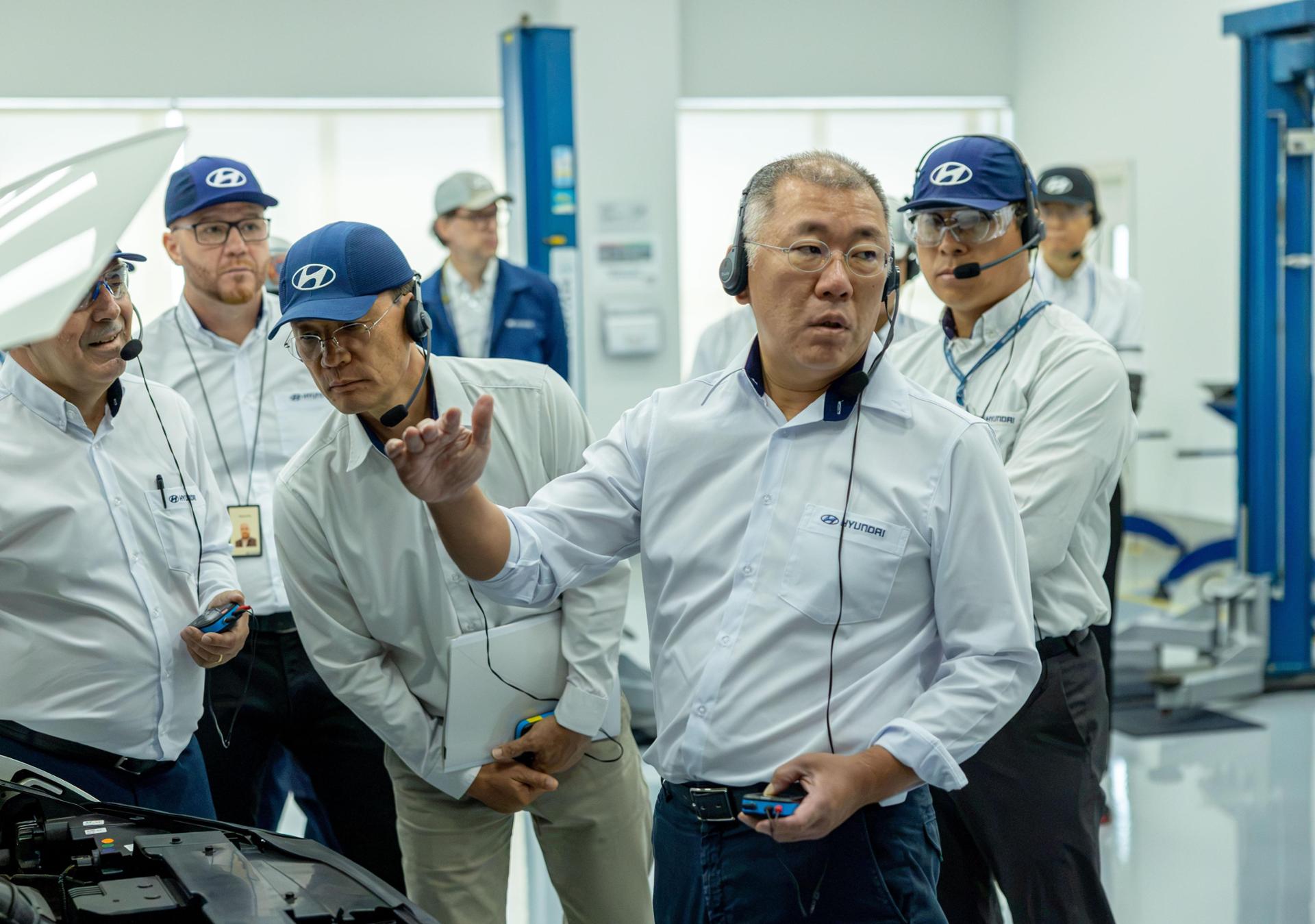
Chung visited Hyundai Motor's manufacturing plant in Piracicaba, Sao Paulo, on Monday while accompanying the Korean business delegation during President Lee Jae Myung's state visit to Brazil. The separate stop underscored Hyundai's intention to reinforce its presence in one of its most important overseas production hubs amid rapid changes in Brazil's automotive industry.
Brazil has emerged as a key pillar of the carmaker's South American operations, housing both its regional headquarters and a manufacturing facility that, since opening in 2012, has reached an annual production capacity of 200,000 vehicles.
Strategic Importance Beyond Vehicle Sales
The visit comes as Brazil gains increasing strategic importance beyond vehicle sales. The country ranks as the world's sixth-largest automobile market, with annual demand for roughly 2.5 million vehicles.
Brazil is also a major supplier of critical minerals, holding the world's second-largest rare earth reserves and more than one-fifth of global graphite deposits. These resources strengthen the country's role in electric vehicle (EV) battery and renewable energy supply chains.
During his visit, Chung inspected the group's Latin America R&D Center, established in 2016, and called for greater localization of research and powertrain development.
"To secure sustainable long-term competitiveness, we must strengthen local R&D capabilities and accelerate localization of powertrain development," Chung told researchers.
Chung later toured the carmaker's production lines for the recently launched i20 hatchback and the Creta SUV and congratulated employees on surpassing cumulative production of 2.5 million vehicles.
"Reaching 2.5 million units in just 13 years reflects the dedication and teamwork of our employees," Chung said. "Brazil remains one of Hyundai's most important global markets, and I sincerely appreciate everything our local workforce has accomplished."
Product Strategy and Localized Manufacturing
The Piracicaba plant currently manufactures the HB20 subcompact vehicle, the Creta, and the i20, all tailored for Brazilian consumers.
Hyundai Motor views the i20, which entered production in June, as a key growth driver in the country's highly competitive B-segment — the second-largest passenger vehicle category by market demand in Brazil, comprising mostly compact cars. The i20 is designed to deliver SUV-like interior space and advanced safety features. Hyundai Motor expects the model to strengthen its position in Brazil alongside the HB20.
To support sales, Hyundai plans partnerships across the travel, retail, entertainment, and fitness industries, offering customers integrated experiences ranging from vehicle test drives to subscription services and travel promotions.
Looking further ahead, Hyundai will expand its SUV portfolio, pursue localized production of electrified vehicles, and accelerate development of hybrid models powered by Brazil's ethanol-gasoline fuel mix. Brazil has operated one of the world's most established biofuels programs since the 1970s, and flex-fuel vehicles capable of running on any blend of ethanol and gasoline have dominated new-car sales since the mid-2000s, making ethanol-compatible hybrid technology a natural fit for the market. The company intends to introduce flexible-fuel hybrid SUVs tailored specifically for the Brazilian market and seek local production of compact EVs.
Hydrogen Ambitions and Research Partnerships
The carmaker is also positioning Brazil as a future hub for hydrogen mobility and renewable energy. Leveraging the group's fuel-cell technology, Hyundai Motor Group plans to develop businesses spanning hydrogen production, distribution, and utilization, while pursuing opportunities in hydrogen commercial vehicles, trams, fuel-cell systems, and renewable power generation.
The company is also seeking to expand research partnerships with Brazilian universities, including the University of Sao Paulo.
Sales Performance
Hyundai's business momentum has remained solid despite intensifying competition in the Brazilian market. According to Brazil's National Federation of Motor Vehicle Distribution, the carmaker sold 96,723 vehicles in the first half of 2026, up 12.1 percent from a year earlier and marking its strongest first-half performance since 2019.
The HB20 and Creta continued to lead sales, helping the carmaker secure a 7.1 percent market share and maintain its position as Brazil's fifth-largest auto brand.
Source: The Korea Times

