Hyperliquid HIP-3 Open Interest Tops $4 Billion
Key Takeaways
- •HIP-3 open interest has risen to about $4 billion, while Hyperliquid’s total open interest is around $10 billion.
- •Hyperliquid is now the third-largest perpetual futures exchange globally by open interest, according to the article.
- •HIP-3 activity has shifted beyond crypto-native pairs into equities and commodities, including the S&P 500, oil, the Nasdaq 100, and technology stocks.
- •The framework requires deployers to stake 500,000 HYPE, which acts as both collateral and a barrier to entry.
- •The article says trade.xyz is the sole operator handling listings, margin limits, and oracles, creating concentration risk for the segment.
The Hyperliquid HIP-3 builder-deployed perpetuals segment has reached approximately $4 billion in open interest, according to Talos Research, as the on-chain derivatives platform expands into tokenized equity indices, commodities, and synthetic pre-IPO exposures.
The milestone comes alongside broader platform open interest of about $10 billion, making Hyperliquid the third-largest perpetual futures exchange globally by open interest.
FOR THE FIRST TIME EVER, HIP-3 OPEN INTEREST HAS SURPASSED $4B. pic.twitter.com/wmzNxXwITR — Hyperliquid News (@HyperliquidNews) August 4, 2026
FOR THE FIRST TIME EVER, HIP-3 OPEN INTEREST HAS SURPASSED $4B. pic.twitter.com/wmzNxXwITR
— Hyperliquid News (@HyperliquidNews) August 4, 2026
The market’s key question is whether HIP-3’s growth reflects durable builder-economy demand that can support HYPE at current valuations, or whether the segment’s concentration in a single operator weakens the bullish case. Either way, the scale of the segment matters because it shows how far Hyperliquid’s activity has moved beyond crypto-native perpetuals into markets that track macro, earnings, and commodity events.
At the time of the data drop, HYPE was trading near $57, up 4.5% over the previous 24 hours, making it one of the largest gainers among major-cap tokens. Daily trading volume stood at $395 million.
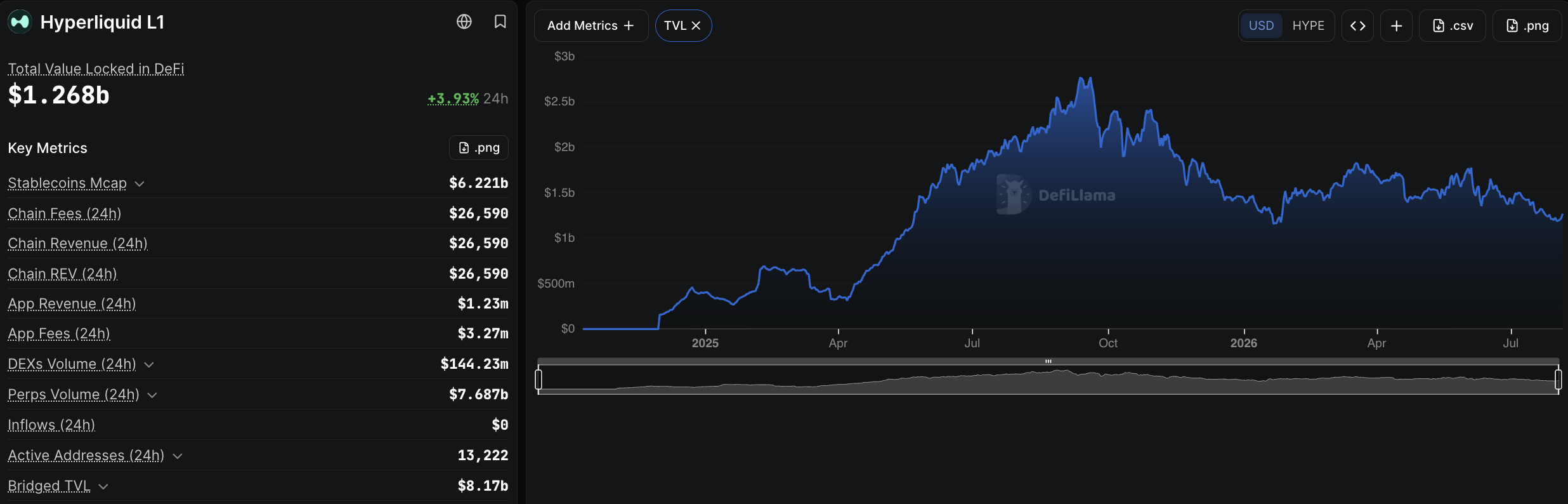
Hyperliquid HIP-3 Open Interest and Builder-Deployed RWA Perpetual Demand
(Source: DefiLlama)
HIP-3 is Hyperliquid’s framework for permissionless, builder-deployed perpetual markets. It allows third-party deployers to create their own DEXs with custom listings and margin parameters by staking 500,000 HYPE.
The model has turned Hyperliquid into a multi-asset on-chain synthetic derivatives platform and, by open interest, the third-largest perpetual futures exchange globally, with about $4 billion attributed to HIP-3.
Trading activity has shifted from crypto-native pairs toward equities and commodities, with notable volume in oil, the Nasdaq 100, and technology stocks.
The S&P 500-linked contract is the largest HIP-3 market, and interest in AI infrastructure and semiconductors is also increasing, as shown by contracts for SK Hynix and Micron Technology.
One notable feature is that nearly half of S&P 500 perpetual volume and more than 60% of oil perpetual volume occur outside U.S. market hours, allowing traders to respond in real time to earnings and geopolitical events.
Platform Context and Concentration Risk
The HIP-3 milestone reflects a segment-level development within a platform that has about $10 billion in total open interest. Its growth suggests capital rotation from core crypto perpetuals into builder-deployed equity and commodity perpetuals, rather than simply broad-based platform expansion.
A major risk is concentration, as trade.xyz solely manages listings, margin limits, and oracles. On-chain data shows that liquidity depends heavily on this single venue.
While open market creation can improve product discovery, it can also lead to uneven standards and fragmented liquidity. The segment’s credibility depends on the number and stability of markets launched during periods of volatility.
The 500,000 HYPE staking requirement, valued at roughly $33.5 million, serves as both an economic security mechanism and a barrier that favors well-capitalized operators. For observers tracking Hyperliquid’s RWA perpetual narrative, the key question is whether more deployers can enter without sacrificing liquidity quality or operational consistency.
well I guess $HYPE goes to $100 here Hyperliquid. pic.twitter.com/FrqZB9ysxo — (@smileycapital) August 4, 2026
well I guess $HYPE goes to $100 here
Hyperliquid. pic.twitter.com/FrqZB9ysxo
— (@smileycapital) August 4, 2026
HYPE Token and Protocol Revenue
The HYPE staking model increases token demand as HIP-3 scales. Each new deployer locks 500,000 HYPE, validators stake it as collateral, and the AQAv2 revenue-sharing arrangement with Circle and Coinbase redirects USDC reserve yield toward HYPE buybacks.
With a $5 billion USDC base, Talos Research estimates that about $160 million annually flows back to the protocol from Circle’s investments, potentially leading to $450 million in additional HYPE burns. That supply compression helps align HIP-3 growth with HYPE’s price performance.
In a bull case, HIP-3 open interest remains near $4 billion and continues to grow, generating fee revenue that accelerates HYPE buybacks. Talos says the Circle/Coinbase USDC AQAv2 structure could deliver about $160 million per year in reserve yield, funding an additional $450 million in HYPE burns and tightening float.
In a base case, HIP-3 continues to expand at a measured pace under trade.xyz’s infrastructure, while concentration risk and event-driven volume spikes keep institutional allocators cautious. In this scenario, the buyback program offsets sell pressure without driving a breakout.
In a bear case, operator dominance could draw regulatory scrutiny over on-chain synthetic equity perpetuals, or a sharp oracle divergence during an off-hours equity event could trigger a HIP-3 liquidation cascade. Either outcome would likely reduce HIP-3 open interest sharply and weigh on HYPE.

