'Human Error' Exhibition Explores Identity, AI and Bodily Vulnerability at Buk-Seoul Museum of Art
Key Takeaways
- •The exhibition is the 13th edition of the Buk-Seoul Museum of Art's annual title match format and remains on view through October 25 with free admission.
- •Curator Yoo Eun-soon reframes human error as an inherent condition of human existence and a wellspring of creativity rather than a deficiency to eliminate.
- •Oh In-hwan's newly commissioned video "Razor-Sharp Synchronization" uses body-mounted cameras on K-pop-style dancers to reveal subtle individual variations beneath seemingly uniform choreography.
- •Chang Seo-young's section "Silicon Venitas" juxtaposes limitless technological advancement against the material vulnerabilities of the human body, including aging and mortality.
- •Both artists converge on the shared question of what remains distinctively human as technology is increasingly expected to operate without friction or imperfection.
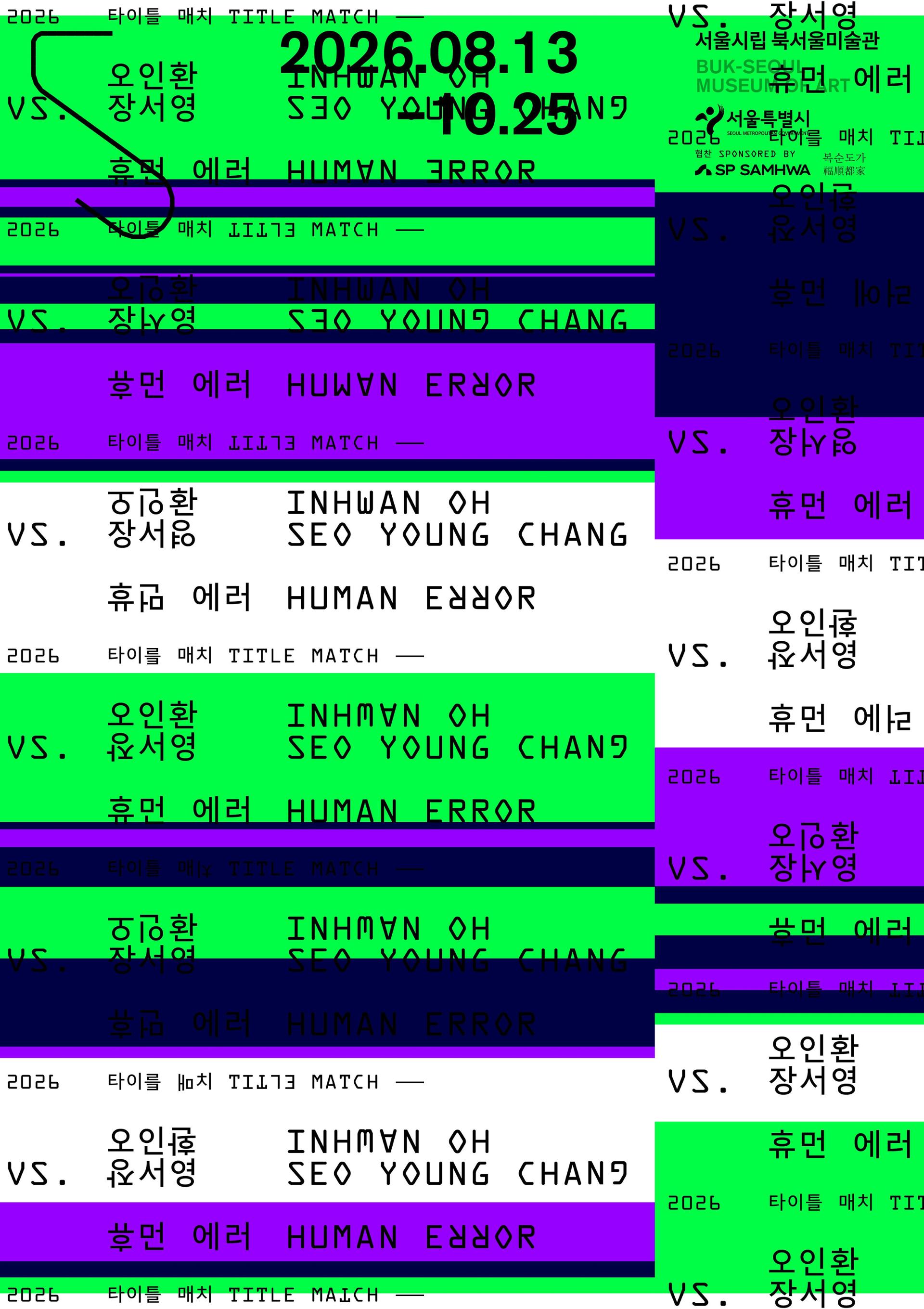
The Buk-Seoul Museum of Art, a branch of the Seoul Museum of Art (SeMA) system in northern Seoul, has opened "2026 Title Match Inhwan Oh vs. Seo Young Chang: Human Error," an exhibition that confronts the ideal of technological perfection with the unruly realities of human bodies, identities, and relationships.
The 13th edition of the museum's annual title match exhibition — a format that pairs two artists in a head-to-head dialogue across the institution's galleries — is on view from Thursday through Oct. 25. It brings together two Seoul-based contemporary artists whose practices differ in medium and generation but converge on a shared question: What remains distinctively human when technology is increasingly expected to be frictionless, efficient, and even creative?
The exhibition's title borrows a term commonly used to identify mistakes caused by human limitations. Rather than treating human error — mistakes arising from physical or mental imperfection — as a defect to be overcome, the show reframes it as a condition of human existence and a wellspring of creativity, curator Yoo Eun-soon said. The exhibition highlights the two artists' distinct efforts to disrupt and move beyond technological systems rather than simply conform to them.
Oh In-hwan: Questioning Conformity and Collective Identity
Oh In-hwan, 61, presents "We're Not One; Neither Am I," a survey of conceptual and participatory works that interrogate collective identity and the social demand for conformity. The exhibition marks his first large-scale museum presentation in 11 years, following his selection for the National Museum of Modern and Contemporary Art's Korea Artist Prize in 2015 — one of the country's most prominent honors for contemporary artists.
"I don't think that everything being the same is beautiful," Oh said at a press conference on Thursday. "I think it is beautiful to acknowledge that differences exist."
His newly commissioned video, "Razor-Sharp Synchronization," takes on the precision choreography associated with K-pop, a global cultural export whose standards of polished uniformity have come to symbolize South Korea's broader drive for collective excellence. Five dancers perform in unison to a soundtrack built from rhythmic elements of Girls' Generations' "Genie" and BTS' "Am I Wrong." At first glance, the dancers' movements are almost indistinguishable. But body-mounted cameras complicate that picture, registering subtle tremors, shifts, and rotations that escape a front-facing view.
Oh said the work began with his unease over the ideal of "knife-like choreography," in which dancers are expected to move with total uniformity, adding that "even within what we call unity, there is diversity."
That pursuit of difference also informs "Aegyo Project," a seven-channel installation in which 15 male actors, ranging in age from their 20s to 60s, perform "aegyo" — exaggerated expressions of cuteness more commonly expected of young female entertainers in Korean popular culture. The unfamiliar sight exposes how certain gestures are assigned to particular genders, ages, and sexual identities, Oh said.
Another piece, "Isn't It Beautiful, Like Rainbow, That We Are Not One," was created with participants of Oh's Iban Art Gathering, an art community for queer people without formal arts education that has been running for 16 years. Participants crafted rainbow arrangements using objects found at home.
"Minority communities can be viewed as highly homogenous," Oh said. "But these works show the diversity within them — and, in turn, the wider diversity that exists throughout society."
Chang Seo-young: Technology and the Vulnerable Body
On the museum's upper floor, Chang Seo-young, 43, approaches the exhibition's theme through the lens of the vulnerable human body. Her section, "Silicon Venitas," juxtaposes the seemingly limitless development of technology with bodies that age, fall ill, and die.
In "All No Grip," Chang uses the disappearance of items to physically grip and control in increasingly screen-based, automated environments to evoke a body rendered passive by external systems. "When everything converges into screens, there is nothing to hold onto," she said, explaining how free will and bodily activity are diminishing in an age when everything is smoothed into automation, leaving nothing to grasp.
Chang's two-channel video, "Pollux's Mirror," positions AI as twin-like entities that learn from, occupy, and potentially replace human beings. It follows a human user's exchanges with AI until the apparent hierarchy between questioner and respondent begins to reverse.
Chang said her interest lies in the tension between technological smoothness and the body's resistance to it. "Technology can make us feel both omnipotent and powerless at the same time," she said. "It seems to erase spatial and temporal boundaries, becoming faster and smoother. But the human body remains material — vulnerable to disease and bound to age."
In "This Memory," a self-driving birthday cake wanders through an abandoned hospital after humanity's extinction, searching in vain for someone to blow out its candles — a scenario Chang said turns the hospital into "a relic of an era" and reflects her view that marking anniversaries is "a very human act," one that "marks points along the continuous flow of time."
The exhibition runs through Oct. 25 at Buk-Seoul Museum of Art. Admission is free of charge.
