Former Hack VC Partner Hsin-Ju Chuang Died Two Days Before Her Promised Evidence Release
Key Takeaways
- •Hsin-Ju Chuang, a 37-year-old former Hack VC partner, was pronounced dead at the scene on Interstate 15 in California on Aug. 24, one day after announcing plans to publish evidence against the firm on Aug. 26.
- •Her allegations included being pressured to work through a serious medical condition, threats of blacklisting, retaliation, and complications with COBRA health coverage, though the promised evidence package never surfaced publicly.
- •The Ethereum and Solana wallet addresses Chuang posted were framed as requests for financial support rather than as components of her promised evidence.
- •Hack VC removed its statement after Chuang's death, saying it did not want its comment to contribute to public hostility toward her.
- •The San Bernardino County coroner notice provides no cause of death, and SEC filings confirm only Hack VC's status as a registered investment adviser without resolving the employment allegations.
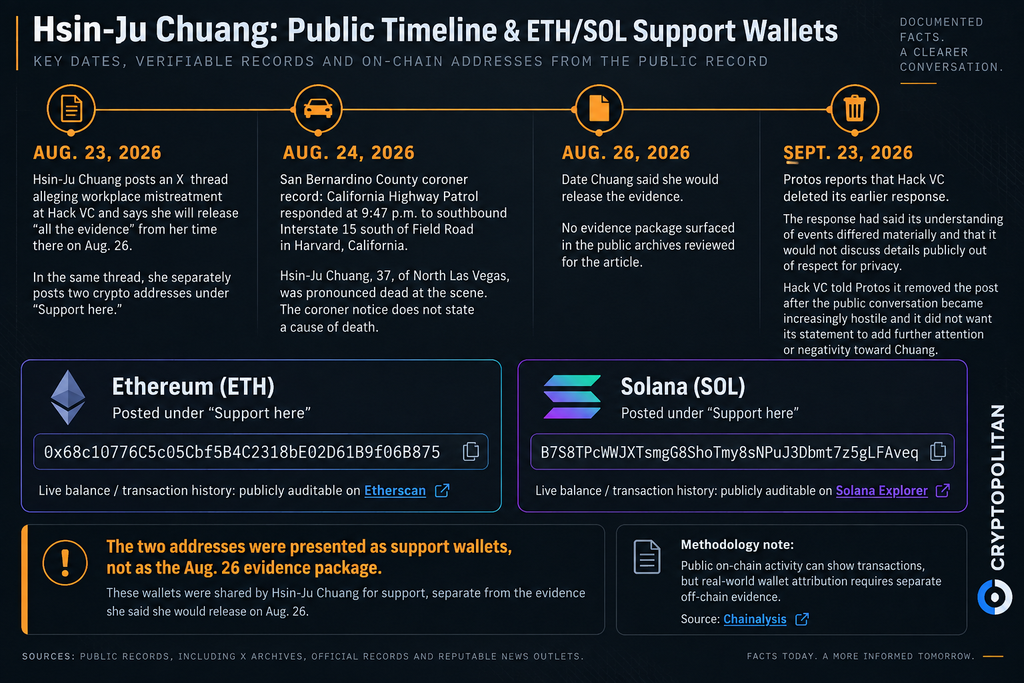
Former Hack VC partner Hsin-Ju Chuang left behind a public record that is notable both for what it contains and for what is missing. On Aug. 23, she said she would publish evidence supporting allegations against her former employer on Aug. 26. She died the next day.
The evidence Chuang promised has not appeared in the public archives reviewed for this article. What remains are her archived posts, two cryptocurrency wallet addresses, Hack VC's response, and official records. Taken together, they offer only a partial view of the controversy, separating verifiable facts from unsubstantiated claims and lingering questions about the disclosure that never arrived.
The Aug. 26 disclosure that never surfaced
In an archived post dated Aug. 23, Chuang said she would unveil “all the evidence” from her tenure at Hack VC on Aug. 26. She claimed she was coerced into working through a grave medical issue, threatened with blacklisting, and later encountered retaliation and problems with her COBRA health insurance — the U.S. federal program that allows departing employees to continue their employer-sponsored health coverage, typically at their own cost.
She also said the case was heading to private mediation and a settlement, but that she preferred not to receive any settlement amount in exchange for remaining silent in the case. Mediation is, by design, a confidential process, so any resolution would not automatically become part of the public record.
The archived posts are valuable because they preserve the promise and its surrounding context. Chuang posted two wallet addresses in the thread, but framed them as a request for support rather than as evidence. Zamant saved her entire thread.
According to Protos, Hack VC subsequently deleted its post after Chuang died. The firm said it removed the comment after noticing how people were discussing the incident in public and did not want its statement to add to the hostility toward Chuang.
The San Bernardino County coroner record states that the California Highway Patrol responded to southbound Interstate 15 south of Field Road in Harvard at 9:47 p.m. on Aug. 24. Chuang, 37, of North Las Vegas, was pronounced dead at the scene.
The notice does not give a cause of death, and none of the sources reviewed establishes that her death was caused by the employment dispute.
The two wallets were support addresses, not evidence
Chuang concluded her Aug. 23 thread by posting an Ethereum and a Solana address under the heading “Support here.” In a later post, she explained that she believed going public could involve expensive lawsuits and that there is a financial imbalance between an individual and a large venture firm.
That distinction matters. Both addresses are publicly auditable blockchain addresses, but Chuang did not describe them as part of the evidence package she promised for Aug. 26.
According to Chainalysis, blockchain records can provide insight into transactions, but establishing a connection between an address and an actual individual or entity requires additional evidence from outside the blockchain. On-chain information can demonstrate that something was transferred, but cannot clarify the reason for the transfer or the identity of the owner of another address.
A separate Cryptopolitan report drew a similar distinction regarding a wallet an analyst connected to Hack VC: although the transaction itself was traceable, the attribution and the confirmation of a sale had not been verified.
What remains verifiable
The surviving record includes Chuang's Aug. 23 thread and its Aug. 26 deadline, the two support addresses, Hack VC's response, and the coroner notice.
SEC records identify Hack VC Management, LLC as an SEC-registered investment adviser under file number 801-126321. Its Form ADV — the standard disclosure filing registered advisers submit to the SEC — shows an Other-Than-Annual Amendment dated July 30, 2026. The filing confirms the firm's identity and regulatory status; it does not resolve the employment allegations.
Missing from the public archives reviewed is the evidence package Chuang said she would release. Its absence does not prove that it never existed, that it was deleted, or that it was shared privately.
That leaves a narrow but important line: the allegations remain allegations, the support wallets remain publicly auditable, and the promised Aug. 26 evidence remains absent from the public record examined so far. What could shift that line is equally narrow: a cause-of-death determination from the coroner, which the notice published so far does not contain, or the promised materials surfacing in a public archive.
In memoriam
“In case it needs to be said, I did a good job at Hack VC. I was only there full time for 7 months; been part-time since 2021. I got a $50k raise to $300k, $30k bonus, and promises of additional carry that would have been implemented about a week or so after my last day. I was also offered admission into the GP entity (but not sure if admission was actually completed bc it was during my medical emergency). This + my resume, should show that me suing is not a money grab; I was genuinely harmed.”
— Hsin-Ju C.

