How Crypto Exchanges Make Money: Revenue Streams and Fee Breakdown (2026)
Key Takeaways
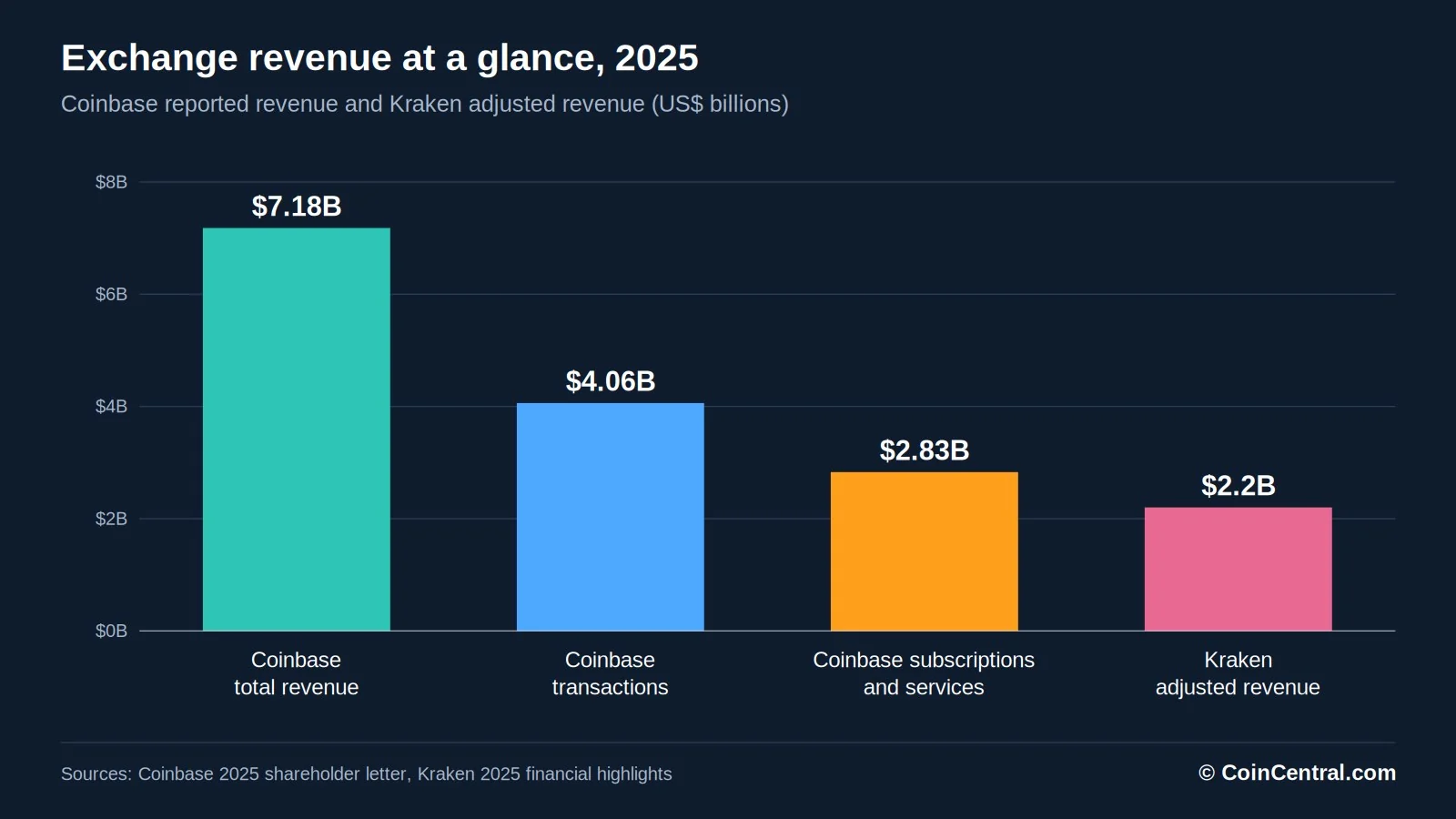
- •Coinbase generated $7.18 billion in total revenue for 2025, comprising roughly $4.06 billion from transactions and $2.83 billion from subscriptions and services.
- •Kraken's parent company Payward reported $2.2 billion in adjusted revenue for 2025, with 53% coming from asset-based and other non-trading activities.
- •Coinbase's stablecoin revenue rose to approximately $1.35 billion in 2025 from about $910 million in 2024, driven by its USDC partnership with Circle.
- •Subscriptions and services grew to 48% of Coinbase's net revenue in the second quarter of 2026, up from roughly 41% for full-year 2025.
- •Despite revenue diversification, Coinbase posted a net loss of about $360 million in the second quarter of 2026 on approximately $1.2 billion in net revenue.
Cryptocurrency exchanges earn revenue from trading fees, price spreads, derivatives, staking, stablecoins and services aimed at large investors. Every purchase of Bitcoin, sale of Ethereum or token swap can generate a charge for the platform.
Trading is still the core of the business, but it is no longer the whole story. Coinbase, Binance and Kraken have each built product lines that extend well beyond simple trades.
Coinbase reported $7.18 billion in total revenue for 2025, including roughly $4.06 billion from transactions and $2.83 billion from subscriptions and services. Payward, Kraken's parent group, reported $2.2 billion in adjusted revenue for 2025, with more than half coming from sources outside trading. Because Kraken uses company-defined adjusted measures, its figures do not align exactly with Coinbase's reported results.
This breakdown examines each revenue source in turn, drawing on published fee schedules and company reports.
The Main Revenue Sources for Crypto Exchanges
Exchanges operate under several business models. Some platforms simply match buyers and sellers, while others add brokerage, custody, payments and investment services. Not every exchange runs all of these businesses, and revenue arrangements differ by platform, product and jurisdiction.
Coinbase offers the clearest public picture because it publishes a detailed breakdown. In 2025, consumer transactions generated the most revenue, followed by stablecoin revenue.
Trading Fees: What Exchanges Charge Per Trade
Trading commissions remain a major revenue source. When customers buy or sell, the exchange can take a percentage of the trade's value. Because crypto markets operate around the clock, these fees accrue on nights, weekends and holidays as well.
Fees vary with the exchange, the order type and the customer's trading volume. Binance lists a 0.10% maker fee and a 0.10% taker fee on its standard spot tier. Kraken Pro's entry tier lists 0.40% for makers and 0.80% for takers. Coinbase Exchange starts at 0.40% for makers and 0.60% for takers.
These are specific products and fee tiers, not blanket prices for every service a company offers. Published standard rates were checked in October 2026; promotions, trading pairs, jurisdictions and volume tiers can all change what customers actually pay.
What an Exchange Earns on a $10,000 Trade
Consider a customer who buys $10,000 of Bitcoin at a 0.10% fee. The exchange collects $10. If the customer later sells $10,000 at the same rate, that is another $10 — $20 in total.
Now picture a platform handling $1 billion in daily trading volume. At an average fee of 0.10%, gross trading fees would run to $1 million a day. That assumes every dollar traded pays the full rate, which rarely happens: discounts for large traders, promotions and rebates all reduce the amount collected.
Trading volume is not revenue, and revenue is not profit.
Maker and Taker Fees: How Exchanges Encourage Trading
Most large order-book exchanges use maker-taker pricing, which separates traders who add liquidity from those who use it immediately.
A maker order rests in the order book until it is matched — for example, a Bitcoin buy order placed below the market price, waiting for a seller. A taker order executes against existing orders at once, such as a market order to buy Bitcoin.
Exchanges typically charge makers less because a busy order book attracts traders and improves pricing. Some platforms go further and pay rebates — known as negative maker fees — to eligible high-volume traders. Kraken's schedule includes negative maker rates for certain tiers and markets.
That does not mean the exchange loses money on those trades. Taker fees, other trading activity and additional services can more than offset the rebates.
Trading Spreads and Commission-Free Trading
Commissions are not the only way platforms earn. The spread is the gap between the price at which an asset can be bought and the price at which it can be sold.
Suppose Bitcoin trades at a reference price of $70,000. A crypto broker might quote $70,350 to buy and $69,650 to sell — a $700 gap, or 1% of the reference price. That gap does not equal profit. It can reflect genuine market differences, execution costs and margins retained by brokers or liquidity providers.
How Coinbase Uses Spreads
Coinbase says its simple buy and sell service builds a spread into the quoted price and that it may retain excess spread. Coinbase Advanced, by contrast, uses an order book and does not include the same quoted-price spread.
Total cost can therefore differ by interface. Comparing how much crypto actually arrives after fees, spreads and execution costs is the more reliable measure.
How Commission-Free Platforms Earn
Some platforms advertise zero commissions. Robinhood's US order-routing disclosure states that it receives rebates from third-party market makers. As of 15 June 2026, it reported $0.95 for every $100 of crypto order volume sent through that route — 0.95%. The payment is built into the spread rather than shown as a separate commission.
Not every commission-free trade is expensive, but total cost — including the execution price — remains the fairest comparison.
Crypto Futures and Derivatives Trading
Derivatives give investors a way to take positions on crypto prices without owning the underlying coin. Common products include futures, options and perpetual futures. Exchanges can charge a fee when a trader opens and closes a position, and some also earn from clearing, financing and related services.
How Leverage Can Raise Fee Revenue
Suppose a trader deposits $1,000 and opens a $10,000 Bitcoin futures position with 10x leverage. At a 0.05% fee on the full position value, opening the position costs $5 and closing it costs another $5, so the exchange collects $10. The trader controls $10,000 with only $1,000 in margin.
Because fees apply to the larger position, leverage can raise the volume on which fees are charged. Fee schedules vary, and trading volume is not the same as borrowed money.
Do Exchanges Keep Perpetual Funding Fees?
A common assumption is that exchanges pocket funding payments on perpetual futures. In many markets, funding moves directly between traders holding long and short positions. Coinbase says funding payments on its relevant global derivatives products are exchanged between contract holders and are not retained as exchange fees.
Platforms can still charge normal trading fees and other disclosed charges. Derivatives also carry liquidation risk, which makes them a poor fit for many newer investors.
Stablecoins: A Growing Source of Exchange Revenue
Stablecoins have become an increasingly significant part of exchange revenue. Tokens such as USDC aim to hold a steady value against the US dollar, and issuers may hold reserves in cash and short-term government securities that earn interest. Through business agreements, exchanges can receive a share of the benefits tied to stablecoin distribution and use.
Coinbase and Circle's USDC Partnership
Coinbase's arrangement with Circle, the issuer of USDC, is the leading example. Coinbase's 2025 financial statements show about $1.35 billion in stablecoin revenue for the year, up from about $910 million in 2024.
Circle's 2026 disclosures say Coinbase receives amounts linked to USDC held on its platform, plus a share of certain wider ecosystem income. Revenue therefore depends on USDC in circulation, balances held in eligible products, reserve yields and contract terms. In the second quarter of 2026, Coinbase reported about $292 million in stablecoin revenue under its updated presentation method.
Unlike trading fees, stablecoin revenue can flow in even when customers are not actively buying or selling Bitcoin.
Staking Commissions and Crypto Rewards
Staking provides exchanges with a steady income stream. Proof-of-stake networks rely on validators to secure the network and process transactions, and holders of eligible coins can stake their assets and receive rewards. Exchanges make this simple for customers and, in return, may keep a percentage of the rewards.
How Much Can an Exchange Earn From Staking?
Say a customer stakes $10,000 of crypto and earns $500 in a year. With a 30% commission, the exchange keeps $150 and the customer keeps $350.
Coinbase's pricing page lists a standard 35% staking commission for several supported assets, with lower rates available to some eligible subscribers. At 35%, the exchange would keep $175 of that same $500.
Rewards are never guaranteed: they depend on network rules, validator performance and token prices. Customers should also check unstaking limits and whether an advertised reward rate is shown before or after commissions.
Institutional Custody and Margin Lending
Large exchanges also serve institutions — hedge funds, asset managers, trading firms and corporations. These clients may need custody, trade execution, financing, portfolio tools and settlement systems. Coinbase Prime bundles several of these services.
Exchanges can earn fees from custody, institutional trading and financing. Institutional clients can hold large balances and use many services, though institutional revenue still rises and falls with market activity and asset prices. In 2025, Coinbase reported $480 million in institutional transaction revenue, while consumer transactions produced $3.32 billion.
Margin Lending and Interest Income
Lending is another income source. A trader may borrow money to raise exposure to Bitcoin, and the platform charges interest. A customer who borrowed $20,000 at 10% a year for a full year under simple interest would owe roughly $2,000 — revenue before funding costs, losses and operating expenses.
Not every exchange lends customer crypto, and custody, lending programs and leveraged accounts carry different risks. Crypto held in custody does not belong to the exchange; customer assets are not automatically available for a platform to spend, trade or lend.
Withdrawal Fees, Subscriptions and Listings
Exchanges can collect additional fees when customers move money, including fiat withdrawal fees, crypto processing fees, card charges and conversion fees. Coinbase lists a 0.2% processing fee for Bitcoin transfers over the Lightning Network. Blockchain network fees are generally paid to miners or validators rather than retained by the exchange. Some platforms absorb withdrawal costs, while others recover them through fixed or estimated charges.
Premium Subscriptions
Coinbase One is a membership offering trading benefits and extra features. In February 2026, Coinbase reported about one million subscribers. Subscriptions can reduce reliance on swings in trading activity, though for occasional traders a monthly fee may cost more than a standard account. Coinbase reported $2.83 billion in subscription and services revenue for 2025.
Do Exchanges Charge to List Coins?
Coinbase says applications and listings are free and that projects are not required to buy marketing services. It does offer optional education campaigns and other paid services for eligible projects. Other exchanges may apply different listing or token-launch terms. A paid promotion does not amount to an endorsement, and a listing does not guarantee quality or returns.
Coinbase and Kraken Revenue Breakdown
Public filings offer the clearest evidence of how exchanges earn money. Figures are rounded and drawn from Coinbase's 2025 Form 10-K and shareholder disclosures.
Transaction revenue accounted for about 59% of Coinbase's $6.88 billion in net revenue in 2025, with subscriptions and services making up the remaining 41%. In the second quarter of 2026, subscriptions and services represented 48% of net revenue. With Coinbase reporting quarterly and Kraken's parent publishing annual highlights, the shifting balance between trading and non-trading income is one of the clearest trends to follow in future disclosures.
Kraken Revenue
Kraken's parent, Payward, reported $2.2 billion in adjusted revenue for 2025. About 47% came from trading-based revenue and 53% from asset-based and other revenue. Adjusted EBITDA was $531 million, and platform volume reached $2 trillion.
Kraken's adjusted measures cannot be compared directly with Coinbase's, but the pattern is similar: large exchanges increasingly want income from customers who hold, borrow, move and manage assets — not only those who trade.
Are Crypto Exchanges Profitable?
Exchanges can be highly profitable, but results swing with the market. Strong markets lift trading, deposits and demand for products; weak markets do the opposite. Costs are substantial as well, spanning cybersecurity, technology, compliance, customer support, payroll and marketing. Competition pushes fees down, so low-fee platforms need high volume or other income to compensate.
Interest rates matter too. Revenue tied to stablecoin reserves or interest-bearing assets can fall when rates fall.
Coinbase and Robinhood in 2026
Diversification does not guarantee profit. Coinbase reported a net loss of about $360 million in the second quarter of 2026, on roughly $1.2 billion in net revenue.
Robinhood reported $100 million in crypto transaction revenue in the same quarter, down 38% from a year earlier, though its overall revenue still rose on the strength of other products.
Trading volume alone offers an incomplete picture. Net revenue, operating costs, cash flow, customer retention and revenue concentration give a fuller view.
How Decentralized Exchanges Make Money
Decentralized exchanges, or DEXs, operate differently. Services such as Uniswap let users swap tokens through smart contracts on a blockchain, with many using liquidity pools instead of a central order book. People who add assets to a pool can earn a share of trading fees. Uniswap documentation explains how swap fees are divided between liquidity providers and protocol mechanisms, and protocols may direct some fees to treasuries or other approved uses.
Not every fee a DEX trader pays becomes company revenue. Gas fees generally pay network participants, liquidity provider fees follow the protocol's rules, and operators of popular interfaces may add their own charges. A protocol and the business running a popular interface are not always the same entity.
Are Exchange Business Models Safe for Customers?
A profitable exchange is not automatically a safe one. Some platforms combine trading, brokerage, custody and lending, which can create conflicts of interest. Customers should know whether an exchange matches orders between users, acts as the counterparty, or sends orders to third-party market makers — choices that can affect execution quality and incentives.
In the European Union, the Markets in Crypto-Assets Regulation (MiCA) sets rules on conflicts of interest and on safeguarding client assets. Article 70 includes duties intended to protect customers' ownership rights and limit the use of client assets for a provider's own account.
Investors should verify the legal entity, regulatory authorization, custody setup and withdrawal terms. Low fees alone are not reason enough to hold large balances on any platform.
Frequently Asked Questions
Do Crypto Exchanges Make Money When Bitcoin Falls?
Yes. Exchanges can earn trading fees whether prices rise or fall, though prolonged bear markets can reduce trading, customer balances and other revenue.
Do Exchanges Make Money From Your Losses?
Ordinary order-book exchanges generally earn trading fees rather than taking customers' losses. Some brokerage and derivatives models involve counterparties, financing or other incentives, so customers should understand how their orders are executed.
Do Exchanges Earn Money From Holding Crypto?
Some earn revenue from custody services, staking commissions and agreements linked to customer balances. Holding customer crypto does not give an exchange ownership of those assets.
Which Exchange Makes the Most Money?
There is no firm global ranking, because major exchanges do not all publish comparable financial statements. Coinbase reported $7.18 billion in total revenue for 2025, but that does not establish it as the highest-revenue exchange.
Why Do Exchanges Offer Zero Trading Fees?
Free trading can attract customers, add liquidity and encourage use of paid services. Some platforms are compensated through spreads or market-maker deals. Zero commission is not the same as zero total cost.
Bottom Line
Crypto exchanges make money from far more than Bitcoin trading fees. Commissions and spreads still matter, but stablecoins, staking, derivatives, lending, custody and subscriptions now add materially to revenue. Coinbase's subscriptions and services accounted for about 41% of net revenue in 2025 and 48% in the second quarter of 2026, while Kraken reported that more than half of its 2025 adjusted revenue came from asset-based and other activity.
For investors, costs are not always obvious: a platform with low commissions may still earn through spreads, routing deals, financing or extra services. For the industry, diversification can add stability, but operating costs, competition, regulation and market swings remain real challenges.
Sources
- Coinbase Fourth Quarter and Full-Year 2025 Shareholder Letter
- Coinbase Second Quarter 2026 Financial Results
- Coinbase Quarterly Report, June 2026 (SEC)
- Kraken 2025 Full-Year Financial Highlights
- Robinhood Second Quarter 2026 Results
- Binance Spot Trading Fee Schedule
- Kraken October 2026 Trading Fee Schedule
- Coinbase Cryptocurrency Pricing and Fee Disclosures
- Robinhood Cryptocurrency Order Routing and Market-Maker Rebates
- Circle June 2026 Quarterly Financial Report (SEC)
- Coinbase Perpetual Futures Funding Payments
- Coinbase Digital Asset Listing Fees and Policies
- Uniswap Liquidity Provider Fees
- ESMA MiCA Article 70: Safeguarding Client Assets
Disclaimer: This article is for educational purposes only and is not financial or investment advice. Exchange fees, services and financial results change over time and vary by jurisdiction. Figures reflect disclosures available as of 27 October 2026.
This article originally appeared on Blockonomi.

