Hong Kong Pushes Banks to Adopt AI to Detect Crypto Crime Before Funds Vanish
Key Takeaways
- •The HKMA is pushing banks to adopt AI more quickly and is examining how AI agents could combine blockchain transaction data with customer records to detect financial crime.
- •Chainalysis research cited by the regulator shows illicit crypto addresses received at least $154 billion in 2025, a 162% increase from the prior year, with stablecoins accounting for 84% of the total.
- •HKMA executive director Raymond Chan said the core challenge lies in linking wallet activities to real-world identities quickly enough to prevent fund dissipation.
- •A Hong Kong Institute for Monetary and Financial Research survey of 39 financial institutions and eight technology providers found 90% had adopted or planned generative AI, but only 13% had implemented AI agents, with banks raising security and explainability concerns.
- •ZIG Finance co-founder Abdul Rafay Gadit said AI agents can gather records and prepare cases for investigators, but decisions to freeze accounts, reject payments, or report suspicious activity should remain with bank staff.
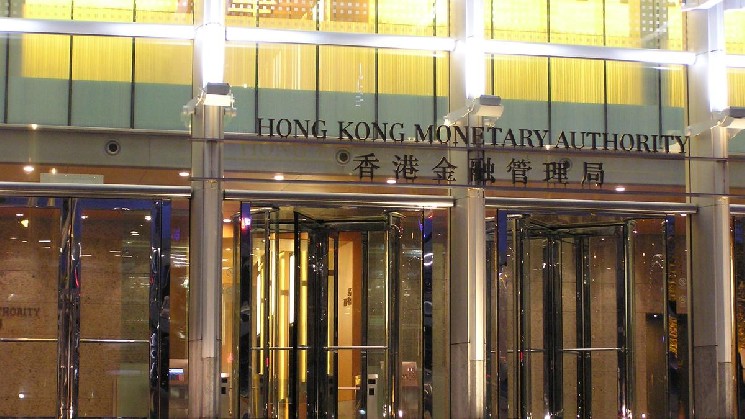
Hong Kong's central bank is moving to accelerate the adoption of artificial intelligence among lenders as the surge of stablecoins and other digital assets makes suspicious money transfers increasingly difficult to track.
Raymond Chan, executive director for enforcement and anti-money laundering at the Hong Kong Monetary Authority (HKMA), said Tuesday that the regulator is working to speed up AI adoption across the banking sector. The effort includes examining how AI agents could combine blockchain transaction data with customer records to detect financial crime.
Chan cited research from Chainalysis showing that illicit crypto addresses received at least $154 billion in 2025, a 162% increase from the previous year. The rise was largely driven by activity involving sanctioned entities, with stablecoins accounting for 84% of the total. The analytics firm estimated illicit activity at less than 1% of the crypto transaction volume measured in its analysis. While illicit flows remain a small share of overall volume, their rapid growth, and their concentration in stablecoins, helps explain why the regulator is focused on banks' ability to trace digital-asset transfers.
While banks can trace transactions on a blockchain, identifying who controls the wallets behind them is more difficult, Chan noted.
"The core challenge obviously lies in linking wallet activities to real-world identities quickly enough to prevent fund dissipation," Chan said.
Abdul Rafay Gadit, co-founder of ZIG Finance, said banks should test AI agents against past fraud cases and run them alongside existing monitoring systems before allowing them to act independently.
"Compare what it catches, what it misses and how long investigations take. Fewer alerts only helps if you're still catching suspicious activity," he said.
AI agents can carry out several tasks with limited human supervision. Chan said they could flag patterns, such as rapid switches between cryptocurrencies and conventional money, that could conceal the source of funds. Identity tools designed to help establish who controls a wallet are also being piloted, he added.
A report released Tuesday by the Hong Kong Institute for Monetary and Financial Research stated that the HKMA has provided technical support and workshops to help banks deploy AI. It describes one bank using generative AI to investigate possible money laundering through transaction records, images and customers' digital activity. The bank reported faster, more accurate fraud investigations, without providing details.
The report found that 90% of surveyed financial institutions had adopted or planned to adopt generative AI. Across business use cases, 13% had implemented AI agents, and 56% planned to do so. The survey, conducted from January to March, covered 39 financial institutions and eight technology providers. Banks also raised concerns about security and about how to explain decisions made by AI systems. The distance between broad generative AI uptake and the far lower use of agents, together with the security and explainability concerns banks raised, helps explain why both the HKMA and industry voices frame the technology as support for human investigators rather than a substitute for them.
Gadit said AI agents could gather transaction records, check sanctions lists and prepare cases for investigators, but decisions to freeze accounts, reject payments or report suspicious activity should remain with bank staff. How the pilots of wallet-identity tools and parallel-tested agents perform against historical fraud cases will offer a measure of whether Hong Kong's banks can close the gap between tracing a suspicious transfer and identifying who is behind it.

