Henry Sy Ancestral Home in Jinjiang Traces Roots of SM Group
Key Takeaways
- •The De Cheng Building is identified as the ancestral home of Henry Sy, Sr. in Hong Xi village, Jinjiang, Fujian province.
- •The residence spans about 450 square meters and reflects Minnan Fan Zai Lou architecture, blending southern Fujian and Western design elements.
- •Henry Sy, Sr. left Fujian as a child to join his father in the Philippines and later founded what became the SM Group.
- •Sy financed the restoration of the ancestral house in 2010, and the work was completed in 2011 under his family’s supervision.
- •The restored home is a protected cultural relic and a visitor destination linked to the history of Fujian’s overseas Chinese communities.
By Juliana Chloe A. Gonzales
Before the large shopping malls that have become fixtures across the Philippines, there was a modest red-brick home in Hong Xi village in Jinjiang, Fujian province.
The ancestral residence of the late Henry Sy, Sr. offers a view into the early life of the businessman whose family would later build one of the Philippines’ largest conglomerates.
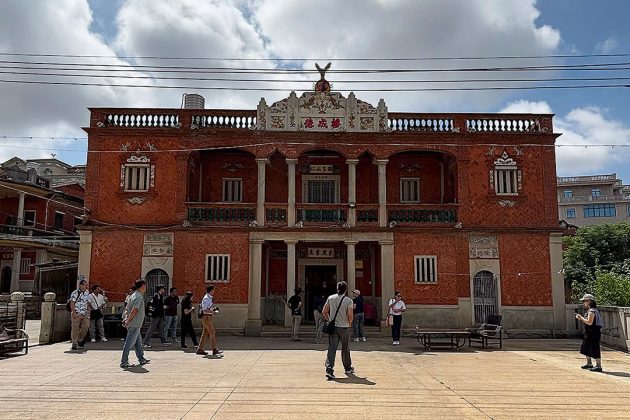
Known as the De Cheng Building, the two-story house covers about 450 square meters. It was built in the Minnan Fan Zai Lou architectural style, which combines traditional southern Fujian design with Western influences, a form commonly associated with homes built by overseas Chinese families.
The restored residence is now designated as a protected cultural relic. A plaque identifies it as Mr. Sy’s ancestral home, while exhibits around the property detail the Sy family’s history and the restoration of the building.
Information displayed at the site says Mr. Sy left Fujian as a child to join his father in the Philippines. He would later establish what became the SM Group. Many years afterward, he returned to Hong Xi village and financed the restoration of the ancestral house in 2010.
The restoration was completed in 2011 under the supervision of the Sy family. In 2013, the Hong Xi village committee put up a stone marker recording the history of the building.
From within the quiet village, it can be hard to imagine that the house is connected to one of Southeast Asia’s largest retail and property groups. The contrast between Hong Xi’s narrow lanes and the present scale of the SM Group highlights the distance the family’s journey has covered.
Village officials describe the Sy family’s continued support for Hong Xi as a lasting link to their ancestral hometown. In places such as Jinjiang, ancestral homes and village markers often serve as records of family migration, preserving ties between local communities and overseas descendants.
The restored house has become both a heritage landmark and a destination for visitors interested in the beginnings of one of the Philippines’ most prominent business families.
Beyond its historical importance to the Sy family, the De Cheng Building also reflects the broader experience of Fujian’s overseas Chinese communities. Their migration across Southeast Asia helped shape generations of entrepreneurs, traders, and business leaders.
Standing before the ornate carvings and red-brick walls of the Sy ancestral home, the high-tech skyscrapers and logistics hubs of modern China seemed distant, yet closely connected. The story that began in this quiet village and grew into one of the Philippines’ largest business groups shows how major enterprises can trace their origins to humble beginnings.

