Hedge Fund Losses and UWM Stock Plunge Signal Financial Stress Echoing 2000 and 2008 Crises
Key Takeaways
- •July 2024 was the worst month for hedge funds since the 2008 financial crisis, with losses exceeding even the 2020 Covid crash due to AI stock declines.
- •Situational Awareness, an AI-focused hedge fund founded by Leopold Aschenbrenner, lost 67% of its value and was forced to sell most of its portfolio to Citadel after failing to meet margin calls from Wall Street lenders.
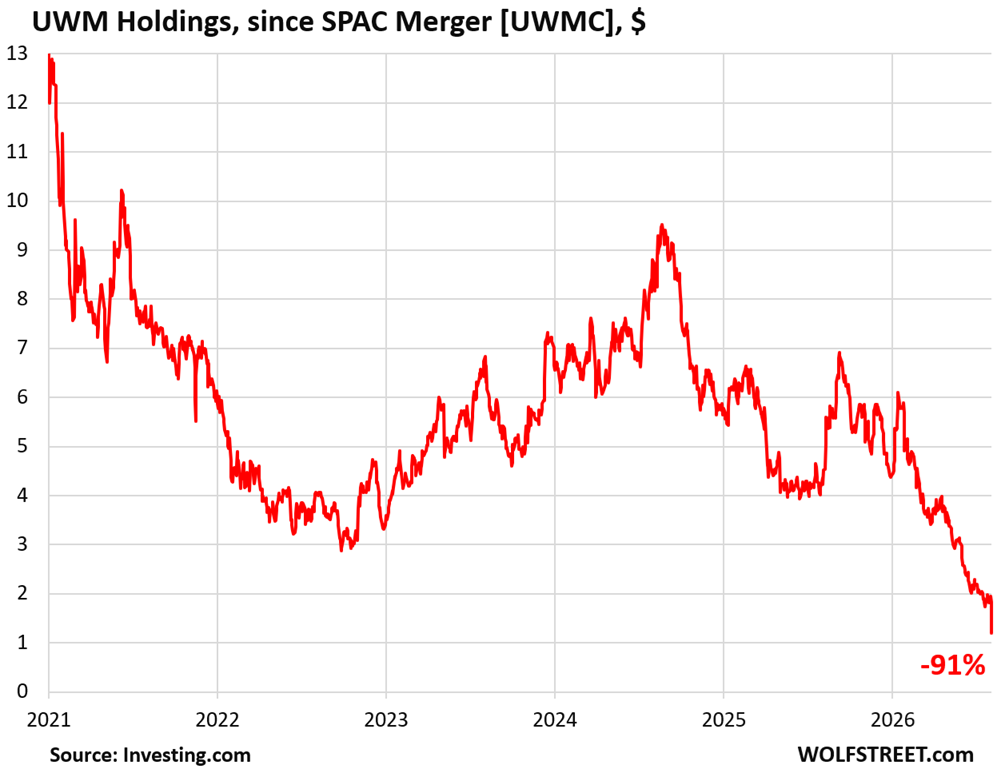
- •UWM Holdings' stock fell 35% to $1.20 per share on August 6th after a failed interest-rate hedge, dividend suspension, and a heavily dilutive $2 billion equity raise from Oak Tree Capital Management and the Ishbia family.
- •Nonbank mortgage lenders, which now originate the majority of US home loans, have cut employment by 39% since their 2021 peak as the housing market endures a severe multi-year slump.
- •Energy price shocks from geopolitical tensions, including Iran's closure of the Strait of Hormuz, are complicating the Federal Reserve's interest-rate decisions and intensifying stress in leveraged finance and housing.
Hedge Fund Losses and UWM Stock Plunge Signal Financial Stress Echoing 2000 and 2008 Crises
Source: GoldSeek — By David Haggith
Geopolitical Backdrop Intensifies Market Pressure
Iran has stated it will not negotiate with Donald Trump again and has reiterated that the Strait of Hormuz will remain closed until the administration meets every one of its non-negotiable demands, including the stranding of US and Israeli ships inside the Gulf. West Texas Intermediate crude (WTI) rose to touch $84/bbl intraday in response, while Brent settled just below $90. Separately, Ukraine successfully struck another Russian refinery deep inside Russian territory.
Energy price shocks of this nature feed directly into inflation expectations and complicate the Federal Reserve's interest-rate trajectory, which in turn pressures rate-sensitive sectors such as housing and leveraged finance — the two areas where stress is already concentrated.
July: Worst Month for Hedge Funds Since 2008
Against this geopolitical backdrop, July became the worst month for hedge funds since the 2008 financial crisis, driven by AI stock wipeouts. The decline surpassed even the Covid crash of 2020. The period was marked by a relentless succession of destabilizing events, including a major earthquake that brought down significant buildings in Colombia, following a double earthquake that destroyed major structures in neighboring Venezuela less than a month earlier.
The financial alarm intensified after Situational Awareness, an AI-focused hedge fund founded by Leopold Aschenbrenner, came close to collapse following a 67% decline in value. The 24-year-old investor, once hailed as the "Nostradamus of AI," was forced to sell the bulk of his fund's portfolio to Ken Griffin's Citadel under pressure from Wall Street lenders whose capital he had been using to place leveraged bets on AI stocks. Leverage — borrowing against portfolio holdings to increase position sizes — magnifies losses when prices move adversely, turning a bad quarter into an existential one for funds that cannot meet margin calls.
Bruno Schneller, managing partner of Erlen Capital Management, described the problems at Situational Awareness as a "near-perfect microcosm" of July's broader hedge fund decline — suggesting that similar distress exists across the sector.
These types of events tend to arrive suddenly when market leaders are already in decline. As Warren Buffett famously observed, when the tide runs out, you discover who has been swimming without a swimsuit.
Yeats's "The Second Coming" and the Present Moment
The author draws a literary parallel to the current environment through William Butler Yeats's poem:
Turning and turning in the widening gyre
The falcon cannot hear the falconer;
Things fall apart; the centre cannot hold;
Mere anarchy is loosed upon the world,
The blood-dimmed tide is loosed, and everywhere
The ceremony of innocence is drowned;
The best lack all conviction, while the worst
Are full of passionate intensity.
Surely some revelation is at hand;
Surely the Second Coming is at hand.
The Second Coming! Hardly are those words out
When a vast image out of Spiritus Mundi
Troubles my sight: somewhere in sands of the desert
A shape with lion body and the head of a man,
A gaze blank and pitiless as the sun,
Is moving its slow thighs, while all about it
Reel shadows of the indignant desert birds.
The darkness drops again; but now I know
That twenty centuries of stony sleep
Were vexed to nightmare by a rocking cradle,
And what rough beast, its hour come round at last,
Slouches towards Bethlehem to be born?
— William Butler Yeats, The Second Coming
UWM Holdings Plunges 35% Into Penny-Stock Territory
The stock of UWM Holdings — the parent company of United Wholesale Mortgage, the largest home-mortgage lender in the US with $40 billion in mortgage originations in Q2 — plunged an additional 35% on August 6th, falling to $1.20 per share.
UWM, which exclusively originates home loans through mortgage brokers, went public in January 2021 via a SPAC merger that gave it a $16 billion valuation. It was the largest SPAC deal at the time, and the listing made CEO and founder Mat Ishbia a multi-billionaire. UWM's SPAC listing occurred at the peak of a 2020–2021 SPAC boom in which over 600 blank-check companies raised capital; many of those deals have since traded well below their $10-per-share offering benchmarks as post-merger performance failed to meet projections. As Wolf Richter noted, the stock has since been reduced to virtual penny-stock status.
The latest decline was driven by several factors: a substantial loss after an interest-rate hedge blew up, the suspension of the company's dividend, and a $2 billion equity infusion from Oak Tree Capital Management — the world's largest distressed-debt investor, co-founded by Howard Marks — together with the Ishbia family, at terms expected to heavily dilute public shareholders.
The author draws comparisons to the 2008 Global Financial Crisis, citing the mortgage-backed derivatives dimension of the current situation and evoking the collapses of Bear Stearns, Lehman Brothers, and Washington Mutual as historical parallels. The pattern of contagion — where entities that absorb distressed assets from fallen institutions eventually suffer their own losses — mirrors dynamics observed during the 2008 crisis.
Housing Market Slump and Employment Cuts
UWM sits at the center of a housing market that has been in a severe multi-year slump. Sales of existing homes have plunged, purchase mortgage originations have declined even further, and refinance mortgage originations have collapsed from their pandemic-era highs. Nonbank mortgage lenders — which, unlike deposit-taking banks, fund themselves through warehouse credit lines and securitization markets rather than customer deposits — now originate the majority of US home loans, a structural shift that accelerated after the 2008 crisis pushed traditional banks out of much of the mortgage business.
Nonbank mortgage lenders, including UWM and Rocket Companies, have reduced headcount through attrition, layoffs, or a combination of both since their employment peak in 2021. Overall employment across nonbank mortgage lenders has fallen by 39% since that peak.
Parallels to the Pre-Crisis Period of 2007–2008
The author argues that while current conditions have not yet reached the severity of 2008, the trajectory bears similarities to 2007 — the period preceding that crisis. As Ambrose Evans-Pritchard wrote, "The ingredients are coming together for a US financial crisis."
The recurring elements — hedge fund distress, derivatives exposure, and deteriorating conditions in an overpriced housing market — echo the patterns of previous financial crises, albeit with different proximate causes each time.

