Hedera TVL Climbs 12.3% as Network Joins UK Wholesale Digital Markets Taskforce
Key Takeaways
- •Hedera's total value locked grew 12.3% over 30 days to $33.2 million and transactions per second rose 168.37%, according to Token Relations.
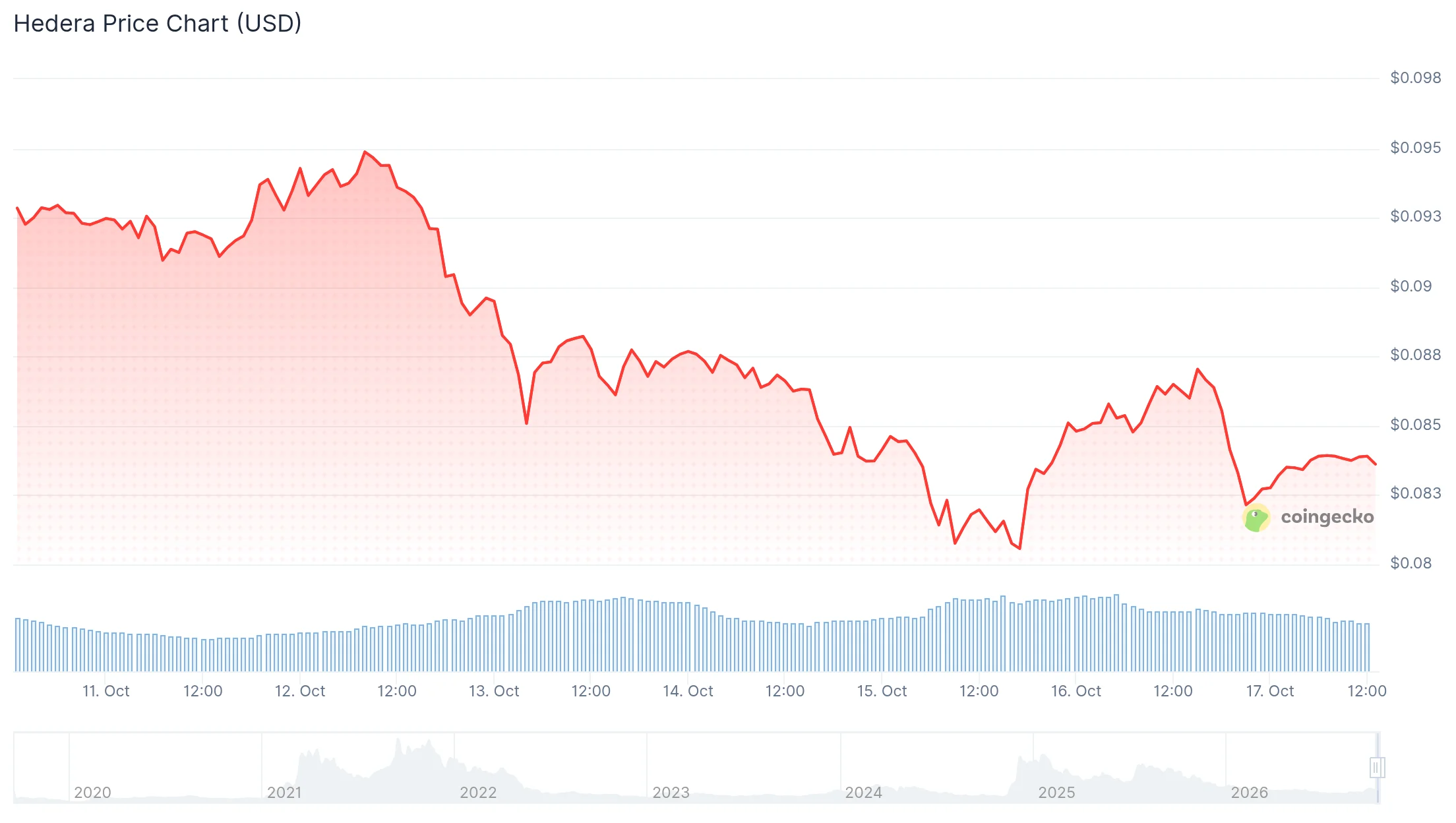
- •HBAR traded near $0.0836 on October 17, down 2.7% in 24 hours and 9.5% over seven days, while retaining a 14.9% gain over the past month.
- •Hedera joined the Wholesale Digital Markets Champion Taskforce, a body led by Christopher Woolard CBE and backed by HM Treasury, covering tokenized repos, fixed income, collateral, interoperability, and settlement finality.
- •Hashgraph contributed its CLPR cross-ledger protocol, which uses state proofs to let independent ledgers verify each other without bridges, to the Linux Foundation Decentralized Trust Labs as an early-stage lab on September 24.
- •Hedera revised its atomic batch rules in September, currently allowing one smart contract call placed last in a batch, with that support scheduled for removal in March 2027.
Hedera's total value locked rose 12.3% over the past 30 days to $33.2 million, while transactions per second increased 168.37%, according to Token Relations. The gains in on-chain activity coincided with two institutional developments: the network joined the United Kingdom's Wholesale Digital Markets Champion Taskforce, and Hashgraph contributed its CLPR cross-ledger protocol to the Linux Foundation Decentralized Trust Labs on September 24, opening the code to external developer contributions.
The HBAR token traded near $0.0836 on October 17, down 2.7% over 24 hours and 9.5% across seven days, though it retained a 14.9% gain over the past month. The price weakness stood in contrast to the network's usage metrics, which accelerated sharply across the same 30-day window.
Network Activity Climbs While HBAR Price Declines
HBAR remained 17.8% lower over two weeks but held a 14.9% gain across 30 days. Trading volume fell to roughly $91 million, down sharply from the $1.51 billion recorded during September's spike. That rally followed IBM adding a network-based identity application to its cloud offerings on September 28, a session in which HBAR rose 27% before dropping 16% the next day.
By comparison, Solana traded near $105 after losing 4.6% over seven days, a decline less than half the size of HBAR's weekly loss over the same period.
The two activity metrics measure different things. TVL tracks assets deposited into applications, while TPS counts the transactions a network processes each second, so the percentage increases describe different kinds of activity. Neither figure, on its own, reflects revenue or the number of paying customers.
Hedera prices network fees in dollars and collects payment in HBAR. That structure means transaction growth alone cannot establish how much additional token buying occurred; fee revenue and the mix of transactions also shape the economic picture.
Hedera has a maximum supply of 50 billion HBAR, with roughly 44 billion in circulation. Market capitalization stood near $3.68 billion, against a fully diluted valuation of $4.18 billion. At the token's $0.57 peak, that circulating supply would imply roughly $25.1 billion in market value. For scale, the $33.2 million locked in network applications amounts to less than 1% of the current market capitalization.
UK Taskforce Membership Ties Hedera to Wholesale Work
Hedera joined the Wholesale Digital Markets Champion Taskforce, a body led by Christopher Woolard CBE and backed by HM Treasury. Wholesale markets are the institutional side of finance, where banks and other large firms trade instruments such as repos, fixed income, and collateral with one another rather than with individual investors. Those are precisely the areas on the taskforce's agenda, which covers tokenized repos, fixed income, collateral, interoperability, and settlement finality. Participants aim to demonstrate an end-to-end repo transaction using blockchain technology, with the work examining connections between public ledgers, private networks, and established financial infrastructure. The taskforce's work forms part of the UK's broader push into wholesale digital markets, and Hedera's membership puts it inside that examination rather than outside it.
CLPR Enters Open Development at the Linux Foundation
Separately, Hedera contributed CLPR, developed by Hashgraph, to the Linux Foundation Decentralized Trust Labs on September 24. The protocol remains under development, with its code available for external review and contributions.
While CLPR was designed to solve the issue of cross-ledger interoperability and liquidity fragmentation, interoperability from a policy perspective is proving to be a greater challenge. @nilminirubin discusses this and more at the @IMFNews & @WorldBankGroup Annual Meetings in…
— Hedera (@hedera) October 16, 2026
CLPR uses state proofs so independent ledgers can verify each other directly. Applications built around it aim to transfer assets, messages, and data without bridges or intermediary validator networks. The approach targets fragmented liquidity and the additional infrastructure normally involved in moving value between networks.
That technical goal runs alongside the policy problem flagged in the post above: interoperability appears both in CLPR's design and on the taskforce's agenda, with the post pointing to policy as greater challenge.
The contribution entered LFDT as a lab rather than a top-level project, a designation for earlier-stage work within the foundation. Developers can inspect repositories, raise issues, test assumptions, and suggest practical applications as the work develops.
Hashgraph also opened a three-phase CLPR early adopter program. Its focus areas include cross-border payments with in-flight foreign exchange, cross-ledger settlement, and collateral mobility; selected participants receive access to a hosted testnet and integration support. The program invites financial institutions, fintech companies, asset issuers, liquidity providers, and corporations, and seeks participants from different countries to incorporate regulatory and compliance considerations during development, according to the company.
Ecosystem Updates Span SDKs, Batches, and Tokenized Assets
At the application layer, HashPack and SODAX are expanding access to tokenized assets. Developers also received a new account balance query in the JavaScript, Java, and Go Hiero SDKs, which reads HBAR balances through the mirror node interface, Hedera's read-only layer for querying network data.
Hedera revised its atomic batch rules in September. Batches can currently include one smart contract call, placed last, though the network plans to remove that support in March 2027, a date that gives developers a defined window to rework any batching logic depending on contract calls.

