Circle Generated $1.4 Billion in H1 2026 USDC Revenue as Distribution Costs Reached $819 Million
Key Takeaways
- •Circle reported approximately $1.4 billion in first-half 2026 revenue, with about $819 million, or 59%, directed to USDC distribution partners and related transaction costs.
- •The company allocated roughly $473 million, or 34% of revenue, to licenses, compliance, banking relationships and product costs, and described its net profit margin as 7%.
- •Coinbase reported a record $20 billion in average USDC held in its products in the second quarter, while Binance signed a five-year commercial agreement with Circle and invested $100 million in the company in September.
- •Circle introduced free, near real-time, around-the-clock USDC redemptions for businesses moving payments over the Circle Payments Network, while standard banking-rail redemptions remain free with settlement in up to two business days.
- •USDC settled more than $36 trillion in on-chain transaction volume in the first half of 2026 and carried roughly 77% of global stablecoin transaction volume by June, up from 60% a year earlier.
Circle, the issuer of the USDC stablecoin, generated approximately $1.4 billion in revenue during the first half of 2026 and directed roughly $819 million of it — about 59% — toward distribution partners and related transaction costs, according to a company breakdown published on Oct. 16. Chief Commercial Officer Kash Razzaghi published the figures in a post on Circle's blog as competition among stablecoin issuers intensified.
The disclosure detailed how the company's USDC business generated and distributed its revenue, and also covered Circle's infrastructure spending, payment services and redemption arrangements. Circle said USDC processed more than $36 trillion in on-chain transaction volume between January and June, while the company described its net profit margin as 7%. The level of detail is itself part of the message, arriving in a market where competition increasingly turns on how much revenue issuers share with the platforms that distribute their tokens.
Distribution Partners Took 59 Cents of Every Dollar
Of the $1.4 billion in first-half revenue, about $819 million went to USDC distribution partners and transaction costs. That works out to roughly 59 cents of every dollar flowing to the platforms that make the stablecoin available to users.
The partner payouts follow adoption. Platforms that hold and grow USDC balances earn a share of the reserve income those balances generate, meaning the larger the balance, the larger the share.
Coinbase is the largest example. In its second-quarter results, the exchange reported that average USDC held in its products reached a record $20 billion, up 44% year over year.
Coinbase is far from the only beneficiary. In September, Binance signed a five-year commercial agreement with Circle and invested $100 million in the company. More than 150 other partners — including neobanks, fintechs, payment platforms and enterprises — also hold an economic interest in USDC's growth.
$473 Million Allocated to Licenses, Compliance and Product Costs
After partner payouts, Circle spent about $473 million, or 34% of revenue, on running and growing the network. That spending covers licenses, banking relationships, settlement liquidity, compliance programs, new products and blockchain integrations, which the company says is what makes the stablecoin usable at scale. Together, the two categories absorb roughly 93 cents of every revenue dollar, which is the arithmetic behind the 7% net profit margin the company described.
USDC now sits behind more than 55 licenses and registrations, including an OCC national trust bank charter and MiCA compliance in Europe. The stablecoin works with more than 25 partner banks, runs compliance and sanctions programs across 185 countries, and is deployed natively on more than 35 blockchains. Reserves are held in a government money market fund managed by BlackRock and custodied at BNY, with monthly attestations.
Circle used the breakdown to push back on rivals that have promised to pass along a "substantial majority" of their economics to users. Its argument is that redemption, compliance and resilience still cost money, and an issuer that gives everything away has nothing left to fund them. The disagreement captures the industry's central split over stablecoin economics: how much can be handed to partners and users while an issuer still pays for the licenses, liquidity and safeguards a dollar token requires.
Free, Around-the-Clock Redemptions for Eligible Customers
Alongside the financials, Circle confirmed changes to how USDC redemptions work. Every customer can still redeem USDC for free through standard banking rails, with settlement within up to two business days.
The new element is speed. Businesses moving payment flows over the Circle Payments Network (CPN) — such as card networks, processors, remittance firms and fintechs — can now redeem USDC for free in near real time, around the clock. Customers on the Circle Platform can qualify for the same treatment by USDC balances or building with products like Arc, Circle Mint and Circle Wallets.
To make that work, the company keeps a large pool of cash pre-positioned with its bank partners, ready to move the moment a redemption confirms on-chain. Because that cash stays liquid, it earns less than Treasuries would; Circle absorbs that cost for customers who participate in the network rather than charging a fee.
The redemption volumes involved are substantial. Circle redeemed $71.8 billion in USDC in the first quarter of 2026 alone, equivalent to about 90% of the supply in circulation at the time. In the second quarter, combined minting and redemption volume reached $170 billion, up 105% from a year earlier.
$36 Trillion in On-Chain Volume as Market Share Grows
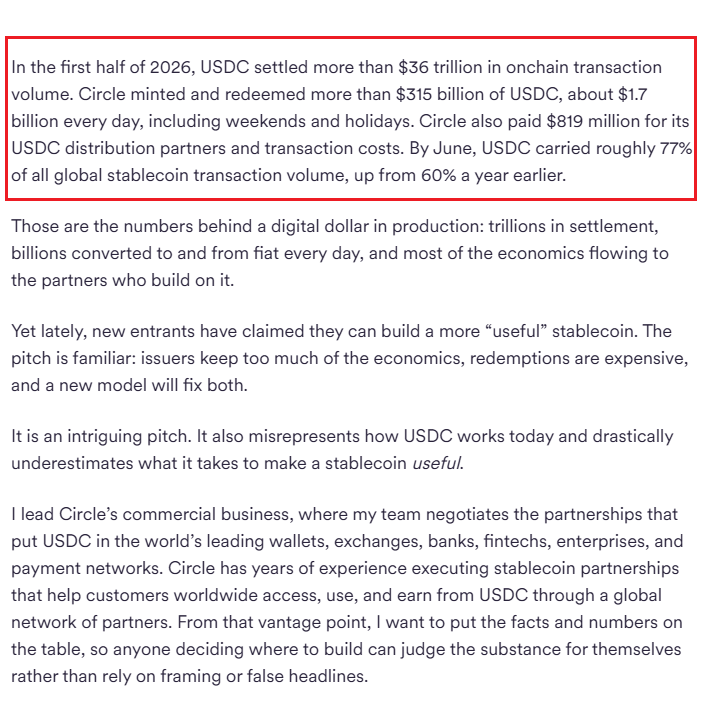
USDC settled more than $36 trillion in on-chain transaction volume during the first half of 2026. Over the same period, more than $315 billion was minted and redeemed, averaging about $1.7 billion per day, including weekends and holidays.
USDC's share of the market has grown as well. By June, the stablecoin carried roughly 77% of global stablecoin transaction volume, up from 60% a year earlier. Visa and Mastercard both settle in USDC seven days a week, including when traditional banks are closed, and a growing number of banks hold the token as a reserve asset.
Circle describes its model as a flywheel: partners grow USDC because they share in the revenue, that growth pays for more licenses, liquidity and chain support, and a more useful dollar attracts the next wave of developers and businesses. With the Binance agreement signed in September, the new CPN redemption terms now in effect, and payouts already running at 59 cents per revenue dollar, the distribution-cost line and the redemption volumes are the figures future updates will be measured against.
This article is for informational purposes only and does not constitute financial or investment advice.

