HD Hyundai Lands Record Engine Contract as AI Data Centre Demand Reshapes Marine Equipment Markets
Key Takeaways
- •HD Hyundai's KRW 956 billion agreement with Corban Energy Group represents its largest power-generation engine contract, bringing total US data-centre bookings to approximately KRW 1.6 trillion within four months.
- •Korea's big three shipbuilders are all pursuing AI infrastructure opportunities, with Samsung Heavy and HD Hyundai developing floating data centre concepts and Hanwha Ocean exploring the sector as well.
- •Major manufacturers are expanding production capacity in response to overlapping marine and data-centre demand, including Wärtsilä increasing output by 65% of its 2025 capacity and Rolls-Royce more than doubling US production of mtu Series 4000 generator sets.
- •Engine availability constraints are primarily extending shipyard delivery timelines rather than preventing orders entirely, with newer and reactivated shipyards most exposed to排队 effects.
- •Moody's estimates up to $3 trillion will be invested in AI data-centre infrastructure by 2030, indicating substantial long-term market potential for marine equipment manufacturers diversifying beyond traditional shipbuilding.
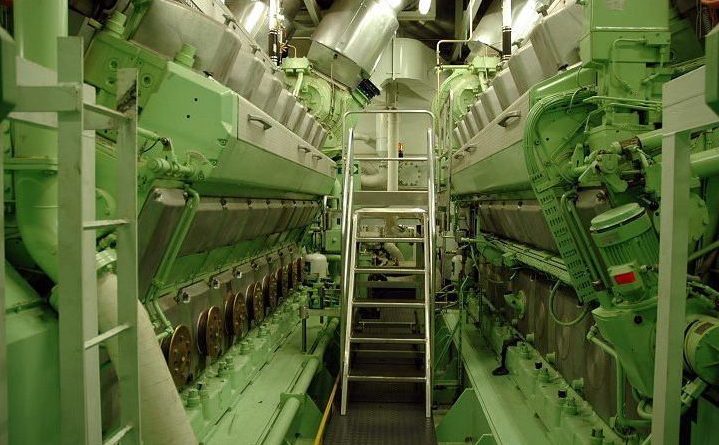
HD Hyundai Heavy Industries has secured its largest-ever power-generation engine contract, highlighting how the artificial intelligence boom is creating a significant new market for marine equipment manufacturers while simultaneously intensifying supply pressures for shipowners.
The South Korean shipbuilding giant signed a KRW 956 billion ($676 million) agreement with US energy infrastructure developer Corban Energy Group to supply 1,000 MW of generating capacity for American AI data centres. The equipment will be built around HD Hyundai's 9.6 MW HiMSEN medium-speed engines — technology originally developed for marine propulsion and onboard power generation.
This record order follows a KRW 627.1 billion US data-centre engine contract secured in April, bringing HD Hyundai's total American data-centre power equipment bookings to approximately KRW 1.6 trillion in just four months. The bookings come as hyperscale operators face growing difficulty securing grid connections in major US data-centre hubs, with interconnection queues in key markets stretching years ahead.
Data-centre developers have been actively seeking alternatives to conventional gas turbines, where extended lead times have become a major bottleneck. Medium-speed engines offer a compelling solution: they can be deployed relatively quickly and combined in arrays to deliver hundreds of megawatts of reliable power. The International Energy Agency has projected that global data-centre electricity consumption could double between 2022 and 2026, with AI workloads a primary driver of that growth.
Korean shipbuilders increasingly view AI infrastructure as an opportunity that extends well beyond onshore engine sales — and as a strategic diversification at a time when Chinese rivals have been capturing a growing share of conventional newbuilding orders. Samsung Heavy Industries and HD Hyundai are both developing floating data centres — facilities that house servers on offshore platforms or vessels, reducing reliance on costly land while leveraging seawater for cooling.
Samsung Heavy has obtained approval in principle for floating data-centre concepts from classification societies and is collaborating with AI server specialist Supermicro and ABB. The company has also signed a design and production agreement with US data-centre developer Mousterian.
HD Hyundai has established a dedicated internal organisation and partnered with Schneider Electric to develop integrated power and cooling infrastructure. Hanwha Ocean is also exploring opportunities in the sector, completing the push by Korea's big three shipbuilders.
The market potential is substantial. According to Moody's, up to $3 trillion is expected to be invested in AI data-centre infrastructure by 2030. Future floating facilities could range from 50 MW to 500 MW and may eventually connect directly to offshore wind farms or floating small modular reactors — a concept already attracting interest from major technology companies, including Amazon's agreement to purchase power from a planned SMR project in the United States.
However, the AI boom is also creating challenges for the maritime sector. As Splash reported in June, engine availability had already become a constraint at certain shipyards, echoing conditions seen during the 2007 ordering frenzy.
The tightest segment is for dual-fuel low-speed main engines, but pressure has extended to auxiliary diesels, generator sets, and turbochargers — categories where marine demand increasingly overlaps with data-centre requirements.
Several major manufacturers have responded with capacity expansions. Wärtsilä has announced production increases equivalent to 65% of its 2025 capacity, citing demand from both marine and energy customers. Rolls-Royce is more than doubling its US production capacity for mtu Series 4000 generator sets compared with 2024 levels as data-centre demand surges. Accelleron delivered a record 8,000 TPX44 turbochargers for data-centre and critical infrastructure applications last year — more than three times the prior year's output.
Adam Kent, managing director of Maritime Strategies International, told Splash that engine availability was already affecting yard output, though primarily by extending delivery timelines rather than preventing orders entirely.
"We've certainly heard that the availability of engines is having an impact on some yards," Kent said.
Arrow research head Burak Cetinok struck a more measured tone, arguing there was no widespread shortage materially disrupting overall shipbuilding output. However, he noted that newer and reactivated yards faced greater exposure as they were effectively "joining the back of the queue."
SSY research chief Roar Adland suggested that market incentives should eventually unlock additional licensed engine production in China — a development that, if realised, could help ease the dual pressure of maritime and data-centre demand on existing manufacturing capacity.

