Elon Musk's Grok AI Outlines Extreme Bitcoin Rally Scenario With $280,000–$350,000 Target by Early 2027
Key Takeaways
- •Bitcoin is trading near $74,500 and testing support in the $73,500–$75,000 zone, with a break below $73,000 potentially exposing the $70,000–$68,000 region.
- •A Grok AI scenario in a 99Bitcoins report imagines simultaneous sovereign wealth fund and central bank allocations to Bitcoin, projecting prices of $280,000–$350,000 by January 2027, with a stretch target above $420,000.
- •The projection is explicitly framed as pure speculation and entertainment rather than a forecast, since the described sovereign-adoption catalyst is considered highly unlikely.
- •An unverified post by commentator Crypto Rover claims Russia's central bank approved public trading of Bitcoin, Ethereum, and USDT starting November 17, pending official confirmation from the Bank of Russia.
- •Despite weekly U.S. spot Bitcoin ETF outflows exceeding $1 billion, Strategy (formerly MicroStrategy) has continued accumulating, lifting its total holdings above 850,000 BTC.
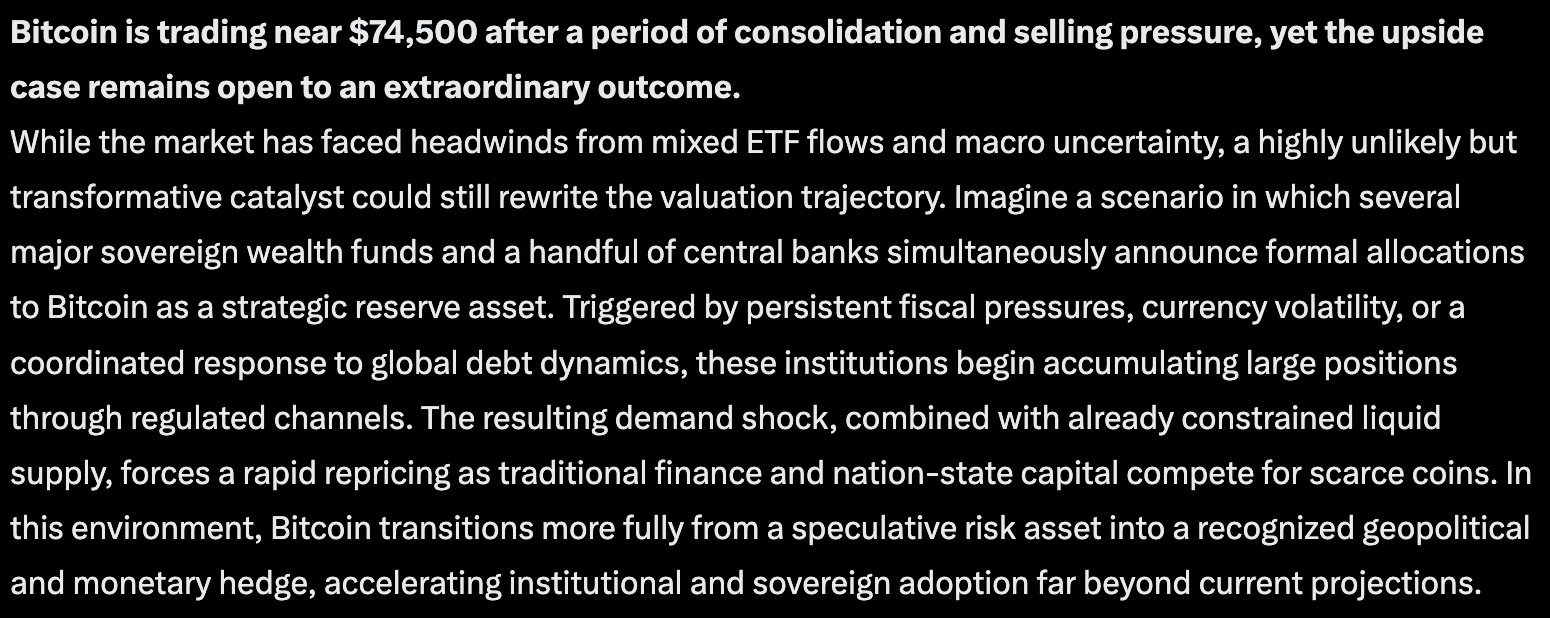
Bitcoin (BTC) is trading near $74,500 after a period of consolidation and selling pressure, but the upside case — however remote — still leaves room for an extraordinary outcome. According to a scenario outlined by Elon Musk's Grok AI — the AI chatbot developed by Musk's company xAI — a highly unlikely but transformative catalyst could still rewrite the cryptocurrency's valuation trajectory, even as the market contends with mixed ETF flows and macroeconomic uncertainty. The exercise, framed as a thought experiment rather than a forecast, maps out the conditions under which such a repricing could unfold.
A Sovereign Reserve Thought Experiment
Grok's scenario asks readers to imagine several major sovereign wealth funds and a handful of central banks simultaneously announcing formal allocations to Bitcoin as a strategic reserve asset. Driven by persistent fiscal pressures, currency volatility, or coordinated responses to global debt dynamics, these institutions would begin accumulating large positions through regulated channels. The report, published by 99Bitcoins, presents the exercise as an exploration of a low-probability path rather than an expectation.
As background for that premise, sovereign involvement with Bitcoin to date has been far narrower: El Salvador made the cryptocurrency legal tender in 2021 before scaling that back under a 2025 agreement with the IMF, and the United States established a strategic Bitcoin reserve in 2025 built from tokens forfeited in enforcement actions rather than open-market purchases — well short of the simultaneous sovereign allocations the scenario imagines.
Such a surge in demand, colliding with an already limited liquid supply, would drive a rapid repricing as traditional finance and nation-state capital compete for scarce coins. In that environment, the scenario suggests, Bitcoin would increasingly shift from a speculative risk asset into a geopolitical and monetary hedge, accelerating institutional and sovereign adoption beyond current projections.
Technical Outlook: Can Bitcoin Hold Above $70,000 in November?
Against that backdrop, the analysis walks through the current technical picture. BTC/USD is testing a support zone near $73,500–$75,000 after retreating from the $80,000–$84,000 region, the report notes. The daily chart shows a series of lower highs, with price trading below several short- and intermediate-term moving averages.
Immediate resistance sits around $76,000–$78,000, followed by the more significant $80,000–$82,000 supply area. A sustained recovery above $80,000 would improve the intermediate structure and open the path toward prior local highs near $87,000. On the downside, a clean break below $73,000 could expose the $70,000–$68,000 region.
Momentum indicators remain subdued, reflecting recent distribution, but the longer-term, higher-timeframe structure still leaves room for a powerful reversal if buying pressure returns with volume. In an extreme demand-driven scenario, measured-move extensions from the current base and multi-cycle Fibonacci projections could theoretically support substantially higher targets once the market shifts from consolidation into a new impulsive phase. The near-term checkpoints are the ones the report itself defines: whether the $73,500–$75,000 support zone holds, whether a break of $73,000 opens the $70,000–$68,000 region, and whether weekly ETF flows stabilize after the recent stretch of outflows exceeding $1 billion.
Even with current caution in sentiment and flows, ongoing institutional accumulation, expanding access in new jurisdictions, and the hypothetical sovereign-reserve catalyst leave open the possibility of a dramatic re-rating by early 2027.
A Russian Catalyst in the Mix?
Adding a potential catalyst to the mix, the report highlights a post from crypto commentator Crypto Rover on X:
BREAKING: Russia's Central Bank officially approves Bitcoin, Ethereum and USDT for public trading starting November 17. While the US failed on the CLARITY Act, Russia is building!
— Crypto Rover (@cryptorover) November 6, 2026
The claim, shared on November 6, frames the move as a contrast with stalled U.S. legislative progress on the CLARITY Act, the digital-asset market-structure bill that cleared the U.S. House in July 2025 before stalling. Because the item reaches the report through a commentator's post rather than an official Bank of Russia announcement, formal confirmation ahead of the stated November 17 start date would be the natural checkpoint for readers weighing its significance.
Despite recent weekly outflows from U.S. spot Bitcoin ETFs — the funds that began trading in January 2024 and became a primary regulated channel for institutional exposure — corporate treasuries have continued to accumulate. Strategy, the software company formerly known as MicroStrategy, which pioneered its corporate Bitcoin treasury in 2020, has kept adding to its holdings, pushing its total above 850,000 BTC.
Russia's decision to open regulated retail access to Bitcoin, Ethereum, and USDT starting in mid-November expands the potential investor base in a large economy. Broader institutional infrastructure continues to mature as well, including expanded custody and payment partnerships.
While ETF flows have been choppy and equity-market correlation has weighed on price at times, these underlying developments keep the structural demand story intact. A decisive shift in liquidity conditions or a renewed appetite for risk could allow these building blocks to matter more.
How High Does Grok's Scenario Go?
By January 1, 2027, in this over-the-top bullish scenario, Grok AI predicts Bitcoin could reach between $280,000 and $350,000, with a stretch target above $420,000 if sovereign and institutional reserve adoption accelerates sharply.
The projection is explicitly framed as pure speculation and entertainment, not a realistic base-case outlook. The catalyst it describes would require extraordinary technical and commercial execution that is currently highly unlikely. For readers, the report's own framing remains the operative lens: AI chatbot scenarios such as this one are thought experiments rather than analyst research, and the $280,000–$350,000 figures are best read through that stated disclaimer.
The report was published by 99Bitcoins.

