Bitcoin's Recovery Faces New Threat as $14.2 Billion in Stablecoin Supply Disappears in One Month
Key Takeaways
- •$14.2 billion in stablecoin supply left the crypto market within 30 days, the largest monthly contraction since 2022, shrinking the capital traders typically deploy into crypto positions.
- •Bitcoin is trading near $74,000, below the $75,600 average entry price of investors who purchased over the past 155 days, with just 35% of that group still holding gains.
- •US spot Bitcoin ETFs recorded $1.6 billion in outflows across 20 trading sessions, while the Coinbase Premium has remained below zero throughout the decline that began in September.
- •Wallets holding 100 to 10,000 BTC were the only groups scoring above 0.5 on Glassnode's accumulation measure last week, and buy orders have outweighed sell orders on Binance and Coinbase since November 5.
- •Futures open interest has rebuilt to September's peak despite Bitcoin's roughly 15% decline, leaving a major upside liquidation cluster near $87,500 that could force short sellers to buy if prices rally.
Bitcoin's recovery effort is running into a fresh obstacle: $14.2 billion in stablecoin supply has left circulation over the past 30 days, according to a Wednesday report from Glassnode on X. The drop is the steepest monthly contraction since 2022, and it comes just as buyers struggle to stop the slide.
Stablecoins are tokens pegged to fiat currencies such as the US dollar, and they hold the capital traders typically park inside the crypto market before placing their next position. When supply shrinks, part of that money has been cashed out rather than recycled into coins. Tether trading slightly below its $1 peg adds to the uneasy picture, and Glassnode noted that a return to growth in stablecoin supply would give traders something concrete to watch.
The episode echoes June 2022, when roughly $30 billion vanished from stablecoin supply in 30 days. Bitcoin eventually sank to $15,500 that November.
Recent buyers underwater while stocks recover
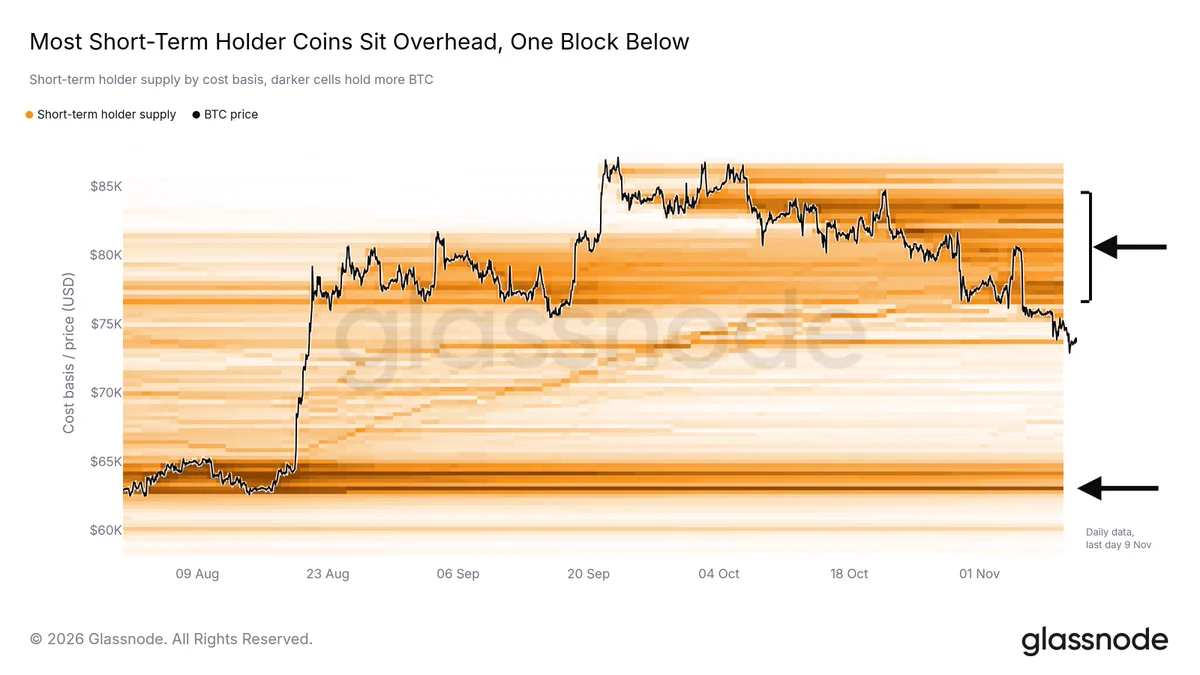
Bitcoin is hovering near $74,000, inside the $73,000–$76,000 zone Glassnode flagged a week ago. The price also sits below the $75,600 average entry of investors who bought over the past 155 days.
That newer cohort has swung from almost universally profitable at September's peak to just 35% sitting on gains, and those exiting now are realizing small losses on average.
Any rebound also faces a structural catch: roughly two-thirds of those recently acquired coins were bought at higher prices, spread across three pockets of demand formed between August and October, with the upper end reaching $83,600. A rally would return many of these investors to breakeven, and some may take the exit.
There is, however, a substantial mass of the most recent purchases between $62,000 and $66,000, which corresponds to Bitcoin's August minimum.
The data does not suggest the broader bull run has failed. September marked a fresh price peak above the high Bitcoin set in 2025, and the market has retained gains against the June lows near $58,500. Reclaiming $77,500 — the level Glassnode labels the True Market Mean — would put half of recent purchases back into profitability.
Selling pressure has been heavy since November 5 in both crypto and stocks, but since November 9 the S&P 500 and Nasdaq 100 have recovered above their pre-election closing levels. Bitcoin slipped again after the release of inflation data on November 10 and now trades 5% below its pre-election close.
Rate expectations remain a key variable. The two-year Treasury yield, a gauge of where markets expect interest rates to head, stands at 4.75% against the Federal Reserve's 4% policy rate, a 75-basis-point spread that indicates expectations for further hikes. That gap is nowhere near the 244-basis-point spread observed in June 2022, and it has continued to narrow since October.
ETF investors retreat as larger wallets cautiously buy
US-listed Bitcoin ETFs — funds that hold Bitcoin and trade on stock exchanges like shares — recorded $1.6 billion in outflows across 20 trading sessions, crossing the $1.5 billion outflows mark according to Glassnode's November 9 data.
US spot buyers are in no hurry to step in. Glassnode's Coinbase Premium metric measures the price difference between trading BTC on Coinbase and trading it overseas, and it is adjusted for Tether's trading discount so the numbers are not skewed. The premium has remained below zero throughout the decline that began in September, reaching its lowest level since February. Glassnode wrote, "In past rallies, the premium ran positive as US buyers paid up for Bitcoin. Today they are not." Several positive weeks would indicate demand returning.
Futures traders, however, have set up an interesting dynamic. Bitcoin's grinding decline has already wiped out many leveraged long positions near current prices — trades that exchanges forcibly close once losses exceed the collateral backing them — reducing the ammunition for another immediate liquidation cascade. The largest untouched downside liquidation pool sits much farther away, between $59,500 and $62,600.
At the same time, futures open interest — the tally of contracts still open — has rebuilt to September's peak level even though Bitcoin is down around 15%, pointing to possible new short bets. If prices rise, traders caught betting on a fall may have to buy Bitcoin to close out their positions, and the biggest liquidation pocket on the upside sits near $87,500.
Actual exchange orders tell a similarly mixed story. Since November 5, buy orders within 5% of Bitcoin's price have outweighed sell orders in every hour measured on Binance and Coinbase. The heaviest bids are clustered between $68,000 and $72,500, and relatively few orders stand in the way of a climb toward $84,000, aside from nearby sellers. Those bids are not guaranteed buyers, however — some were canceled during the drop and then placed again.
Buying is concentrated in larger wallets. Addresses holding 100–1,000 BTC and 1,000–10,000 BTC were the only groups to score above 0.5 on Glassnode's size-weighted accumulation measure last week, and both had mostly been selling through October. Wallets holding less than 1 BTC, the largest holders with more than 10,000 BTC, and every group in between were still cutting their balances. The two large-wallet groups also attempted to buy in late September before changing course again.
Source: Cryptopolitan

