Green Party Activists Push Radical Motion as Poll Support Slides, Warns Eliot Wilson
Key Takeaways
- •Zack Polanski became sole leader of the Green Party of England and Wales last September, and the party's polling rose from 10 to 21 per cent by March before declining in recent months.
- •Polanski's recent difficulties include retweeting criticism of police force used against the attacker of two Jewish men in Golders Green and the emergence of exaggerations or falsehoods in his professional career record.
- •Green Party activists, including council member Animah Kosai, have submitted a five-page conference motion calling for more radical campaigning, centred on a wealth tax on the richest one per cent.
- •Wilson notes that France, Germany, Denmark, Sweden, the Netherlands, Ireland and Australia all scrapped wealth taxes after finding them unworkable, harmful or short of expected revenue.
- •Wilson warns that the party's absolutist, moralising approach threatens public discourse and could ultimately target Polanski himself.
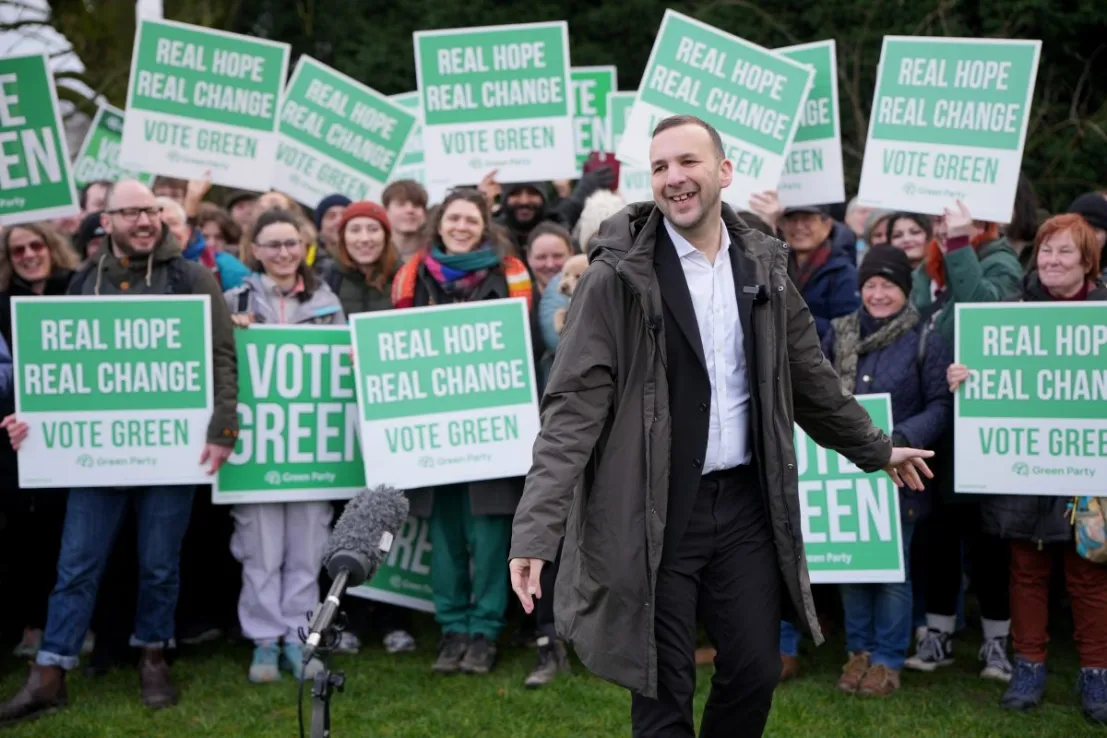
Zack Polanski, leader of the Green Party of England and Wales, has proved a divisive figure — and according to Eliot Wilson, the absolutism now gripping his party's activists is bad news both for politics and for Polanski himself, because those who police dogma tend to see heretics everywhere, even at the top.
There is something preposterous and confected about Polanski, writes Wilson, and it is no surprise that he has a background in acting. He is suffocatingly earnest and displays armour-plated self-belief even when pronouncing what Wilson calls the most implausible silliness. He once explained that, as Prime Minister, he would "keep pushing for negotiation" with President Vladimir Putin to end the war in Ukraine (The Telegraph); last November he told Sky News's Trevor Phillips that "we should never leave the negotiating table" and that he would persuade Putin to give up Russia's nuclear weapons.
Wilson finds it hard to imagine the former KGB colonel who has ruled Russia since the last millennium being outfoxed by a man who once taught at the National Centre for Circus Arts — but Polanski continued crossly that "you could have laughed at the point of Nelson Mandela negotiating with the ANC".
Yet many voters have listened to Polanski and liked what they heard. With politics held in such low regard, party leaders now compete not for popularity but to minimise their unpopularity. Last November, Polanski recorded a barely-there -2, and was still only on -7 in mid-January. At the same time Kemi Badenoch was at -26, Nigel Farage logged -37, and Sir Keir Starmer stood at -57.
The Green Party's fortunes followed a similar trajectory. Sitting on 10 per cent of the vote when Polanski — previously a co-leader of the party — won the leadership outright last September, the party rose to 16 per cent within two months. That built on the party's best-ever general election result in 2024, when it returned a record four MPs to Westminster, a breakthrough that raised its profile and expectations. In March this year it polled second overall on 21 per cent, only two points behind Reform UK. In recent months, however, its position has begun to slide — a reminder, as the wealth-tax record elsewhere shows, that poll surges built on a single resonant message can prove fragile once parties are tested on the detail of governing programmes.
Why are the Greens losing support?
Some of the decline may be attributable to mishaps. In April, Polanski retweeted criticism of the force used by police to apprehend the attacker of two Jewish men in Golders Green. It then emerged that elements of his professional career were exaggerations or outright falsehoods (The Times).
Within the Green Party, some activists regard Andy Burnham's premiership as the principal cause of their ebbing popularity. Their candidate in last month's Greater Manchester mayoral by-election, Geraldine Coggins, was barely a factor: Labour's Bev Craig, leader of Manchester City Council, strolled to a two-to-one win over Sian Astley of Reform UK, while Coggins was eliminated in the first round with only 12 per cent.
How, then, is the Green Party to stop this leakage? A group of activists, including Animah Kosai, a member of the Green Party Council, has submitted a five-page motion to the party's annual conference, to be held in Brighton in October. Its diagnosis, Wilson notes, is the one activists always reach: to become more popular, the party must embrace more enthusiastically the kind of radical policies that excite activists. The stakes of that choice will be visible first at the conference itself, where members rather than the leader ultimately shape party policy.
It is, in Wilson's words, a dismally familiar roll call. Campaigning should underline the party's pledge to introduce a wealth tax on the richest one per cent, the revenue from which Polanski has already announced will fund — variously — universal free childcare, the nationalisation of water, energy and rail, and rent controls. Wilson argues that it matters not at all to the motion's authors that France, Germany, Denmark, Sweden, the Netherlands, Ireland and Australia all introduced wealth taxes and quickly scrapped them because they were unworkable, economically harmful or delivered much less revenue than expected. The point, he writes, is the target of the burden: the "monstrous rich".
The motion also recommends placing more emphasis on national and international issues: its authors want to attack Labour for continuing to sell arms to Israel throughout the conflict in Gaza (Wilson notes that UK arms sales to Israel are extremely small and limited, representing well under one per cent of the country's defence imports). The Greens have already agreed resolutions to designate Israel's government as an "apartheid" state, and they appealed to voters in the Gorton and Denton by-election in February to "punish Labour for Gaza".
The Green worldview is all black and white
In April, Wilson described the Greens' policy platform as "familiar from any 1990s or 2000s student common room: environmentalism, social and racial justice, soak the rich, strong trades unions and opposition to NATO" (City AM). It shares with student politics, he argues, one further aspect: it is uncompromising yet unrealistic, make-believe yet Manichaean. It reflects a tone of "debate" now common in public life: refusing to engage with other viewpoints, demanding safe spaces, and calling for opponents to be deplatformed.
This, Wilson writes, is a form of civic behaviour that believes in moral absolutes rather than debate. After all, how can you be against protecting the environment or reducing inequality? How can you be in favour of genocide, apartheid or poverty? These are the questions over which Green Party activists want to do battle: they are simple, binary, and people know instinctively which side they are on. Its counterpart on the right, Wilson observes, is the "wedge strategy" pursued by Sir Lynton Crosby: find an issue on which your opponent is divided and exploit it ruthlessly to peel off some of their natural supporters.
Rory Sutherland, vice-chairman of Ogilvy UK, describes the phenomenon as "album politics": "A kind of artificial worldview where you have to buy the entire album, as it were… in other words, it's not just that you have left-wing opinions, you have to buy into every single opinion".
Wilson concludes that this is not politics so much as theology, with soi-disant "progressives" as certain as any mediaeval cleric of St Cyprian's mantra, extra ecclesiastam nulla salus — none is saved outside the Church. If a political party concentrates on deeply emotive issues on which voters are seen as saved or damned, friends or enemies, seeking to force repentance rather than descending into the arena of persuasion, Wilson expects a bitter, moralising general election campaign — bad news for public discourse and for any engagement or generosity of spirit.
None is saved outside the "Church of St Zack", Wilson quips — but Polanski must be careful. Those who police dogma see heretics everywhere, even at the top. All it takes is a careless tweet or a clumsy choice of words, and they might come for their leader next.
Eliot Wilson is a writer and historian. He is a senior fellow for national security at the Coalition for Global Prosperity and a contributing editor at Defence on the Brink.
