'I'd Feel Guilty Recommending This Path': Young Korean Pediatric Doctors Describe Frontline Working Conditions
Key Takeaways
- •Seventy-six percent of Korea's pediatric surgery specialists are 50 or older, and only one pediatric surgeon in the country is in their 30s.
- •Shim Ju-hyeon performed around 400 surgeries a year while on call 365 days a year for seven years, receiving about 50,000 won ($36) per after-hours hospital trip.
- •Only 13 tertiary hospitals in Korea have pediatric intensive care units, and Lee In-kyung is one of just 34 pediatric intensive care specialists nationwide.
- •Fifty-five percent of critically ill children in Korea are treated in adult ICUs, where one study found mortality is 1.6 times higher than in PICUs.
- •Both doctors called for government mandates on hiring pediatric surgeons and financial incentives to staff round-the-clock pediatric intensive care.
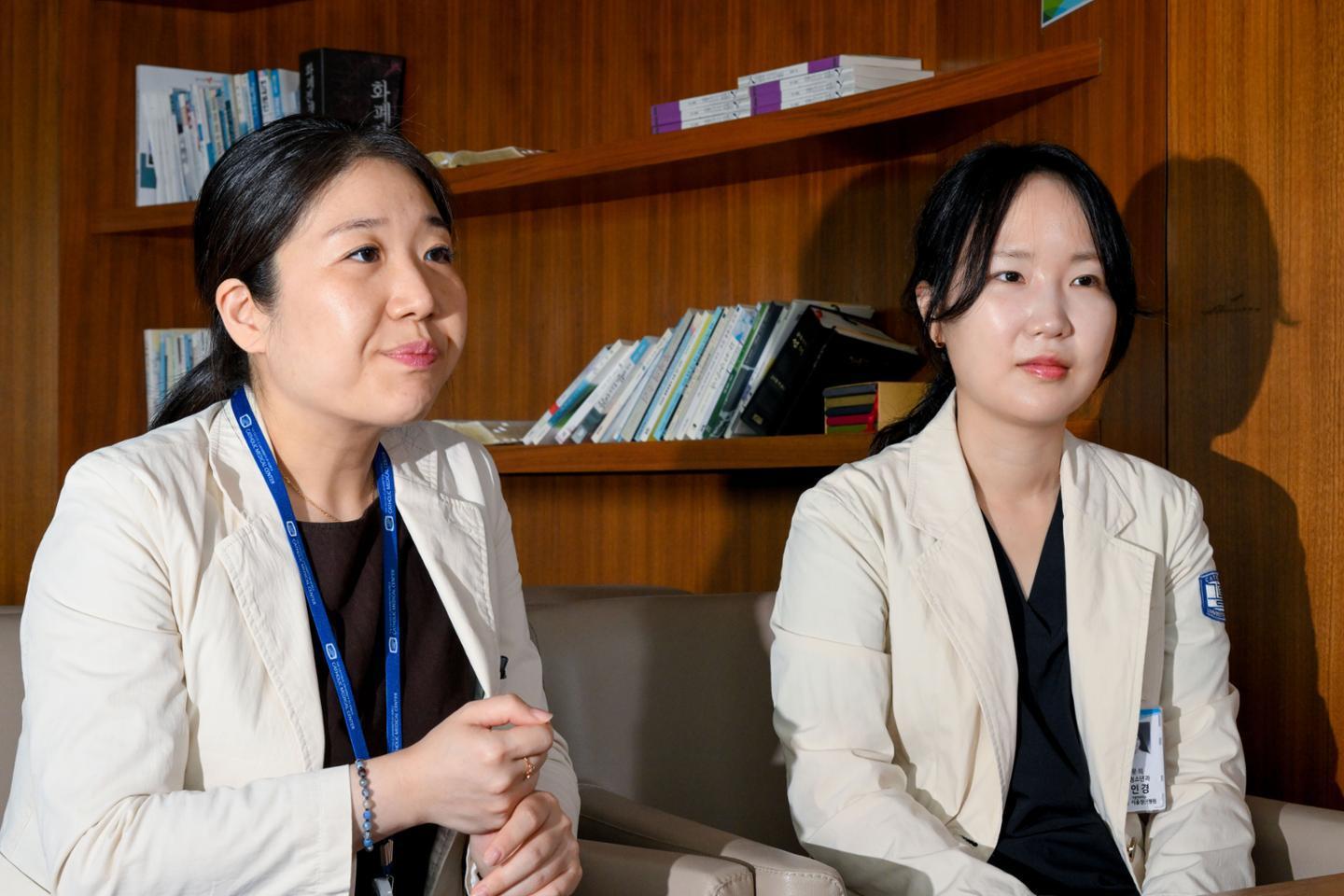
Shim Ju-hyeon, a clinical assistant professor of pediatric surgery at Seoul St. Mary's Hospital's Congenital Disease Center, and Lee In-kyung, a clinical assistant professor of pediatrics and the hospital's dedicated pediatric intensive care specialist, spoke about the conditions facing their fields during an interview with the Hankook Ilbo at the hospital in Seocho District, Seoul, on Aug. 13.
At 41, Shim Ju-hyeon, a clinical assistant professor at the Catholic University of Korea Seoul St. Mary's Hospital, is considered "young blood" among pediatric surgeons in Korea, where 76 percent of specialists are 50 or older. Their accounts come as the strain on pediatric and other "essential" medical fields has become a focus of public debate in Korea, where such specialties are widely described as offering comparatively low reimbursement and demanding working conditions relative to other areas of medicine.
A steady stream of patients arrives for surgery at the hospital's Congenital Disease Center — from babies born with a blocked esophagus to children with perforated intestines. The situation was no different at Ajou University Hospital, where she worked until last month. There, she spent seven years on call 365 days a year, ready to rush to the hospital at any moment, and performed an average of 400 surgeries a year. After her mentor retired, Shim shouldered the entire workload alone until the hospital recruited another surgeon.
"Many retired pediatric surgeons, some well into their 70s, are called back to hospitals because there is no one else to perform surgeries," Shim said. "And I think that is how it will be for me as well."
Her fears are well founded: the ranks of younger doctors are even thinner, with only one pediatric surgeon in their 30s in the entire country.
Children arrive after 72 hours of being bounced between ERs
Shim chose pediatric surgery due to circumstances that left her little choice. Rheumatoid arthritis, which she developed during her fourth year of surgical residency, left her joints so swollen that she could barely tolerate physical exertion during the early stages of treatment, forcing her to give up her long-held dream of becoming a trauma surgeon.
She turned instead to pediatric surgery, because the operations involve smaller areas of the body and generally take less time than those on adults. Though practical constraints led her to the specialty, Shim said she began to feel she had found her place once she started working. There were patients who needed her care, and a sense of fulfillment in watching them recover quickly after successful surgery.
But Shim soon realized that a sense of purpose alone could not sustain her through the practical difficulties.
"Every time I was called back to the hospital after work, I was paid 50,000 won (around $36) for transportation," she said. "That alone added up to 1 million won a month."
Nor did each trip to the hospital mean just one operation. More often than not, she performed two or three, adding up to around 20 to 30 surgeries outside her regular working hours every month.
The workload did not end there. Shim also handled everything from routine calls from the ward and outpatient consultations to interpreting ultrasound scans and providing postoperative care. In theory, those duties would require specialists from several fields. But Shim barely had any residents to assist with consultations and surgery, let alone a colleague to share the workload. Her experience reflects a broader pipeline problem: with so few trainees entering pediatric subspecialties, hospitals struggle to staff even the residency positions that would ease senior specialists' loads.
"There are so few doctors who can operate on children these days. Many children arrive after spending days being bounced from one ER to another without receiving the treatment they need," she said. "They need surgery within 48 hours at the latest for a good prognosis, but many arrive well past the 72-hour mark. When I open their abdomens, their intestines have often already become necrotic."
Shim added that general surgeons are increasingly performing pediatric operations. But because children have less developed abdominal muscles and thinner fascia than adults, making an incision in the same way as for an adult can cause the surgical wound to come apart, allowing organs to protrude through the abdominal wall.
"If that happens, I take over the case and operate again," Shim said.
After such high-risk operations, lingering inflammation leaves children at greater risk of serious complications such as sepsis. Normally, they should be admitted to a pediatric intensive care unit (PICU) for monitoring. But Ajou University Hospital, where Shim worked at the time, had no PICU. Caring for critically ill patients after surgery also fell entirely to her.
"For pediatric surgery to function properly, you need to work alongside subspecialists in pediatric gastroenterology, intensive care, radiology and anesthesia. In reality, whenever no one was available, I had to do everything myself," she said. "And when one doctor somehow manages to take on multiple roles, hospitals tend to think, 'Well, it looks like everything is running just fine with only one doctor.'"
After nearly a decade of shouldering the work of an entire team, Shim recently moved hospitals because she desperately needed colleagues she could work alongside.
"At least there's a pediatric intensive care unit here," she said.
A scarce specialty
Lee In-kyung, 34, a clinical assistant professor of pediatrics who oversees the PICU at Seoul St. Mary's Hospital, is one of just 34 pediatric intensive care specialists in Korea. She treats critically ill patients ranging from 1 month to 18 years old, handling every type of case except trauma. Her patients include children rescued from drowning, those suffering from seizures or acute pneumonia and those with childhood cancer.
Critically ill children vary widely in age, weight and developmental stage, requiring the expertise of a doctor trained in pediatric intensive care for everything from ventilator settings to medication. One study found that the mortality rate for critically ill children treated in adult ICUs was 1.6 times that of those admitted to PICUs.
Yet across the country, only 13 tertiary hospitals have such units, most of them concentrated in the Seoul metropolitan area. Around 30 percent of Lee's patients are also transfers from other regions, due to the scarcity of PICUs in rural areas and regional cities — a regional imbalance that means families outside the capital often face long-distance transfers at the moments when time matters most.
"Even among pediatricians, quite a few have never worked in a PICU. I'm also the first faculty member at Seoul St. Mary's Hospital dedicated to the unit," she said.
According to figures released last year by the Korean Society of Pediatric Critical Care Medicine, 45 percent of critically ill children are admitted to PICUs, while 55 percent end up in adult ICUs, suggesting there simply are not enough PICU beds.
To address persistent concerns over the shortage, Seoul St. Mary's Hospital plans to expand its PICU from five beds to eight by the end of this year. The bigger problem, however, is staffing. Although the hospital has hired doctors to help cover on-call duty, Lee remains the unit's only dedicated physician.
"I've been burned out ever since I started this job. It's hard even to take a vacation without worrying," she said. "But as I work, I can see the color returning to the children's faces day by day as the care I give them pays off. That sense of fulfillment keeps me going."
Physically demanding work with little reward
When asked whether they would recommend their job, the two doctors — the youngest in their respective fields — both shook their heads. They would feel "too guilty" to recommend this path to anyone, they said.
"I feel bad to encourage anyone to do this. Risk to bear is too great, while reward is too small," said Lee. "In this line of work, parents often project their anxiety or guilt toward their children onto medical staff. It is our job to reassure parents, which is not an easy thing to do."
The uncertain career path is another reason holding them back from recommending that young doctors follow in their footsteps. That hesitancy matters beyond individual careers: if the youngest specialists cannot encourage successors, the fields they carry risk shrinking further as today's senior doctors retire.
"Even after years of training to qualify as a pediatric surgeon, there are fewer hospitals where you can find work than in other surgical subspecialties. The pay is lower, too," Shim said. "So I can't tell a younger colleague, 'I'll make sure you're supported until you become a professor.'"
To prevent the entire field from disappearing, the priority is creating more positions where pediatric surgeons can put their training to work, according to Shim.
"Neonatal intensive care units (NICU) in tertiary hospitals, for example — the government can make it mandatory for those hospitals to hire pediatric surgeons. Right now it is just recommendations," she said. "NICUs have high reimbursement rates and long patient stays, so hospitals are eager to open them. Yet they make little effort to hire doctors in other pediatric subspecialties. We need government support to ensure stable employment."
Lee called for institutional support for PICUs, which receive far less assistance than NICUs. At a minimum, she said, units that provide round-the-clock specialist care should receive additional compensation.
"Children fall ill at any hour, on weekends as well as weekdays. Specialists with extensive experience caring for critically ill children need to be able to respond immediately, even at night and on holidays," she said. "I think financial incentives need to be in place first to give hospitals a reason to hire more staff."
This article from the Hankook Ilbo, the sister publication of The Korea Times, is translated by a generative AI system and edited by The Korea Times.
