Zcash ETF Inflows Reverse Three Weeks of Outflows as ZEC Rallies
Key Takeaways
- •Grayscale's Zcash ETF attracted $41.1 million in net inflows last week, its strongest weekly intake since mid-September, ending three consecutive weeks of outflows that totaled $143.4 million.
- •ZEC rose 6.98% over the week even as Bitcoin and Ethereum declined, rebounding from a low of $1,118 after falling roughly one-third from a peak near $1,690.
- •Friday delivered the week's largest single-session intake at $20.5 million, accounting for about half of the weekly total.
- •Zcash's NU7 upgrade is scheduled for mainnet activation on November 5, cutting block spacing from 75 seconds to 25 seconds and introducing the Network Sustainability Mechanism.
- •Technical outlooks diverge: one bullish scenario requires a close above $1,223 before a moving-average crossover around October 28, while another analysis places ZEC within a declining channel with $597 as a key historical level.
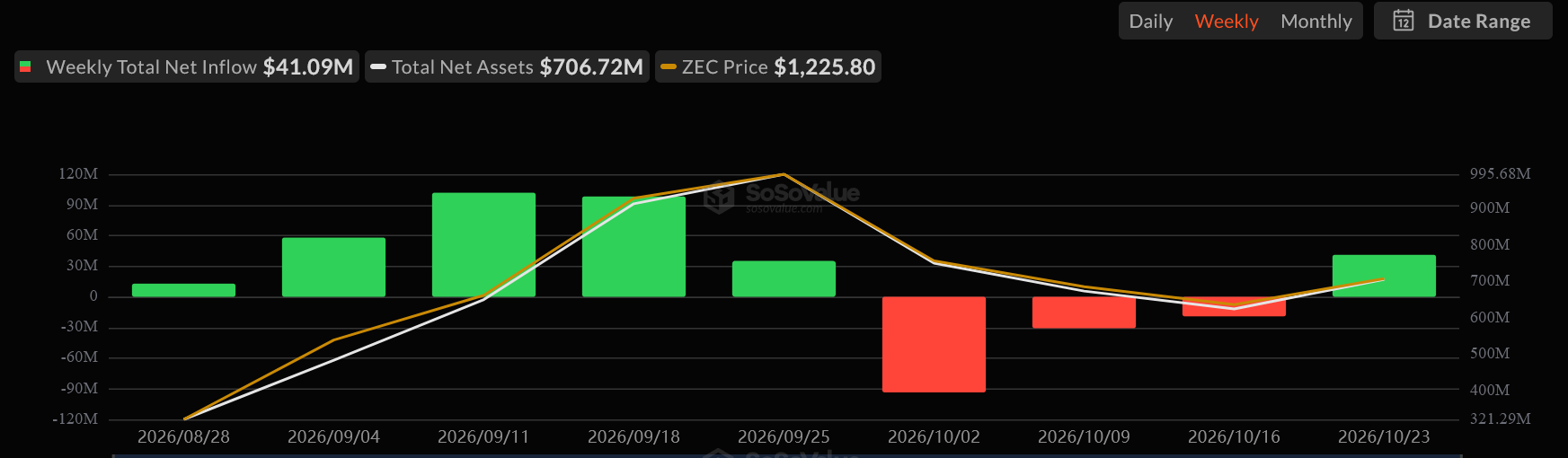
Grayscale's Zcash ETF recorded $41.1 million in inflows last week, its largest weekly intake since mid-September, ending a run of three consecutive weekly withdrawals that had removed $143.4 million from the fund. The reversal stood out because the price of ZEC rose 6.98% over seven days even as Bitcoin and Ethereum prices declined.
The shift came ahead of a busy stretch for the market: Zcash's NU7 mainnet upgrade is listed for November 5 following an October 20 decision on the activation height, and the Federal Reserve meets October 27–28.
Friday delivered $20.5 million in inflows, the strongest single session of the week. The return of fund demand ran counter to a weakening broader crypto market. The change marks a clear shift in weekly flow direction, though a single reporting period cannot show whether the recovery will last.
"$ZEC turns green amid the broader market downtrend, with Grayscale's Zcash ETF drawing $41.1 million last week, its biggest week of inflows since mid-September. pic.twitter.com/7nVAhkBV5w"
— CoinGecko (@coingecko), October 25, 2026
Three Weeks of Outflows Reversed in Five Sessions
The week began on a weak note, with $10.4 million in outflows on Monday. The Zcash ETF then recorded positive flows across the next four sessions, which combined for $51.5 million and, net of Monday's outflow, finished the week at $41.1 million. Friday's $20.5 million intake alone represented half of the weekly total. On a net basis, the latest week recovered about 29% of the $143.4 million removed over the prior three weeks, leaving $102.3 million of the earlier withdrawals unrecovered.
The Zcash flows diverged from the largest crypto funds. Bitcoin ETFs lost more than $500 million across two sessions but still finished the week with $301.2 million in net inflows after earlier buying. Ethereum ETFs recorded $220.7 million in withdrawals during the week. Zcash ETF inflows therefore reflect separate weekly activity rather than a broad rotation into crypto funds.
What the Flow Data Do and Do Not Show
The Zcash ETF inflow series documents daily fund activity — the net movement of investor money into and out of the fund — not investor intent. It cannot show whether buyers sought temporary exposure, portfolio diversification, or a position tied to Zcash's privacy features. Zcash supports private transactions, a capability that sets ZEC apart from Bitcoin and Ethereum, but a single week of inflows does not establish that privacy demand drove the move.
Recent history offers a cautionary comparison. A $98.2 million inflow week was followed by three weeks of withdrawals, during which ZEC pulled back from a peak near $1,690. That earlier weekly intake was roughly 2.4 times last week's total, a reminder of how quickly fund demand has swung in both directions.
ZEC Rebound Faces Technical Tests
The ZEC price rebounded after sliding from a peak near $1,690 to a low of $1,118 last week, a drop of roughly one-third, and the $1,200 area now marks the immediate test. Some bullish chart analysis requires a close above $1,223 before the short and long moving averages cross around October 28. Such a crossover would be a chart signal, not confirmation of a sustained advance.
ZEC's 6.98% weekly gain contrasts with declines in Bitcoin and Ethereum, but one week does not establish a durable trend. The $1,118 low stands as ZEC's most recent recovery point.
"$ZEC next thing im watching is the 1D green cross, current eta is in ~5 days and if price can close above the 1223 level if ZEC god candles above 1414 it will force the cross but atm its a bulls wet dream. imo the battle for the 1200ish levels will be fought over the next week pic.twitter.com/FdWIcayMPm"
— that1618guy (@that1618guy), October 23, 2026
Other technical readings are less constructive. Whale Factor sees ZEC price action inside a declining channel and identifies $597 as a major historical level. That reference sits well below the recent price range and belongs to a different technical time frame from the $1,200 and $1,223 tests. The bullish setup depends on closing above $1,223, while the view based on the declining channel retains downside risk. Neither level confirms what Zcash ETF buyers will do next.
NU7 Upgrade Nears Activation
Zcash's NU7 upgrade adds another scheduled catalyst. October20 was the planned date for setting the mainnet activation height, and the published timeline lists November 5 for mainnet activation, according to the Zcash Community Forum.
The proposal cuts block spacing — the interval between new blocks — from 75 seconds to 25, a two-thirds reduction, and adds the Network Sustainability Mechanism, which is intended to support network security over time. It may affect infrastructure used by full nodes, indexers, and block explorers. The proposal also describes reduced confirmation latency, though the weekly flow data do not connect ZEC buying to the upgrade. Notably, the proposal does not add a transaction format: version 4 transactions become invalid after activation, while versions 5 and 6 remain valid.
Fed Meeting Caps the Week
The Federal Reserve's scheduled October 27–28 meeting adds another market event to the days ahead. The moving-average crossover that some chart analyses place around October 28 falls in the same window. The next ETF flow reports will show whether ZEC inflows continued through the following week.
Source: Blockonomi

