Grayscale Rebrands Bitcoin Miners ETF Into AI Compute ETF (GCPU)
Key Takeaways
- •Grayscale rebranded its Bitcoin Miners ETF (MNRS) into the Grayscale AI Compute ETF (GCPU), which tracks the Indxx High Performance Computing Index and does not hold any digital assets directly.
- •The GCPU portfolio allocates roughly half to firms built around GPU cloud and AI-hosting capacity and half to operators, including Bitcoin miners, transitioning into AI workloads, with the index rebalancing every quarter.
- •North American data centers are operating at record-low vacancy with roughly six months of spare capacity, while new facilities can take up to five years to construct.
- •Goldman Sachs projects that AI-related capital spending, directed mostly at physical infrastructure, will exceed $1 trillion annually.
- •Bitcoin miners pursuing AI and HPC contracts have announced deals totaling roughly $70 billion to $100 billion, and AI-integrated miners are up about 21% year to date while the broader Bitcoin market declines.
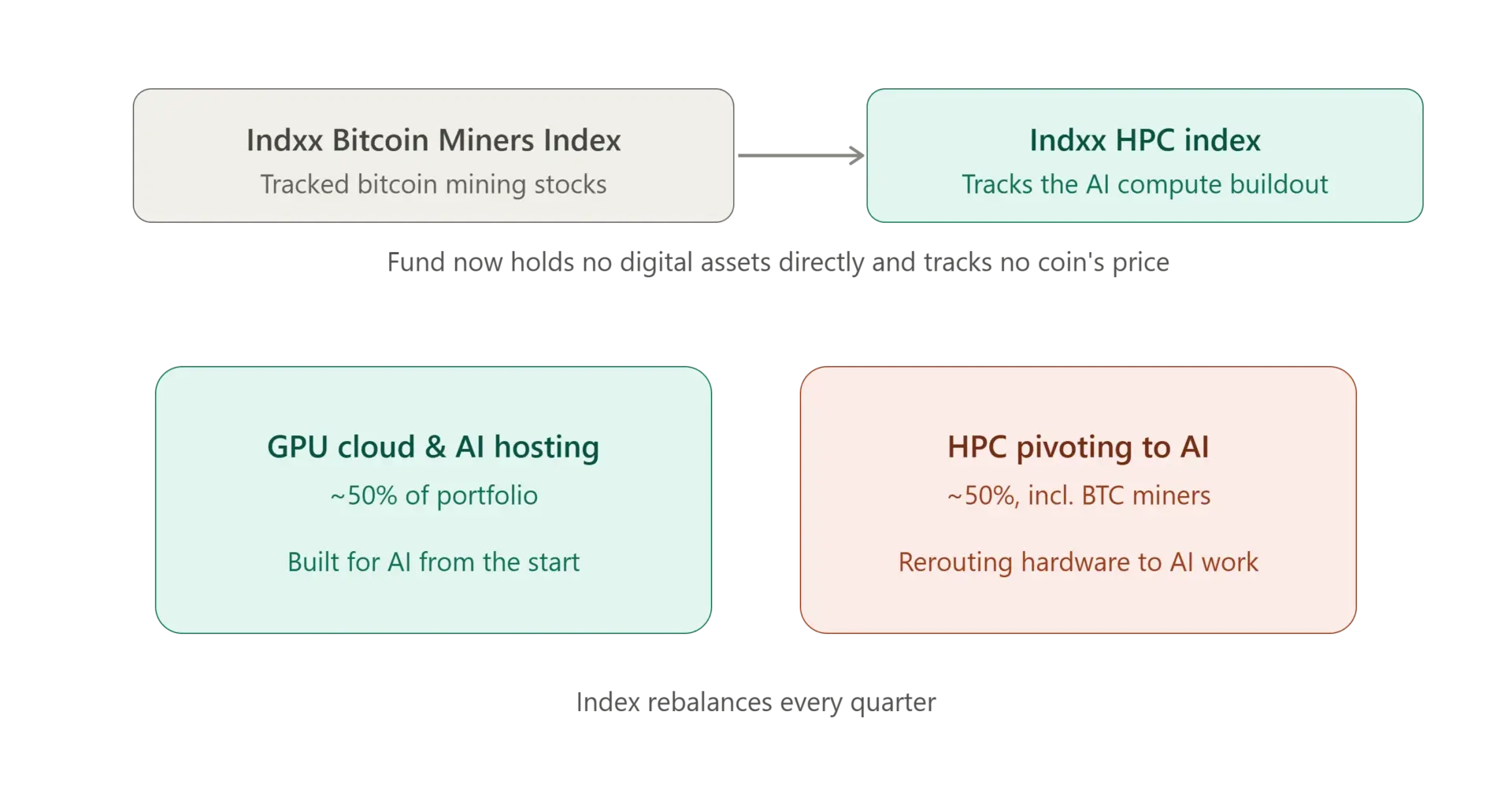
Grayscale Investments has rebranded its Bitcoin Miners ETF (MNRS) into the Grayscale AI Compute ETF (GCPU), joining the well-worn path of firms pivoting from Bitcoin mining exposure toward artificial intelligence infrastructure. The fund is being marketed as a way for ordinary investors to gain exposure to the energy and compute demand driving the AI buildout. The rebrand also moves the mining-to-AI pivot from individual company strategies to the fund level, packaging the transition into a single listed portfolio.
The public mining sector is currently riding a substantial demand wave, with announced AI and high-performance computing (HPC) contracts totaling roughly $70 billion to $100 billion. Even so, available capacity remains well short of what the AI buildout would need to run at full strength. That room to grow is what GCPU buyers are wagering on to deliver returns as more capital continues to flow in to finance the buildout.
How Did Grayscale Turn a Bitcoin Miners Index Into a High-Performance Computing One?
According to Grayscale's announcement, the new fund now tracks the Indxx High Performance Computing Index, which pools companies buying data centers, securing power supply, and stacking the compute capacity that AI models run on. It replaces previous benchmark, the Indxx Bitcoin Miners Index, which tracked companies that solve blocks for Bitcoin.
Another difference Grayscale explicitly stated is that the rebranded GCPU will not hold any digital assets directly and will not track any coin's price.
Notably, the GCPU ETF will cover a mix of firms focusing on different parts of the AI buildout. About 50% of the portfolio will track companies built around GPU cloud and AI-hosting capacity from the start. The other half of the portfolio will consist of operators with roots in other parts of high-performance computing, including Bitcoin mining, that have publicly announced or are already in the process of pivoting into AI workloads. The index rebalances every quarter. The split design effectively covers both sides of the transition: purpose-built AI cloud capacity on one side, and the permitted, grid-connected power footprints that miners already hold on the other.
Why Grayscale Thinks Compute Is the Scarce Asset
Grayscale's Head of Index, Steve Vanourny, endorsed the argument around the scarcity of the compute needed to power the AI boom. Writing in the September 22 announcement (), he stated: “GCPU is a direct extension of that thesis, giving investors access to the companies closing the gap between AI's demand for compute and the physical infrastructure needed to meet it.”
Grayscale's release backed the scarcity thesis with figures highlighting record-low vacancy rates at North American data centers, with roughly six months of spare capacity in reserve, per CBRE data. Building fresh capacity is not straightforward, as new facilities can take as long as five years to construct. Goldman Sachs projects that AI-related capital spending, directed mostly at physical plant, will exceed $1 trillion annually. Those figures capture the bottleneck at the heart of the scarcity case: spare capacity is measured in months, while new supply is measured in years.
AI Compute Providers That Were Previously Bitcoin Miners
Grayscale is packaging a trend that has been reshaping the mining sector for months. AI-integrated miners are up about 21% year to date, while the broader Bitcoin market is declining.
Firms that have already made the switch are riding a wave of momentum. TeraWulf has posted gains near 73%, while Riot Platforms is up roughly 94% over the same stretch. Core Scientific booked $136.7 million in colocation revenue against just $27.5 million from mining in the second quarter of 2026.
The economics also make the switch compelling for firms contemplating the move. AI cloud services fetch an estimated median of $940 per megawatt-hour, versus $113 to $179 for Bitcoin mining. Cryptopolitan has previously reported that miners carrying AI or HPC contracts trade at about 12.9 times forward sales, against 3.7 times for those without, as OpenAI's roughly $280 billion compute push and a 2,600-gigawatt US interconnection backlog — projects queued for grid interconnection — make an already-permitted, grid-connected site worth far more than the rigs sitting inside it. Under the index's rules, miners that disclose AI or HPC contracts become candidates for the fund's pivoting half at each quarterly rebalance, so the sector's announcement pipeline is what will shape GCPU's composition going forward.

