Goldman Sachs Backs Won, Taiwan Dollar and Ringgit on AI-Driven Asia FX Split
Key Takeaways
- •Goldman Sachs said the South Korean won, Taiwan dollar and Malaysian ringgit are the main beneficiaries of an AI-driven shift in Asian currency markets.
- •South Korea’s current account surplus is forecast to nearly double to about $300 billion this year, while Taiwan’s surplus is projected at 25% of GDP.
- •Goldman said semiconductor exports, USD deposit holdings and foreign direct investment are providing structural support for the won, Taiwan dollar and ringgit.
- •The bank expects energy-importing currencies such as the Thai baht, Indonesian rupiah and Philippine peso to keep lagging because of oil-price pressure and other headwinds.
- •Goldman said the regional currency split is likely to persist and widen if AI investment remains intact.
Goldman Sachs has issued one of its most consequential Asia FX calls of 2026, backing the South Korean won, Taiwan dollar, and Malaysian ringgit as the main beneficiaries of a structural shift driven by the global AI investment boom. The bank is drawing a sharp line between those chip-exporting economies and energy importers such as the Thai baht and Indonesian rupiah, which it expects to continue lagging.
South Korea’s current account surplus is forecast to nearly double to about $300 billion this year, equal to 13.9% of GDP, while Taiwan’s surplus is projected at 25% of GDP, the widest in Asia. Goldman said both economies are benefiting from surging semiconductor exports and substantial USD deposit holdings.
The macro split Goldman identifies — AI capital spending on one side and energy supply shock exposure on the other — is not limited to foreign exchange markets. It also helps explain why investors are watching the region’s balance-of-payments strength so closely: in economies with large surpluses and export receipts, foreign-currency earnings can support liquidity even when broader global markets remain uneven. Stronger local-currency liquidity in Korea and Taiwan could translate into more dry powder on regional crypto exchanges, more aggressive positioning in AI tokens, and a broader EM liquidity expansion that creates the classic conditions for altcoin rotation.
Goldman Sachs lists Asian currencies riding the AI boom — CNBC (@CNBC) July 27, 2026
The market’s open question is whether the AI investment cycle lasts long enough to turn this FX outperformance into a durable crypto liquidity tailwind, or whether a reversal in AI sentiment compresses both at the same time.
Goldman Sachs: What the Asia FX Split Signals About AI’s Macro Footprint
Goldman said two forces are reshaping Asian macro markets in 2026: a global energy supply shock that weighs on oil-importing economies and an AI capital spending boom that generates sustained export revenue and FDI inflows for semiconductor hubs.
According to the bank, that divergence has become the dominant driver of intra-Asia exchange-rate dispersion.
For the South Korean won, Goldman’s bullish case rests on a current account surplus expanding faster than outbound equity flows can offset. The bank said reduced foreign equity outflows have lessened the drag on the surging surplus, creating room for a won rally.
For the Taiwan dollar, the mechanism is similar. Semiconductor exports are running at record levels, and a current account surplus equal to 25% of GDP provides structural support for the currency even with interest rates unchanged.
The Malaysian ringgit completes Goldman’s bullish trio, supported by resilient AI-led economic growth, strong export performance, and sustained foreign direct investment. Together, those three currencies sit on the more directly AI-linked side of the region’s split, where trade flows and capital inflows are reinforcing each other.
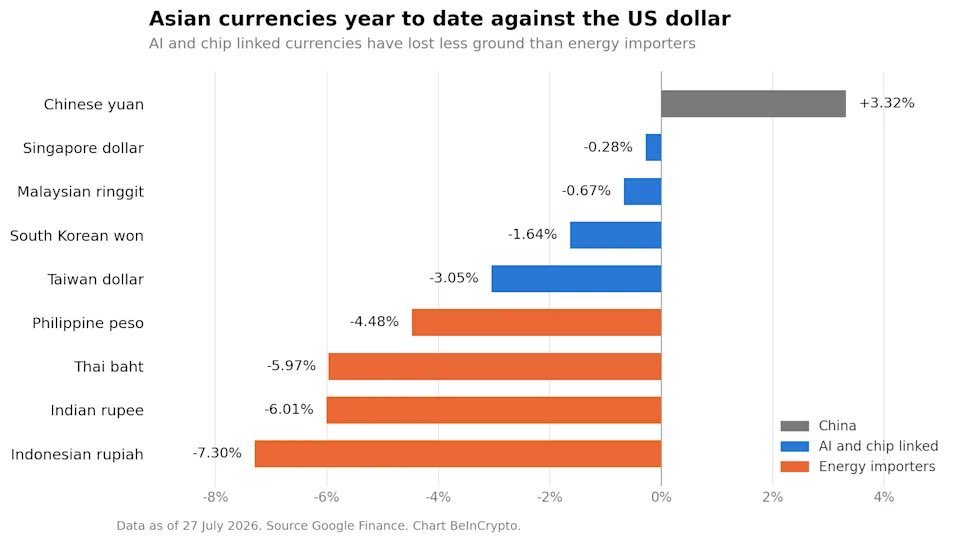
Goldman is more cautious elsewhere. Falling gold prices and lower real rates weigh on the Thai baht. Indonesia faces governance questions, and the Philippine peso remains sensitive to elevated oil costs. China is the outlier: the yuan has gained 3.32% year-to-date, making it the only Asian currency higher against the greenback. Goldman kept its 12-month USD/CNY forecast at 6.50, citing undervaluation and yuan internationalization.
Critically, the outperformance is relative. The dollar index is up nearly 3% in 2026, which means every AI-linked Asian currency Goldman favors has still weakened in absolute terms. The won is down 1.64%, the ringgit is down 0.67%, and the Taiwan dollar is down 3.05%.
Energy importers have fared worse. The Indonesian rupiah has dropped 7.30%, the baht 5.97%, and the peso 4.48%. Goldman said the divergence is likely to hold, and widen, as long as AI investment remains intact.

