Gold Tumbles 2% as Strong US Jobs Data Revives Fed Rate Hike Speculation
Key Takeaways
- •The US economy added 162,000 jobs in August, far exceeding the roughly 53,000 forecast, with unemployment steady at 4.1%.
- •Spot gold fell approximately 2% to $4,391.61 per ounce, while silver declined 1.5% and platinum slipped 0.6%.
- •The probability of a September Fed rate hike shifted to roughly 50% after the jobs report, down from about 70% earlier in the week.
- •Fed Governor Christopher Waller said he could support holding rates steady at the September meeting if upcoming inflation data confirm continued moderation.
- •Next week's August CPI report is viewed as the decisive factor for the Fed's policy decision, with gold facing technical resistance near its 200-day moving average around $4,526.
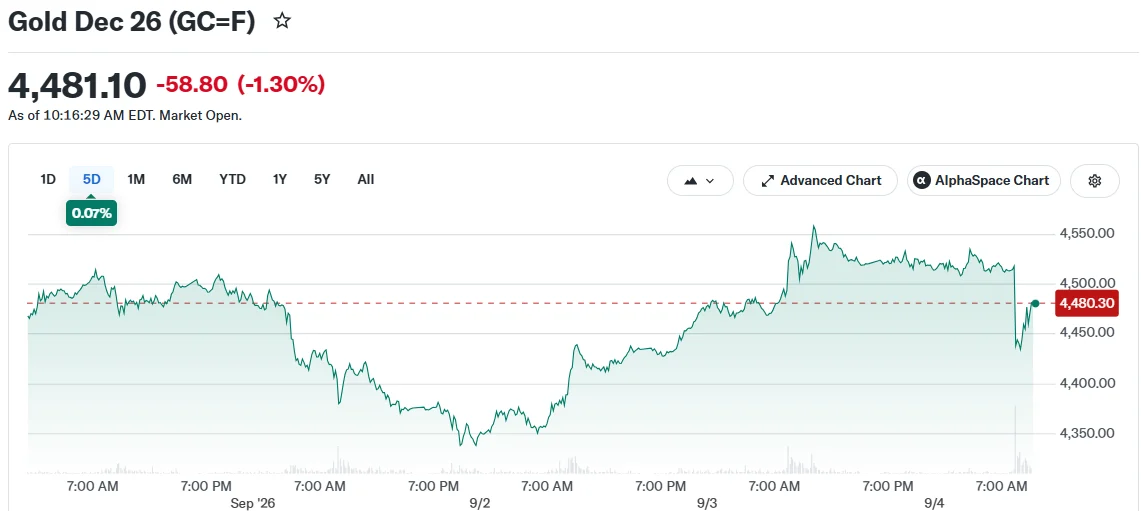
Gold came under significant pressure on Friday after unexpectedly robust US employment figures raised fresh questions about the Federal Reserve's policy decision at its September meeting.
Employment data is among the most closely watched inputs the Fed uses to gauge the economy's strength, and stronger-than-expected labor numbers can signal to policymakers that the economy has room to absorb tighter monetary conditions. That dynamic put the precious metal, which is highly sensitive to interest-rate expectations, on the defensive.
August employment data showed the American economy added 162,000 new positions, far exceeding the roughly 53,000 additions forecasters had projected. The unemployment rate held steady at 4.1%. The figures marked a sharp turnaround from July's numbers, which had indicated a contraction of 23,000 positions.
BREAKING: The US economy adds +162,000 jobs in August, well above expectations of +55,000. The unemployment rate was 4.1%, in-line with expectations of 4.1%. July's job number was also revised up by +43,000 jobs and is now positive for the month. The US job market nearly… — The Kobeissi Letter (@KobeissiLetter) September 4, 2026
Market Reaction
Spot gold retreated approximately 2% to settle at $4,391.61 per ounce, while futures contracts declined 0.6% to reach $4,514.19. Silver fell 1.5% and platinum slipped 0.6%.
The US Dollar Index climbed 0.2% to 99.03 following the employment announcement. Dollar strength typically weighs on gold valuations, as foreign currency holders face elevated costs when purchasing the precious metal. Gold is priced in dollars globally, so the inverse relationship between the currency and the metal is a long-standing feature of the market.
Gold had recovered nearly 2% during Thursday's session, ending a three-day selloff, but Friday's employment release curtailed portions of that advance.
Central Bank Commentary and Policy Expectations
Federal Reserve Governor Christopher Waller indicated on Thursday that he would be willing to advocate for maintaining current policy settings at the upcoming September 15-16 gathering, contingent on forthcoming inflation metrics confirming sustained moderation in price growth.
Waller did not entirely dismiss the possibility of tightening, however. He emphasized that August's inflation statistics would carry substantial weight in shaping his stance and acknowledged that renewed price acceleration could shift his preference toward a rate adjustment.
Financial markets responded swiftly. The probability of a September rate hike slid to approximately 50%, based on CME FedWatch tool data, down from roughly 70% odds observed earlier in the week. The CME FedWatch tool tracks pricing in fed funds futures markets to infer the probabilities traders assign to different Fed decisions.
Fed rate-hike odds for September are now slightly favored, climbing to 52% after the stronger-than-expected jobs report. pic.twitter.com/TGijsM22kk — Wall St Engine (@wallstengine) September 4, 2026
Reduced borrowing costs generally benefit gold valuations, since the metal generates no yield and becomes more attractive when returns on alternative investments decline. Conversely, when expectations for higher rates firm up, the opportunity cost of holding gold rises.
Outlook for Precious Metals
Next week's August consumer price index release has emerged as a critical determinant for the Fed's ultimate policy choice. Market observers suggest inflation data may carry greater significance than employment figures in shaping whether officials opt to tighten or hold rates steady. The CPI report, released by the Labor Department, is the government's headline gauge of consumer price trends and a key reference point in the Fed's dual mandate for price stability and maximum employment.
Compensation growth reflected in Friday's employment statistics remained relatively moderate, providing some underlying support for gold and preventing additional selling pressure. Moderate wage growth matters to Fed officials because sustained pay gains can feed into services inflation, one of the more persistent components of price growth.
IG senior market analyst Tony Sycamore observed that gold's recent recovery also benefited from diminishing pressure stemming from energy valuations and Treasury yields. He noted that recent Middle East tensions appear to have subsided, alleviating inflation concerns associated with elevated petroleum prices.
Gold continues to trade above the $3,942 trough established in late June. Sycamore suggested this level reinforces the interpretation that gold has established a medium-term foundation.
The precious metal currently confronts technical obstacles near the 200-day moving average positioned around $4,526. The 200-day moving average is widely followed by traders as a dividing line between longer-term uptrends and downtrends. Successfully penetrating that threshold would enhance near-term prospects, while an inability to sustain levels above it may trigger renewed downside movement.
The primary challenge awaiting gold arrives with next week's inflation statistics.
