California Natural Gas Generation Hits Three-Year High as Summer Heat Strains Battery Buffer
Key Takeaways
- •Natural gas-fired generation in California hit a three-year high in late August during a Southwest heat wave combined with reduced solar output.
- •At the peak of the event, natural gas supplied nearly half of the electricity on the California grid, according to a Natural Gas Intelligence report.
- •California's battery storage fleet, among the largest in the world, reached its summer operational limits during the multi-day heat event.
- •Regional spot natural gas prices rose sharply as generator fuel demand climbed across the Southwest despite an overall abundant supply backdrop.
- •The episode shows thermal generation remains a critical backstop for California when renewable output falls and extreme heat drives up electricity demand.
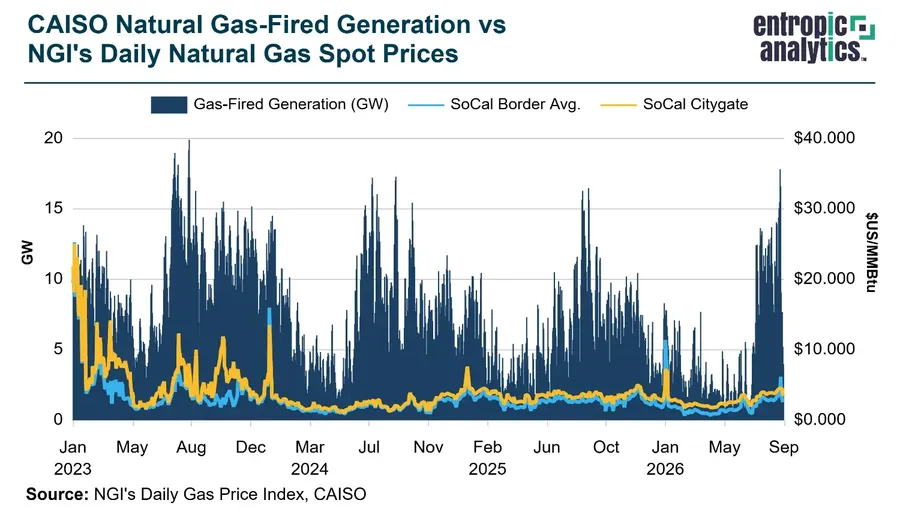
Natural gas-fired generation in California surged to a three-year high in late August as a Southwest heat wave and a slump in solar output forced the state's grid to lean harder on thermal plants, helping send regional spot prices sharply higher after months of abundant supply.
The spike highlights the California Independent System Operator (CAISO)'s continued reliance on natural gas as a flexible resource during extreme weather, even as the state expands battery storage capacity at a rapid pace. During periods of intense heat, demand for electricity typically peaks in the late afternoon and evening, when solar output declines — precisely the window when gas-fired plants and, increasingly, batteries are called upon to meet the load. This evening ramp, sometimes called the "duck curve," has become more pronounced as solar's share of the state's resource mix has grown, because it compresses the hours in which solar can serve demand while steepening the transition to other resources after sunset.
At the peak of the late-August event, natural gas was supplying nearly half of the electricity on the California grid, according to the report from Natural Gas Intelligence. The state's battery buffer, which has grown substantially in recent years to several gigawatts of installed capacity — among the largest such fleets in the world — met its summer operational limits during the event, underscoring that storage deployments — while significant — still have finite capacity when confronted with sustained heat waves that stretch across multiple days. Multi-day heat events pose a particular challenge for storage because batteries must be recharged between evening discharge cycles, and sustained heat can reduce the overnight window available for recharging.
The episode also had price implications beyond California's borders. Regional spot natural gas prices, which had been suppressed amid months of abundant supply, moved sharply higher as gas demand for power generation climbed across the Southwest. The dynamic illustrates how weather-driven electricity demand can ripple into gas markets: power burn is a major component of U.S. natural gas consumption, so a heat-driven surge in generator fuel use can tighten regional supply even when the broader production backdrop remains ample.
The late-August heat event comes as grid operators across the western United States continue to prepare for periods of extreme summer weather, when air-conditioning demand can push electricity systems close to their limits. California's resource mix has shifted markedly toward solar and storage over the past decade, but the August surge demonstrates that thermal generation remains a critical backstop when renewable output falters and temperatures spike simultaneously. How the state balances further storage build-out against the need for firm, dispatchable capacity during extreme heat is likely to remain a central question for planners as heat events grow more frequent.
