‘I Want to See Red’: General Motors Is Teaching Engineers to Fail Fast and ‘Speak Fearlessly’ as It Takes the EV Battery Fight to China
Key Takeaways
- •GM's $900 million Battery Cell Development Center in Warren, Michigan, is expected to reach full operation later this year, letting the company build full-size battery cells in-house for the first time.
- •GM is betting its next-generation electric trucks and full-size SUVs on lithium manganese-rich (LMR) cells, which use roughly 30% to 40% nickel compared with about 85% in current high-nickel cells and promise about a third more energy density than leading LFP batteries at comparable cost.
- •Commercial LMR production with partner LG Energy Solution is targeted for 2028, while GM separately announced in July 2025 that it would convert its Spring Hill, Tennessee, plant to produce LFP cells.
- •GM booked about $7.6 billion in EV-related charges last year, a fraction of the $19.5 billion and $26.5 billion recorded by Ford and Stellantis respectively, and is deliberately maintaining its EV program while rivals scale back.
- •Under battery vice president Kurt Kelty and chief product officer Sterling Anderson, both former Tesla executives, GM is adopting tech-inspired practices such as quarterly stretch goals with expected failures, a 'speak fearlessly' candor protocol, and AI-driven simulation, targeting a two-year vehicle development cycle.
The General Motors Technical Center in Warren, Michigan, still looks the way architect Eero Saarinen drew it in the 1950s: low glass-and-steel boxes arranged on a grid, end walls of glazed brick in saturated colors, and vast man-made lakes, everything in its right place. Dedicated in 1956 and a National Historic Landmark since 2014, the campus felt, during a recent Fortune site visit, like a massive public high school.
Slotting into the scene like a bright Lego set are two newer additions: the $900 million Battery Cell Development Center (BCDC), a huge light-gray rectangle, and an Innovation Center that resembles a blue-and-yellow battery pack perched atop a historic building.
If GM's campus is a giant school, longtime battery engineer Andy Oury is its cheerful science teacher — polo shirt tucked into blue jeans, cruising the grounds in a large all-electric Silverado. The weekend before the visit, he said, he drove the truck 220 miles to Traverse City, powered his camper off it all weekend, and towed a wood chipper around town.
Oury joined GM in 1999 and became interested in batteries about a decade later, as the company began work on the Chevrolet Volt. That plug-in hybrid convinced him GM was serious about electric transportation, he told Fortune. Today he reports to Kurt Kelty, a battery-industry lifer who spent more than a decade each at Panasonic and Tesla. About ten years ago, Oury noticed on LinkedIn that Kelty was leaving Tesla and called his boss at the time: “Hey, you've got to try to hire this guy.”
Kelty, now GM's vice president of battery and sustainability, told Fortune that the battery operations and research labs represent a massive investment at a time when Detroit is largely reeling from a failed bet on EVs. The federal EV tax credit expired at the end of September 2025, and GM took about $7.6 billion in EV-related charges last year — a fraction of the charges Ford and Stellantis booked in their EV divisions, at $19.5 billion and $26.5 billion, respectively. GM says the figures are not comparable, because it is sticking with EVs as its end-game scenario. That stance makes GM a deliberate outlier in Detroit: while rivals book far larger EV write-downs, it is doubling down on developing battery cells in-house.
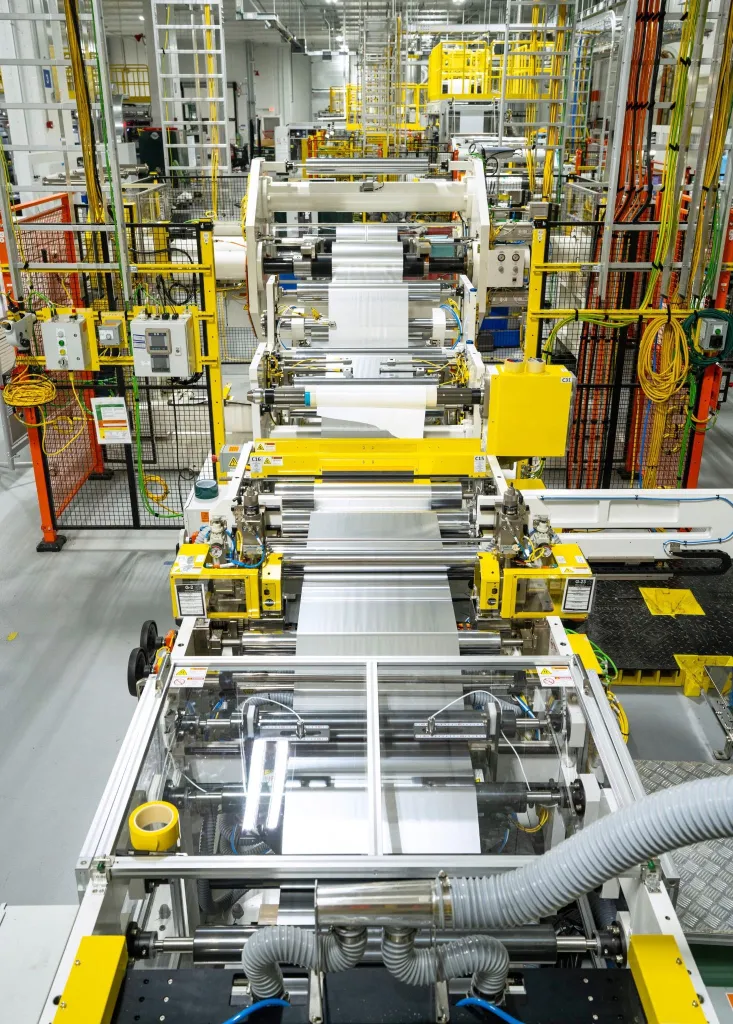
The battery plant remains very much a work in progress and is expected to come online as fully operational later this year.
From science class to industrial process
Anselmo “Mo” Gallegos, director of battery cell development, is responsible for rapidly scaling that science class into an industrial process. If Oury is the cool teacher, Gallegos is the brainy grad student — grinning from behind his glasses or safety glasses and prone to food metaphors. Every battery maker has a proprietary formation protocol, the final charging process that brings a cell to life, he said: “a recipe to get the perfect donut at the end of it.”
On a walk past the ovens and mixers — some of them a tangle of pipes and wires recalling the bombastic 0s art of Marvel Comics great Jack Kirby — Gallegos casts himself as a chef seeking just the right mix of ingredients. Batteries, he said, are “a mix of chemistry, mechanical interfaces [and] dark, dark black magic.”
The ovens are where the proverbial cake can be overbaked. “Is it going to stick? Is it going to crack?” he said. “You get your cake out of the oven and sometimes it's got cracks along the top. We hate that.”
Gallegos' team is ramping up to make a couple thousand full-size cells a day, and his job is to work out the process so that every one comes out smooth, with no cracks. Before the BCDC was built, GM could not build a cell like this at all. Engineers drew one on paper, took it to a partner such as Samsung or LG and asked, in Oury's words, “pretty please, will you put this together?”
A big bet on chemistry
What the plant is built to prove is a major wager on battery chemistry. Much of the world's cheap EV battery supply runs on lithium iron phosphate, or LFP, a chemistry that China dominates. GM is betting that its next generation of electric trucks and full-size SUVs will run on something else: lithium manganese-rich, or LMR, cells, which swap out much of the nickel and cobalt for cheaper, more plentiful manganese and extra lithium.
GM's LMR cells use about 30% to 40% nickel, Oury said, compared with roughly 85% in the high-nickel cells currently in use. GM says LMR can deliver roughly a third more energy density than leading LFP cells at comparable cost — and Gallegos and Oury are scrambling to start commercial production with partner LG Energy Solution in 2028.
Kelty explained that GM has been working on LMR for more than a decade and considers the technology homegrown. “We're not licensing this from China,” he said. “We're developing this here.”
If it works, GM gets a cheaper, longer-range battery for its biggest vehicles that does not depend on Chinese technology. If it does not, the company will have wagered on a chemistry that, by Kelty's own account, most of the industry considers a long shot. “Our data showed one thing,” Kelty said: “that this actually made sense.”
The question inside GM became why the company was not already moving. “It took a voice saying, the reason we're not doing LMR is because it's us. It's our own broken mentality. So let's fix that,” Oury recalled. The hurdle, he said, was “actually more momentum-based or emotion-based rather than data and business-based.”
When GM made the call, Kelty said, the team had supporting data to get it perhaps 60% to 70% of the way to the decision. “What we had to do was make that last leap and say, ‘You know what? We're going to get the next 30% or 40% of the data and make it there.’” He called it a “testament to the trust in the team.”
GM has not fully abandoned LFP: in July 2025, it announced it would convert its Spring Hill, Tennessee, cell plant to produce LFP cells. But for its biggest vehicles, GM chose LMR. The sequencing sets up two near-term markers for whether the bet is on track: the battery plant reaching full operation later this year, and commercial LMR production with LG Energy Solution targeted for 2028.
Teaching A students to accept a few Bs
It is a big change for America's No. 1 automaker, which has long produced, in Alfred P. Sloan's famous phrase, “a car for every purse and purpose” — and whose employees pride themselves on being A students who know all the answers. GM leaders told Fortune they are trying to grow a different kind of high achiever: someone who challenges inherited constraints, works from incomplete information, admits what will not get done, and uses early failures to learn faster, without missing core deliverables. But it is not easy to accept a few Bs when you are used to being an A student. The stakes of that cultural experiment are concrete: by Oury's account, it was an internal challenge — the kind Kelty's process is designed to produce — that broke open the LMR decision.
Red light, green light
When Kelty joined GM in February 2024, he began a new quarterly process with his team. At the start of each period, he spends an hour one-on-one with each direct report, agreeing on goals. He describes his job in three parts: “set the direction, set the priorities, and then remove obstacles.” At the end of each quarter, the work is marked red, yellow or green.
“At the end of the quarter, when we look at it, there should be some red lights on there,” Kelty said in an interview with Fortune. “And if there isn't, then to me that means that they didn't stretch far enough. So I want to see red.”
The goals have to be measurable, he said, citing a battery assignment he might make: “We're going to make the cells, cells are going to cycle 500 times and they're going to have at least 90% retention by the end of the quarter.” His teams now run their goals through AI to check that each one has a metric attached, he added. “I want to make sure that we have some stretch targets in there,” Kelty said. “I don't want just goals that they're doing already.”
What Kelty found at GM was a team that treated the quarterly scorecard like a report card. “The team was just paranoid that everything had to be green because that's kind of the GM culture,” he said, adding that he comes from a culture where “if everything's green, you obviously are not stretching hard enough.”
At his first staff meeting, Kelty asked his new direct reports to bring their top priorities for the year — and the top two things they would not do. Several called Oury to ask whether their new boss was serious. As a longtime GMer, Oury said the instinct was to never say no, “because it always feels like you have the resources to get it done.” But the truth, he said, is that “no company, no matter how big they are, has the resources to do everything. So having that — building that muscle of saying no and prioritizing — is super important.”
Kelty puts it more bluntly: “If you don't have a list of things you're not going to do this quarter, then I assume you have too many people.”
It took about a year for the team to buy in, Kelty said. What helped was an example. At a meeting with his leaders, he shared an anonymized quarterly review, full of red lights. “They didn't hit hardly anything on their targets, but I gave them the highest ranking of all of you,” he recalled telling them. As he put it to Fortune, “The person that got the most red actually was the highest-performing person on my team.”
Some reds are delays. Some are experiments that did not work out. Either way, Kelty said, “Let's move on.”
The view from the CFO's office
Finance chief Paul Jacobson has steered GM into a position where Kelty has room to dig deep and experiment. The former Delta Air Lines CFO has held the same position at GM since 2020, and on his the company has generated annual cash of about $10 billion since 2021, compared with an average of $3 billion in the five years prior, while buying back roughly a third of its shares since late 2023.
Jacobson said he learned in the airline sector to strip out what he calls “self-imposed cyclicality” — the pileup of inventory and price slashes during soft demand. That cushion pays for bets like Kelty's, he said. “What we really want to do is create a continuous stream of healthy cash flows.” GM recorded $185 billion in revenue and $2.7 billion in net income in 2025, with 2.85 million cars sold domestically, a 17.2% market share.
Jacobson has run a stretch experiment of his own in public. At GM's 2021 investor day, he laid out 10-year targets that were unusual for an automaker to put on paper, including $20 billion in annual digital revenue by 2030. He told Fortune he thinks the market discounted that heavily at the time and is now more focused on quarterly performance. GM stock's price-to-earnings multiple is one of the lowest in the S&P 500, he noted, even though the company has generated over $10 billion a year in free cash flow for almost five years.
“People take a view that's more historical,” he said. “They look at the GM of the '90s and the 2000s and the restructuring era versus really looking at what's going on today.”
The oracle
Sterling Anderson, another former Tesla executive, may be the clearest sign of how far GM is willing to go to remake itself: the company handed one of its most important jobs to someone from the tech world — along with a distinctly tech-flavored title, chief product officer.
Announcing his hire in May 2025, GM President Mark Reuss said the company had “an opportunity to evolve the way we build from the ground up, with tighter integration between software and hardware, shorter development cycles, and an unwavering focus on a seamless customer experience” (). CEO Mary Barra said Anderson was joining “at a critical time as our industry continues to reinvent itself.”
Anderson holds a master's degree and a PhD in robotics from MIT, where he developed the school's groundbreaking semi-autonomous vehicle safety system, Intelligent Co-Pilot. He later led Tesla's Autopilot program before co-founding autonomous trucking company Aurora. He joined GM after conversations with Barra, Reuss, Jacobson and the board of directors, and told Fortune he made the decision for three main reasons: GM's trajectory, vision and scale.
The car, he said, is “the most complex robot you and I and most of us will probably ever own.” What surprised him in those conversations, he added, was GM's “appetite for transformation.” “I saw a much higher neuroplasticity in this leadership team than I've seen from many others in this and related industries.”
Anderson is especially pushing a “no sacred cows” mentality. “Engineers thrive when you take the constraints off the problem,” he said. For instance, he challenged a team to come up with voice-controlled in-vehicle experiences, and a four-person team had a prototype running in a Cadillac Lyriq about 30 days later. Old GM would have asked, “Who's the supplier we can go talk to and integrate a module?” he said. His product organization now gives out an award called “Big Swings,” for “effort that swings through the fences, whether successful or not.”
Anderson described GM's overhaul of product development as “effectively the third phase in the evolution of product development for humanity,” built on “probabilistic, large data-requiring methods.” In plain terms, that means fewer handoffs between departments, shorter timelines and more decisions made by simulation and data instead of trial and error.
“It is definitely a philosophical bent,” said Rashed Haq, GM's vice president of Autonomous Vehicles, of Anderson. Haq, who came from a robotics background before joining GM in 2020 to work on its self-driving unit Cruise, added that many leaders in the physical AI space have to “think very deeply” about these issues. “I think everybody in [autonomous vehicles] thinks of [the car] as a robot. When we had been hiring, we either hired people from a deep, [machine learning] background or robotics background,” he said. He estimated that half of his team holds PhDs in robotics, and the other half PhDs in deep learning or machine learning.
Permission to speak fearlessly
Some aspects of the new GM carry a distinctly Big Tech tone, evoking the radical candor of Amazon's “disagree and commit” or Bridgewater's “radical truth and radical transparency.”
About a year and a half ago, Kelty said, GM began encouraging employees to open a disagreement with a set phrase: “I want to grant myself permission to speak fearlessly.” Whatever follows afterward is understood to be fair game. It is part of how the LMR debate broke open, Oury said.
Recently, on a call with a senior vice president listening in, an engineer from a neighboring group used the phrase on Kelty: “Kurt, I want to have permission to speak fearlessly. What you said is absolutely wrong. It is not the way we should be going.” Kelty grinned. “It's great to have that.”
The B-plus A student
Jason Fischer, a 28-year GM veteran who leads the AI push inside engineering, described the old instinct as a hunt for perfection. “The old GM would have been like, ‘Wait till this is the most perfect,’” he said. The end result, he added, is the same high standard as always, but the company is taking pains not to “stifle innovation.”
Fischer reaches for a high-school metaphor to describe himself as a perpetual learner. “I tell people I'm a B-plus student,” he said, in the sense of always having more to learn. He joked: “If you ask me an answer, you've got an 89% chance that I'm going to give you the right answer.”
That mindset is essential for using AI, Fischer said during Fortune's site visit, as he stood in front of a screen where a digital car slid off a course of cones until engineers tuned its calibration in simulation — work he said would otherwise take months with a physical car and a human driver. “When I use AI, it gives me the wrong answer most likely because I gave it the wrong engineering prompt,” he said, arguing that the B-plus approach is worth it because of the scale of the efficiencies. “AI actually enables engineers to have some time back to do what we should be paying them to do, and that's innovate.”
Few people have a job like Fischer's, said Haq, who added that he swaps notes with him at least once a week. Fischer is “creating how we should work, the future of how we should work, and how to infuse AI into our entire process,” Haq said. Haq does this for autonomy; Fischer does it across all of GM engineering.
Fischer's education in failing fast started with GM's self-driving acquisition, Cruise, where he was assigned in 2017. Nearly 20 years into his time with the company, he began spending two weeks of every month in San Francisco, embedded in a startup environment with a team of roughly 40 that later grew to thousands. When senior GM product executive Doug Parks heard Fischer was breaking some rules, he called him into his office. “I don't want you to break the rules anymore,” Parks told him, as Fischer described the conversation. “I want you to completely destroy every rule that we have at General Motors and I want you to document it.”
GM folded the work into its own teams in 2024, buying out Cruise's outside investors. Haq said GM skipped robotaxis but kept the autonomy engineers, along with much of the code and “a lot of the methodologies,” which are now going into the next-generation Super Cruise, GM's autonomous system set to launch in 2028. The original robotaxi thesis assumed that “car sales would go down, rideshare would be dominant,” Haq said, and that simply “never played out.” He noted that rideshare still accounts for less than 1% of vehicle miles traveled.
Fischer, for his part, said he was innovation-pilled by his time at Cruise, citing the electrification of the GMC Hummer, which needed to come together in record time. GM is hoping to move toward a two-year vehicle development cycle, he said, with weekly “tall pole” reviews of whatever is holding up each job function. He expressed confidence: “I'm convinced that we're going to be able to do things just as fast as China.”
This story was originally featured on Fortune.com (https://fortune.com/2026/10/20/general-motors-ev-battery-china-tesla-culture-change/).

