Global AI Adoption in 2026: UAE Leads Usage as Regional and Workplace Gaps Persist
Key Takeaways
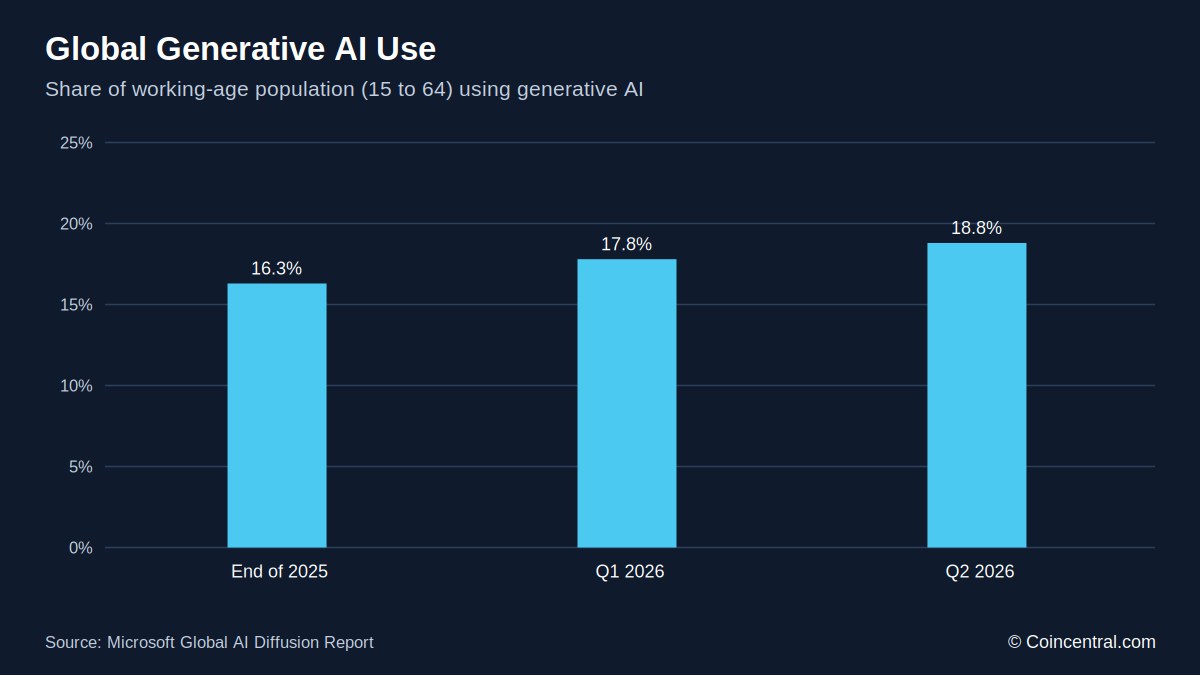
- •Microsoft estimates that 18.8% of the global working-age population used generative AI by June 2026, up from 16.3% at the end of 2025.
- •The United Arab Emirates leads global adoption at 73.3%, followed by Singapore at 64.3%, while the United States ranks outside the top 20 despite leading in AI investment, model development and venture funding.
- •Workplace surveys cited by Stanford show that more than 80% of employees use AI at work in India, China, Nigeria, the UAE, Egypt and Saudi Arabia, exceeding the global average of 58%.
- •OECD statistics show 20.2% of firms used AI in 2025, more than double the 2023 level, with about 52% of large firms adopting compared with 17.4% of small firms.
- •Generative AI use reached 28.8% in the Global North versus 16.2% in the Global South by mid-2026, and the article notes unequal access could widen productivity gaps between countries.
Artificial intelligence adoption is expanding worldwide, but usage rates vary significantly between countries and population groups. The countries developing the most advanced AI models are not necessarily those where the largest share of people use the technology.
Microsoft estimates that 18.8% of the global working-age population used generative AI by June 2026. The rate reached 73.3% in the United Arab Emirates and was close to one-third in the United States. Workplace surveys cited by Stanford show a different pattern: more than 80% of employees reported using AI at work in countries including India, China and Nigeria.
The figures come from Microsoft, Stanford, the OECD and Ipsos, which use different methods. Microsoft tracks anonymized usage signals, Stanford and Ipsos rely on surveys, and the OECD uses official statistics. As a result, there is no single AI adoption ranking. A country may lead on population-level use while ranking lower on workplace or business adoption.
Global AI Adoption in 2026
Microsoft’s Global AI Diffusion Report 2026 estimates that 18.8% of people aged 15 to 64 worldwide used a generative AI product by June 2026. The figure rose from 17.8% in the first quarter and 16.3% at the end of 2025.
Microsoft defines diffusion as the share of the working-age population that used a generative AI product during the measurement period. Its methodology uses anonymized usage signals and adjusts the results for internet access, device market share and population.
Mainstream generative AI products began reaching large audiences after 2022. Adoption has grown rapidly since then, although the pace remains uneven across regions. A 2.5-percentage-point increase in six months may appear modest, but the measure covers everyone aged 15 to 64, meaning each percentage point represents a large number of people.
The OECD reports higher adoption rates among its member economies. More than one-third of individuals across OECD countries used generative AI in 2025, while the share among people in employment reached 41.1%. Students reported substantially higher use: about three-quarters of students aged 16 and over said they had used generative AI.
These figures establish a global baseline, but the measures are not directly comparable. The Global North and Global South divide is discussed later in the report.
Countries With the Highest AI Usage
Microsoft’s second-quarter 2026 ranking places several smaller, highly digital economies ahead of larger technology powers. The United Arab Emirates ranks first, followed by Singapore. Ireland, France and Norway each recorded usage close to 50%.
Switzerland, Austria and Germany were also above the global average of 18.8%. The UAE’s rate was more than twice Germany’s and nearly four times the global average.
The rankings can change quickly. South Korea rose from 16th to 12th place in the second quarter of 2026. The United States moved from 24th at the end of 2025 to 21st in the first quarter of 2026. The U.S. figure in the ranking table is from the first quarter, while Microsoft’s second-quarter figure places usage in the low 30% range.
The results indicate that national AI use depends on more than domestic research and model development. Digital infrastructure, internet access, language support, education, government policy and willingness to experiment also influence adoption.
UAE and Singapore Lead the World
The United Arab Emirates has the highest population-level adoption rate in Microsoft’s data. An estimated 73.3% of its working-age population used generative AI by June 2026, up from 70.1% in the first quarter and 64% at the end of 2025.
The UAE has invested in digital government, AI infrastructure and national AI strategies. Its young and highly connected population is positioned to adopt new digital services. Stanford also lists the UAE among the countries where more than 80% of employees use AI at work, giving it a high position on both population-level and workplace measures.
The UAE’s adoption rate increased by 9.3 percentage points between the end of 2025 and June 2026, compared with a 3.4-point increase in Singapore over the same period. Both are relatively small, well-connected economies with strong government support for AI. Microsoft’s population figures and Stanford’s workplace figures measure different groups, but the UAE is among the few countries that ranks highly on both.
Singapore ranks second, with 64.3% of its working-age population using generative AI by mid-2026, compared with 60.9% at the end of 2025. The country has extensive broadband access, advanced finance and technology sectors, strong digital public services and a highly educated workforce. Stanford’s AI Index describes Singapore as a strong adopter relative to its income level.
Ireland, France and Norway Approach 50%
Ireland, France and Norway follow Singapore in Microsoft’s ranking. By June 2026, adoption reached 49.9% in Ireland, 49.6% in France and 49.4% in Norway, meaning roughly half of the working-age population in each country had used generative AI.
Ireland has a large technology sector and many multinational companies. Norway combines high incomes, digital skills and broad broadband access. Switzerland recorded 39.1% adoption and Austria 35.4%, leaving both countries close to twice the global average.
The results show that high usage is possible in economies with very different sizes and structures. France’s position is notable because public attitudes toward AI in Western Europe are often more cautious than those in Asia and emerging markets. High adoption does not necessarily indicate strong enthusiasm.
Germany ranked 23rd using the same Microsoft measure. Its estimated adoption rate was 32.3% in the second quarter of 2026, 17.3 percentage points below France. Germany’s position is consistent with broader European concerns about data privacy, employment and technology regulation. Stanford’s workplace research also found that German workers reported lower trust and use of AI than workers in India, Nigeria and the UAE.
The figures do not mean that German businesses are avoiding AI. Rather, adoption appears to be more deliberate and more tightly controlled than in some faster-moving markets.
United States Leads Investment, Not Population-Level Adoption
The United States illustrates the difference between AI development and user adoption. It leads in private AI investment, model development, venture funding and the number of major AI companies. Stanford reports that the U.S. invested substantially more private capital in AI than any other country in 2025.
Population-level use, however, is lower than in the leading countries. Private investment supports models and companies, while adoption depends on how many people choose to use the products.
The U.S. ranked 24th at the end of 2025, when usage was about 28.3%. By the first quarter of 2026, usage had risen to 31.3%, moving the country to 21st place. Both figures were above the global average. The U.S. rate was approximately 12 percentage points above the global figure at the end of 2025 and about 13.5 points above it in the first quarter of 2026.
Microsoft’s second-quarter estimate indicates that only about one-third of the U.S. working-age population regularly uses generative AI, leaving the country outside the global top 20. The data separates innovation leadership from user adoption: a country can develop powerful models while smaller nations integrate AI into daily life more quickly.
South Korea and Japan Gain Ground
South Korea was among the fastest-moving countries in Microsoft’s rankings. The company reported that South Korea recorded the largest absolute increase in the second quarter of 2026, rising 3.5 percentage points in one quarter. The increase moved the country from 16th to 12th place.
South Korea had already recorded the largest improvement among the top 30 countries during the second half of 2025. Microsoft attributes the growth to strong digital infrastructure, widespread smartphone use and rapid adoption of Korean-language AI systems.
AI adoption is also increasing among large Japanese companies. Microsoft reported that 87% of surveyed leading Japanese corporations—companies comparable in size to those in the Nikkei 225—were using AI agents.
Japan was slower to adopt generative AI than many other wealthy economies. Language performance was one factor, and Microsoft says improvements in Japanese-language AI have supported more recent growth. Japan’s population-level adoption increased from 22.5% in the first quarter of 2026 to approximately 24.7% in the second quarter. The 2.2-point increase represented roughly 10% growth in relative terms and was the largest relative gain among major economies during the quarter.
The experience of Japan and South Korea shows how local-language tools and existing digital infrastructure can support rapid gains. Neither country ranks at the top of the overall table, but their recent increases demonstrate how quickly rankings can shift.
Workplace AI Use Is High in India, China and Other Emerging Markets
Population-level adoption captures only part of AI use. Stanford’s 2026 AI Index cites employee research showing that 58% of workers worldwide used AI at work regularly or semi-regularly during 2025.
Several emerging economies were well above that average. Workplace use exceeded 80% of employees in India, China, Nigeria, the UAE, Egypt and Saudi Arabia. The survey measures regular and semi-regular use, indicating how common AI is at work rather than how many hours employees spend using it.
The six countries span Asia, Africa and the Middle East. Only the UAE also ranks among the leaders in population-level use, underscoring the differences between the measures.
In China, more than 80% of surveyed employees reported using AI at work. The Chinese consumer market differs from Western markets, with products from Alibaba, Baidu, Tencent, ByteDance and DeepSeek playing major roles while many Western services are restricted.
Microsoft says its own measure may understate Chinese adoption because it does not yet capture every major domestic and open-weight AI service. The company expects future methodological changes to increase China’s reported share.
India also reports high workplace use. Its software, customer-service and outsourcing industries make AI relevant to daily work. Microsoft says India has about 24 million developers on GitHub, the second-largest national developer community. Microsoft has committed $17.5 billion to AI and cloud infrastructure in India from 2026 to 2029.
Ipsos found that more than 80% of Indian consumers said they understood what AI is. Its 2026 AI Monitor surveyed more than 23,000 adults in 32 countries.
Ipsos reported that optimism was strongest in Asia and emerging markets. Consumers in India, China, Indonesia, Thailand and Malaysia were among those most comfortable with AI handling complex tasks. Consumers in Canada, France, Germany and Britain were generally more hesitant. Trust is relevant to adoption because willingness to try new tools affects usage.
Differences Within Countries
OECD data shows that national averages conceal substantial differences between demographic groups. Across OECD member countries, about 75% of students aged 16 and over reported using generative AI in 2025.
The share among employed people was 41.1%. It was 36.7% among unemployed people and 12.5% among retired or inactive people. Age produced the largest gap, with a difference of more than 53 percentage points between younger and older groups.
Education and income also affect usage. A country may report high adoption among university students, technology workers and high-income professionals while older and lower-income groups use AI much less. The figures come from OECD members, which are mostly higher-income economies, and rates in other regions may differ.
Retired and inactive people used generative AI at less than one-third of the rate recorded among employed people, highlighting the groups where adoption remains lower.
Businesses Are Adopting AI
According to OECD statistics, 20.2% of firms used AI in 2025, up from 8.7% in 2023 and 14.2% in 2024. Business adoption more than doubled over two years.
Company size was a major factor. About 52% of large firms used AI, compared with 17.4% of small firms, a difference of 34.6 percentage points. Denmark, Finland and Sweden were among the most advanced countries, with firm-level adoption above 35%.
In the information and communication technology sector, adoption was close to saturation in several countries. Sweden reached 87.9%, Austria 79.9% and Finland 79.8%.
AI agents are also reaching large companies in some markets. Microsoft’s finding that 87% of surveyed leading Japanese corporations used AI agents points to the same trend. The Nordic results suggest that digital readiness supports AI adoption by businesses as well as individuals.
Global North and Global South Divide
Microsoft estimates that generative AI use reached 28.8% in the Global North and 16.2% in the Global South by mid-2026. The difference was 12.6 percentage points, with usage in the Global North about 1.8 times the rate in the Global South.
The gap reflects differences in access to electricity, broadband, computing infrastructure, cloud services, education, local-language models, affordable tools and digital skills. Electricity and broadband require physical investment, while local-language models and affordability depend more on software development and pricing.
Unequal access could widen productivity gaps between countries. Open-weight AI models may help narrow the divide because they generally cost less and can be adapted to local languages and requirements.
Sources
- Microsoft Global AI Diffusion Report 2026 (Q2)
- Microsoft Q1 2026 AI Diffusion Report
- Stanford AI Index 2026: Economy
- Stanford AI Index 2026: Public Opinion
- OECD: AI Use by Individuals Surges as Adoption by Firms Continues to Expand
- OECD: Generative AI
- Ipsos AI Monitor 2026
- Ipsos: Global Attitudes on AI 2026
- Microsoft: Global AI Adoption in 2025
- Microsoft: AI Diffusion in Germany, September 2026
- CoinCentral source article

