What Did the German Term Spread Predict for 2024?
Key Takeaways
- •Germany's 10-year/3-month yield spread, historically a reliable recession indicator, inverted in December 2022, which a basic spread regression translated into a 70% recession probability.
- •Probit models built on the term spread and short rate capture all recessions except the 2020 downturn at a 40% probability threshold, yet they also register a false positive for 2024.
- •Incorporating the debt-service ratio raises the pseudo-R² from 0.19 to 0.33 and eliminates the 2024 false signal, whereas adding expected changes in unemployment leaves recession calls essentially unchanged.
- •No official recession has been declared because key indicators peaked at different times, with employment peaking in 2024Q4, real GDP in 2022Q3, and industrial production in February 2023.
- •The December 2022 spread signal's ultimate verdict will hinge on future revisions to GDP, employment, and industrial production data as well as any recession-dating decisions that follow.
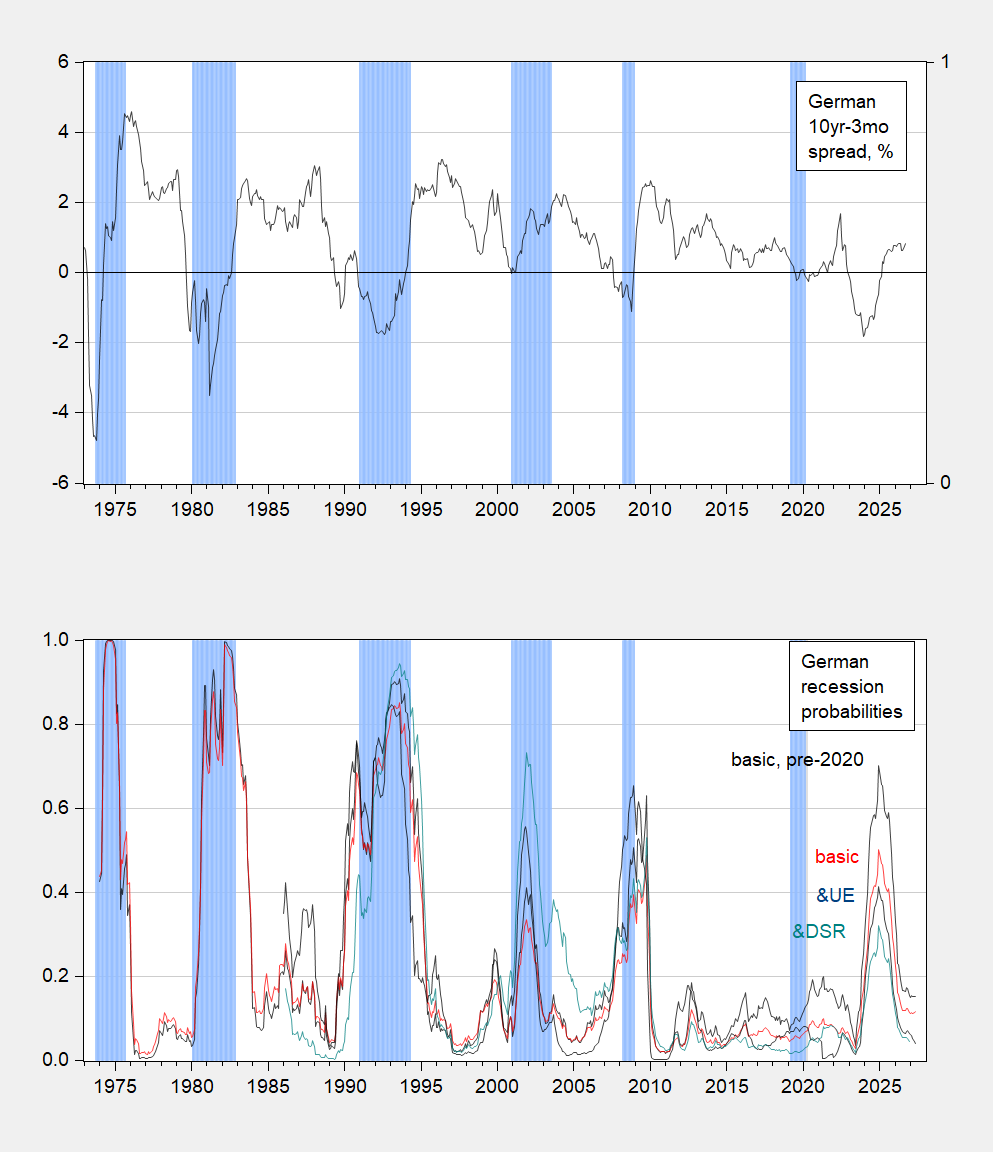
The 10-year/3-month German yield spread, historically a reliable leading indicator of German recessions as dated by ECRI, inverted in December 2022. The spread — the gap between ten-year and three-month German government borrowing costs — turns negative, or inverts, when short-term yields rise above long-term ones. Under a plain-vanilla spread regression, the inversion implied a recession probability of 70%.
Chinn and Ferrara (2026) presents probit-based estimates of German recession probabilities corresponding to the 10yr-3mo term spread, including a specification fitted through December 2019 (the black line in the bottom panel of Figure 1). Probit estimation converts a spread reading into an estimated probability that the economy is in recession at a given point in time.
Figure 1: Top panel: 10yr-3mo German term spread, in percent (black). Bottom panel: probit estimates from regressions on the spread and short rate — pre-pandemic sample (black line), full sample (red), adding the expected change in unemployment (blue), and adding the debt service ratio (green). ECRI-defined peak-to-trough recession dates are shaded light blue. Source: OECD, Chinn and Ferrara (2026).
In Chinn and Ferrara (2026), the authors find that the term spread and short rate specifications explain a relatively high share of variation, both in the pre-pandemic and full samples. As Figure 1 shows, every recession except the 2020 downturn is flagged using a 40% probability threshold, but the same threshold also produces a false positive for 2024. That miss matters beyond statistical bookkeeping, given Germany's position as the euro area's largest economy.
Adding the expected change in unemployment raises the explained share of variation slightly (0.29 versus 0.19 for the basic specification estimated over the same sample period). The recession calls, however, are essentially unchanged, with the false positive for 2024 still registered at the 40% threshold.
Adding the debt-service ratio — a variable that yields markedly different results for the US — raises the pseudo-R² further, to 0.33 versus 0.19. All coefficients enter with the expected signs and are statistically significant, including the debt-service ratio. Most importantly, this specification records no false positive for 2024 at a 40% threshold. The debt-service ratio — interest payments plus principal repayments relative to income — links the curve's signal to the actual debt burden borrowers carry.
Must one appeal to the debt-service ratio to restore the term spread's standing as a predictor? An alternative argument holds that Germany did experience a recession in 2023–24. As Kemp (2026) writes: "Germany's economy experienced a pronounced recession during 2023–24, with real GDP contracting and growth falling notably behind the rest of the euro area." However, neither ECRI — the Economic Cycle Research Institute — nor the German Council of Economic Experts, the German government's official advisory body on economic policy, has declared a post-pandemic recession.
The reason becomes clear in the principal indicators:
Figure 2: Top panel: German employment, ages 15 and over. Middle panel: German real GDP, in billions of 2010 euros, SAAR. Bottom panel: German industrial production excluding construction (three-month centered moving average). Light green shading marks peak-to-trough movements. Source: OECD via FRED, OECD.
The peak-to-trough periods across these measures show almost no coherence. Employment peaked in 2024Q4, real GDP peaked in 2022Q3, industrial production peaked in February 2023, and the recession probability peaked in December 2024. That divergence explains why no recession has been declared, under the definition of a broad, sustained decline in economic activity. The most charitable interpretation is that the term spread captured the downturn in employment, but not those in GDP or industrial production. For readers tracking how the episode is ultimately judged, the markers to watch are revisions to the GDP, employment, and industrial production series, along with any future recession-dating decisions that bear on the spread's December 2022 signal.

