Central Bank of The Gambia Orders Banks to Replace Foreign Staff with Gambian Nationals by December 31, 202
Key Takeaways
- •The Central Bank of The Gambia has instructed all banks to replace non-Gambian employees with qualified Gambian nationals, with full compliance required by December 31, 2026.
- •The directive was issued in a September 16, 2026 letter signed by Second Deputy Governor Dr Paul J. Mendy, following an August 27 meeting between the regulator and bank managing directors.
- •A central bank industry study found banks employ a relatively high number of non-Gambians beyond recognised expatriate roles, a practice the regulator says breaches the Labour Act 2023 and Guideline 9 on expatriate staff.
- •Subsidiaries of Nigerian banking groups in The Gambia, including Guaranty Trust Bank, First Bank, Access Bank and Zenith Bank, are among the institutions most affected by the order.
- •The central bank has not disclosed how many staff are affected, and banks are expected to submit compliance plans covering skills transfer and continuity of operations during the phased transition.
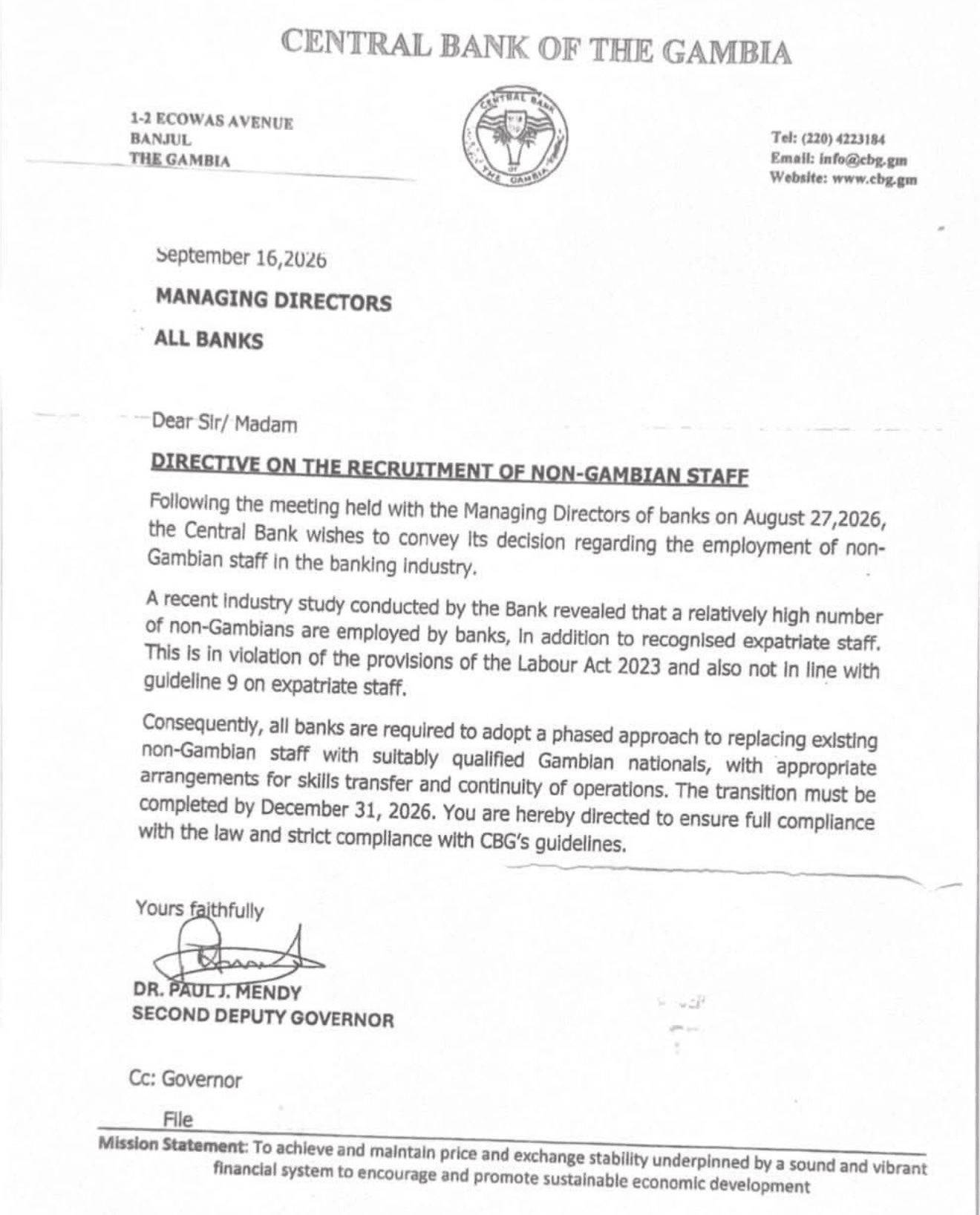
The Central Bank of The Gambia has directed all banks operating in the country to phase out non-Gambian employees and replace them with suitably qualified Gambian nationals, with full compliance required by December 31, 2026.
The order carries particular weight for Nigerian banking groups, which maintain a significant presence in The Gambia through major subsidiaries including Guaranty Trust Bank (Gambia) Limited, First Bank Gambia Limited, Access Bank (Gambia) Limited, and Zenith Bank Gambia Limited. Several of these institutions employ notable foreign directors and staff.
Details of the directive
The directive, dated September 16, 2026, was issued in a letter addressed to the Managing Directors of all banks and signed by Dr Paul J. Mendy, Second Deputy Governor of the Central Bank of The Gambia. It followed a meeting between the central bank and bank managing directors on August 27, 2026, at which the regulator raised concerns about staffing practices across the industry.
According to the letter, an industry study conducted by the central bank found that banks in the country employ a relatively high number of non-Gambians, in addition to recognised expatriate staff already accounted for under existing rules. The central bank said the practice violates provisions of the Labour Act 2023 and is inconsistent with Guideline 9 on expatriate staff. Read together, the statute and the guideline frame the directive as targeting staff employed beyond the expatriate roles already recognised under the rules, rather than recognised expatriate positions themselves.
Banks must therefore adopt a phased approach to replacing existing non-Gambian staff with qualified Gambian nationals, while putting in place appropriate arrangements for skills transfer and continuity of operations. The transition must be fully completed by the end of this year.
"You are hereby directed to ensure full compliance with the law and strict compliance with CBG's guidelines," the letter states.
What this means for banks operating in The Gambia
The directive affects banks with a presence in The Gambia, several of which are subsidiaries of larger Pan-African banking groups with operations spanning multiple West African countries. Those institutions will now need to identify which roles are held by non-Gambian staff, begin transferring relevant skills and responsibilities to local employees, and complete the transition within a little over three months of the letter's date — a window narrow enough that role mapping, skills transfer, and continuity planning will have to advance side by side. The episode also illustrates how staffing at subsidiaries of regional banking groups is governed by host-country labour rules alongside group-level structures.
The Central Bank of The Gambia has not disclosed how many staff across the industry are affected by the directive, nor has it named specific institutions in the publicly circulated letter. Banks are expected to communicate their compliance plans to the regulator as part of the phased transition process outlined in the directive, and those plans are where the practical scale of the transition — and each bank's approach to skills transfer before the December 31, 2026 deadline — will first become visible.

