Friedrich Kunath Turns Restless Movement and Melancholy into Paintings at Pace Seoul
Key Takeaways
- •Friedrich Kunath's first solo exhibition in Seoul, "The Nearest Faraway Place," runs through Oct. 24 at Pace Gallery in Itaewon.
- •The show is Kunath's second with Pace since he joined the gallery's program in 2025 and is part of a broader expansion of international galleries into Seoul, where Pace opened its space in 2023.
- •Kunath's works blend romantic landscape traditions with pop-cultural references and humor, exploring themes of longing, relocation and an unresolved search for home.
- •The artist moved roughly 78 times as a child and continues to split his time between a Berlin studio, a house in the Austrian mountains, and Los Angeles.
- •Kunath describes beauty, such as sunsets, as a "Trojan horse" that draws viewers in before revealing loneliness and existential unease.
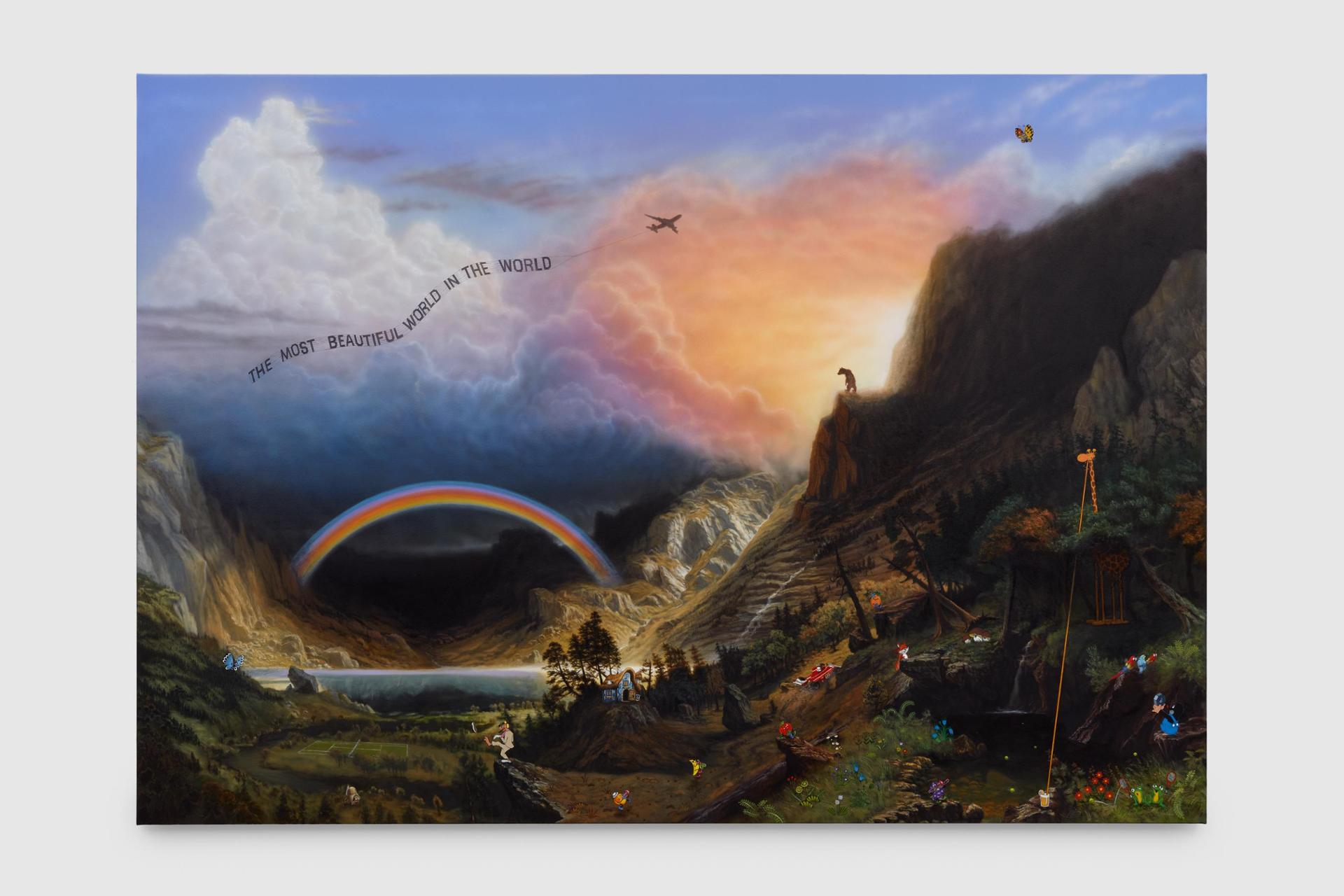
In his first solo exhibition with Pace Gallery in Seoul, German-born artist Friedrich Kunath transforms a life defined by movement — from East Germany to Los Angeles, and more recently between Berlin, Austria and other temporary homes — into a landscape of its own, filled with distant horizons, cinematic sunsets and an unresolved longing for home.
"The Nearest Faraway Place," on view through Oct. 24 at Pace Gallery in Itaewon, gathers new paintings and drawings that dwell on longing, melancholy and the search for home. It is Kunath's second exhibition with Pace since joining the gallery's program in 2025, and his first solo presentation in Seoul. The show is also part of a broader wave of international galleries expanding in the Korean capital — Pace opened its Seoul space in 2023, joining a growing cluster of global dealers betting on South Korea's collector base.
The title comes from an instrumental song by the Beach Boys, whose lush harmonies Kunath cited as a model for balancing beauty with darker emotional undercurrents. It also names the contradiction at the heart of his practice: feeling close while remaining irretrievably distant. That tension has long characterized Kunath's work: since the 1990s, and especially after his relocation to Los Angeles in the mid-2000s, his paintings have blended romantic landscape traditions with pop-cultural references and a bittersweet, often absurdist humor, a mix that has made him a recognized figure in contemporary painting's return to emotional sincerity after decades dominated by cooler conceptual approaches.
"I think it's an inner condition," Kunath said in an interview with The Korea Times on Saturday. "Right now, I feel I'm very far away from myself. But at the same time, when I'm walking through the gallery and seeing my work, I feel somewhat at peace and at home because they're there like old friends."
The exhibition's landscapes feature disappearing roads, horizons hidden behind mountains, glowing sunsets and solitary figures. According to Pace, the works explore distance and relocation, tracing the tension between where a person is and where they imagine they are meant to be.
That restlessness is not merely an artistic motif. Kunath said he moved constantly as a child and stopped counting after roughly 78 moves. The habit became so ingrained, he said, that he sometimes feels compelled to move on after staying in one place for only a few years.
"Every half year, we were moving somewhere," he said. "You grow up with this restlessness, and it becomes almost like a normal thing."
Today Kunath maintains a studio in Berlin, spends time at a house in the Austrian mountains, and works in both Europe and Los Angeles while traveling regularly. Berlin offers friends and social life, he said, while Austria provides solitude, nature and the chance to cook and walk alone.
The question of home, however, remains unresolved. "It really comes down to music, film, literature and friends," he said. "Wherever I am, I try to cook for people, and then we can discuss life. We have music, we can talk about movies, relationships. In those moments, I truly feel at home."
This unsettled interior life runs throughout the exhibition. On the first floor, framed watercolor drawings convey what the gallery describes as a "fleeting urgency." Upstairs, oil paintings expand those tensions into cinematic landscapes.
Music may be the clearest route into Kunath's artistic world. "Music is kind of like the air that I breathe," he said. He listens to music "all the time" and considers a melody a kind of soundtrack that changes the texture of ordinary life.
"Music has this limitless, super-democratic invitation that everybody can take part in," he said. "The beauty of the three-minute song is that it can speak to everyone universally."
The sunlit landscapes, sentimental skies and seemingly familiar beauty of his art are intended to draw viewers in before confronting them with loneliness, fragility or existential unease.
"My 'Trojan horse' is the sunset, the beautiful landscape," he said. "I want to pull you in, and then we can discuss something really sad and existential."
For Kunath, beauty is not a decorative escape from darkness but its necessary doorway. He compared the approach to the Beach Boys' harmonies, which conceal grief and trauma beneath a bright surface.
"Let's find each other through beauty," he said. "Even if it's a false promise, I still feel like it's my way of dealing."
The exhibition runs from Tuesday to Oct. 24 at Pace Gallery in Seoul.
