France’s 192% Stablecoin Surge Has a Tax Dimension
Key Takeaways
- •Stablecoins made up 54.2% of withdrawals from French centralized exchanges in 2026, placing France first among Western Europe's large markets on this measure, up from tenth place in 2023.
- •The number of French personal wallets holding stablecoins rose 3.4-fold from 3,577 in June 2025 to 12,255 in June 2026, while self-custodied stablecoin balances grew 192% compared with 2% growth in French bank deposits.
- •French tax law treats exchanging one digital asset for another as a tax deferral, so swapping bitcoin for a stablecoin avoids the roughly 30% tax that a sale for euros would immediately trigger.
- •The National Assembly adopted amendments to tax stablecoin swaps from January 2027 and to require declaration of self-custodied wallets worth at least €100,000, but both measures fell when the Assembly rejected the 2027 budget's revenue section on November 4 by 458 votes to none.
- •Monthly wallet growth accelerated to about 18% after the autumn 2025 bond-market stress and slowed to 5% by June 2026, and France's 10-year borrowing cost later crossed 5% in late October, a level last seen in 2002.
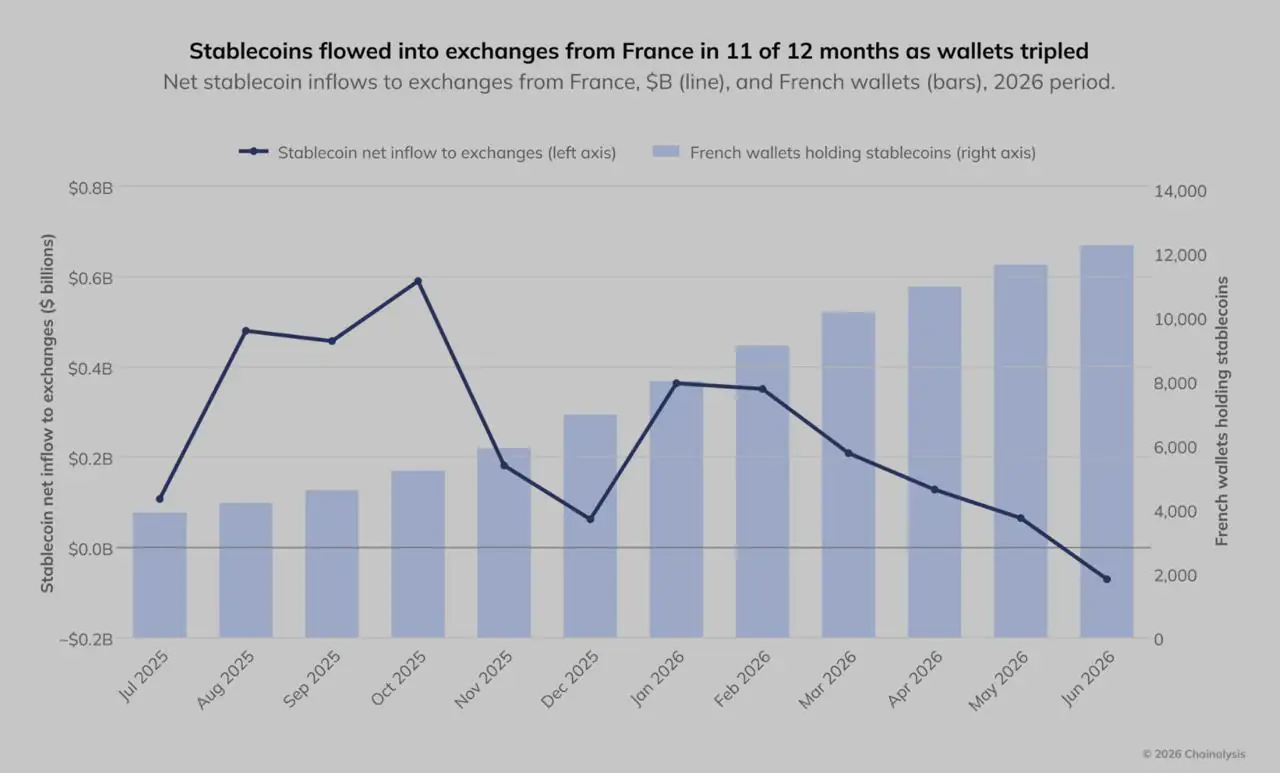
The figures in Chainalysis’s Western Europe report, published on November 9 and covering July 2025 through June 2026, show a sharp rise in French stablecoin activity. Stablecoins accounted for 54.2% of withdrawals from French centralised exchanges, the number of French personal wallets holding stablecoins increased from 3,577 to 12,255, and self-custodied stablecoin balances grew 192%. French bank deposits, by comparison, rose 2% over the same period.
Chainalysis interprets the data as evidence that users were “diversifying how they hold and access their funds” and rules out a broader loss of confidence in the euro. The data, however, also coincided with a feature of French tax law that allows investors to move from bitcoin into a stablecoin without immediately triggering a tax bill. That rule, and an unsuccessful parliamentary attempt to change it, give France’s stablecoin figures a distinct tax dimension.
Three measures point in the same direction
Chainalysis tracks French activity through three measures, all of which increased during the reporting period.
First, stablecoins made up 54.2% of withdrawals from French centralised services in 2026. That placed France first among Western Europe’s large markets on this measure, up from tenth place in 2023. The value transferred from exchanges to French wallets increased 12%, compared with 7% for the rest of the region.
Second, the number of French personal wallets holding stablecoins rose from 3,577 in June 2025 to 12,255 in June 2026. Chainalysis describes that as a 3.4-fold increase, compared with a 1.7-fold rise across the rest of Western Europe. The count increased every month, although the pace varied. Monthly growth was about 6% in mid-2025, accelerated to 18% by the end of 2025 after that autumn’s bond-market stress, and slowed to 5% by June 2026 as markets settled.
Third, self-custodied stablecoin balances increased 192% over the 12 months. Chainalysis compared that growth with the 2% increase in French bank deposits, while noting that the absolute stablecoin balance remained small relative to traditional savings.
The Chainalysis reporting window ended in June. France’s 10-year borrowing cost later crossed 5% in late October, a level last seen in 2002, according to CNBC. The available data cannot show whether that episode caused another increase in French stablecoin wallets comparable to the one that followed the autumn 2025 bond-market stress.
The tax rule behind the stablecoin route
Under French law, crypto gains are taxed when a digital asset is sold for legal tender or used to purchase a good or service. Exchanging one digital asset for another is treated as a deferral. No tax is due at the time of the exchange, and the transaction does not need to be declared, according to the tax administration’s BOFiP guidance. The gain is taxed later, when euros are ultimately received, at 12.8% income tax plus social levies, or around 30% in total.
A stablecoin qualifies as a digital asset. For a French holder with an unrealised bitcoin gain, that creates two routes with different tax consequences: selling bitcoin for euros and paying roughly one-third of the profit in the current year, or exchanging bitcoin for USDC or EURC and deferring the tax until a later sale. The value remains within the crypto market in both cases, but only the first route immediately triggers taxation.
- Bitcoin → euros: Taxable sale, declared on the annual tax return.
- Bitcoin → stablecoin: Tax deferred, with no tax or declaration required under current law.
- Bitcoin → stablecoin from 2027, if the Assembly’s October text returns: Taxable sale.
That rule applied during the period measured by Chainalysis, when the global crypto market lost half its value. French holders seeking to leave bitcoin could move into stablecoins without an immediate tax charge, provided they stayed within the crypto system. Moving the resulting balance to a personal wallet added no tax event and removed the exchange from the custody arrangement.
This sequence is consistent with the 54.2% withdrawal share, the increase in wallet numbers and the 192% growth in self-custodied balances without requiring a broader loss of confidence in the euro as the sole explanation. That does not eliminate the role of market conditions. The growth rate accelerated after the autumn 2025 bond-market scare and slowed as conditions settled. The tax rule helps explain why the exit took the form of stablecoins rather than cash, while the bond market may help explain when users acted.
Parliament sought to close the deferral
French lawmakers targeted the same route. On October 16, the National Assembly adopted amendment I-3898 to the 2027 finance bill by 38 votes to 37. The measure would have treated any exchange from a crypto asset into an electronic money token—a MiCA term for a single-currency stablecoin—as a taxable disposal from January 1, 2027. The committee version described the existing deferral as “a hole in the legislation.” The amendment is available through the National Assembly.
On November 3, the Assembly adopted a separate amendment from Charles de Courson by 150 votes to 44. It would have required taxpayers to declare self-custodied crypto wallets worth at least €100,000 at year-end, with a fine of up to €10,000 for failing to do so.
Together, the measures addressed the behaviour reflected in the Chainalysis data: converting assets into stablecoins and then holding them outside an exchange or other platform. Neither measure survived the week. On November 4, the Assembly rejected the entire revenue section of the 2027 budget by 458 votes to none, with two abstentions. Every amendment adopted in the chamber fell with it. The government’s original text, without the crypto provisions, then moved to the Senate.
Senators begin their examination on November 20 and are scheduled to vote on December 9. They can introduce their own versions of the stablecoin-tax and wallet-declaration measures, but whether they do so remains unresolved.
The legislative timing is important when interpreting the data. The 192% increase occurred under the existing tax rule, before parliament had voted to change it. If a stablecoin swap tax returns in some form, the incentive structure behind the following year’s figures would be different.
The absolute size remains unknown
Chainalysis does not publish the absolute value of French self-custodied stablecoin balances, so the 192% increase cannot be converted directly into euros. The available comparison is the broader household savings pool. Banque de France data for August 2026 put household bank deposits at €1,889 billion. Of that total, €405 billion was held in Livret A accounts, which have paid 1.70% since August, while €555 billion was held in current accounts earning an average of 0.04%.
Current accounts are the more relevant comparison for a stablecoin that pays no interest. French households already hold more than half a trillion euros in a non-interest-bearing form, so holding a stablecoin that pays nothing is not necessarily an unfamiliar choice. That does not establish that it is a better option.
What self-custody changes—and what it does not
Moving funds away from an exchange removes one dependency: the holder no longer needs the platform to process a withdrawal. A warning from the European supervisory authorities describes the corresponding risk: if the holder loses the private keys, there may be no one to contact.
Self-custody does not remove the issuer from the arrangement. Circle’s USDC terms reserve the right to block transfers involving addresses designated by Circle, regardless of who controls the private key. Converting USDC back into euros through Circle’s EEA redemption policy requires identity checks and a receiving bank account. The policy states that the process can take up to five business days. Alternatively, the holder can use an exchange at the price available there.
The European Securities and Markets Authority’s MiCA factsheet notes that electronic money tokens cannot pay interest to holders. A dollar-denominated token also carries exchange-rate risk against the euro that a Livret A account does not. Euro-denominated stablecoins exist, and their supply is growing, but Chainalysis provides no currency breakdown for France. The share of French holdings denominated in dollars is therefore unknown.
Limits to the tax explanation
The available data cannot separate tax motives from market or currency concerns. A holder who exchanged into USDC in October 2025 may have wanted to defer a tax payment, reduce exposure to the euro, or simply stop holding an asset whose price was falling. Chainalysis records the transaction, not the reason for it.
The wallet count also does not equal the number of people involved. One person can control multiple wallets, and Chainalysis assigns wallets to countries based on behaviour, such as interaction with a domestic exchange, rather than on verified identity. The 12,255-wallet figure is therefore a measure of observed activity, not a confirmed headcount.
The tax deferral has also existed since 2019. If taxation alone drove stablecoin accumulation, the increase might have occurred earlier. The change in 2025 was likely the combination of a gain worth protecting, a rapidly falling market that made protection more urgent, and a domestic political environment in which an exchange could appear to be another institution from which to withdraw.
Dates that may clarify the picture
Three developments could provide additional evidence. The Senate’s revenue debate opens on November 23 and ends with the scheduled December 9 vote. If a stablecoin swap tax or wallet-declaration threshold reappears, the incentive affecting 2026 activity would change from January.
Chainalysis’s next reporting window, covering July through December 2026, will include the October bond-market spike. It may indicate whether French wallet growth responded to that event in a manner similar to the response seen in autumn 2025. Banque de France’s quarterly household savings data will also show whether the 2% deposit growth cited by Chainalysis continued through the second half of the year.
Until those data are available, the 192% increase shows that a growing number of French users moved stablecoin balances into self-custody during a falling market while the existing tax framework allowed crypto-to-crypto transfers to defer taxation. The data support a tax-efficient exit from bitcoin, but they do not establish that tax considerations were the only reason for the move.

