Bitcoin Struggles Below $75,000 as ETF Outflows Jump and Fear and Greed Index Hits 28
Key Takeaways
- •Bitcoin traded near $74,718 on Nov. 10, down nearly 15% from its October high, as bearish technical indicators weighed on the market.
- •U.S. spot Bitcoin ETFs have recorded about $1.48 billion in net withdrawals this November, more than double the $515 million lost in October, including over $201 million on Monday and $411 million on Friday.
- •The Crypto Fear and Greed Index dropped to 28 in the fear zone from a reading of 82, marking its lowest level since July.
- •Democrats' landslide in the US midterm elections raised expectations of greater crypto scrutiny and additional regulation, making passage of the CLARITY Act unlikely.
- •A stronger-than-expected US jobs report of 165,000 pushed December Fed rate-hike odds above 80% on Polymarket and Kalshi, making Tuesday's CPI release the next major catalyst for Bitcoin.
Bitcoin's near-term outlook remained bearish on Nov. 10 as the cryptocurrency struggled below $75,000, pressured by weak technical indicators and continued withdrawals from U.S. spot exchange-traded funds (ETFs). The asset has now dropped by nearly 15% from its highest point in October.
Bitcoin traded near $74,718 during an early market snapshot on Nov. 10. U.S. spot Bitcoin ETFs had recorded approximately $1.48 billion in net withdrawals so far in November, although the latest ETF figures remained preliminary. Analysts were also monitoring $72,600 as a potential downside reference.
Crypto Fear and Greed Index Falls Into Fear Zone
Bitcoin has slumped as investors turned highly fearful. Data shows that the Crypto Fear and Greed Index dropped to the fear zone at 28, down from a reading of 82 in the greed zone. The gauge, which runs on a scale from 0 for extreme fear to 100 for extreme greed, now sits at its lowest level since July of this year.
The Crypto Fear and Greed Index is a popular measure of sentiment across the industry. It draws on the price momentum of Bitcoin and other altcoins, market volatility, derivatives market activity, market composition, and other data. In most cases, Bitcoin tends to perform well when the index is rising and to fall when the index is trending downward.
Fear has escalated over the past few days in the aftermath of the US midterm elections, in which Democrats won by a landslide, capturing the House of Representatives, the Senate, and governorships in many states. The result implies that the cryptocurrency industry could face greater scrutiny after the early part of President Donald Trump's term. Congress is likely to introduce more crypto regulations, while the CLARITY Act is unlikely to pass.
Spot Bitcoin ETF Outflows Have Jumped
Meanwhile, American investors have continued to sell their ETF holdings. These products, which have traded in the U.S. since January 2024 and hold Bitcoin directly, are widely followed as an indicator of institutional demand. Data shows that spot Bitcoin ETFs shed over $201 million on Monday, after losing $411 million on Friday, according to SoSoValue. In total, these funds have lost more than $1.4 billion this month, more than double the $515 million they lost in October. Before that, the funds added over $2.65 billion in September and $3.52 billion in August.
ETF outflows have risen amid ongoing market fear. In addition to the midterm elections, concerns surrounding the Federal Reserve have also weighed on investors.
A report released last week showed that the US created 165,000 jobs last month, far above the 65,000 expected and significantly higher than the 60,000 added in the previous month. The strong labor market data raised the probability that the Federal Reserve will hike interest rates at its December meeting. The central bank has already raised rates by 0.25% this year, and economists expect another increase in December. Odds of a rate hike have jumped to over 80% on prediction platforms Polymarket and Kalshi.
The next important catalyst for Bitcoin will be the upcoming US Consumer Price Index (CPI) report on Tuesday. Economists expect the data to show that consumer inflation dropped in October as gasoline and diesel prices fell. A weaker inflation report would lower the possibility of the Fed hiking rates.
Bitcoin Price Prediction: Technical Analysis
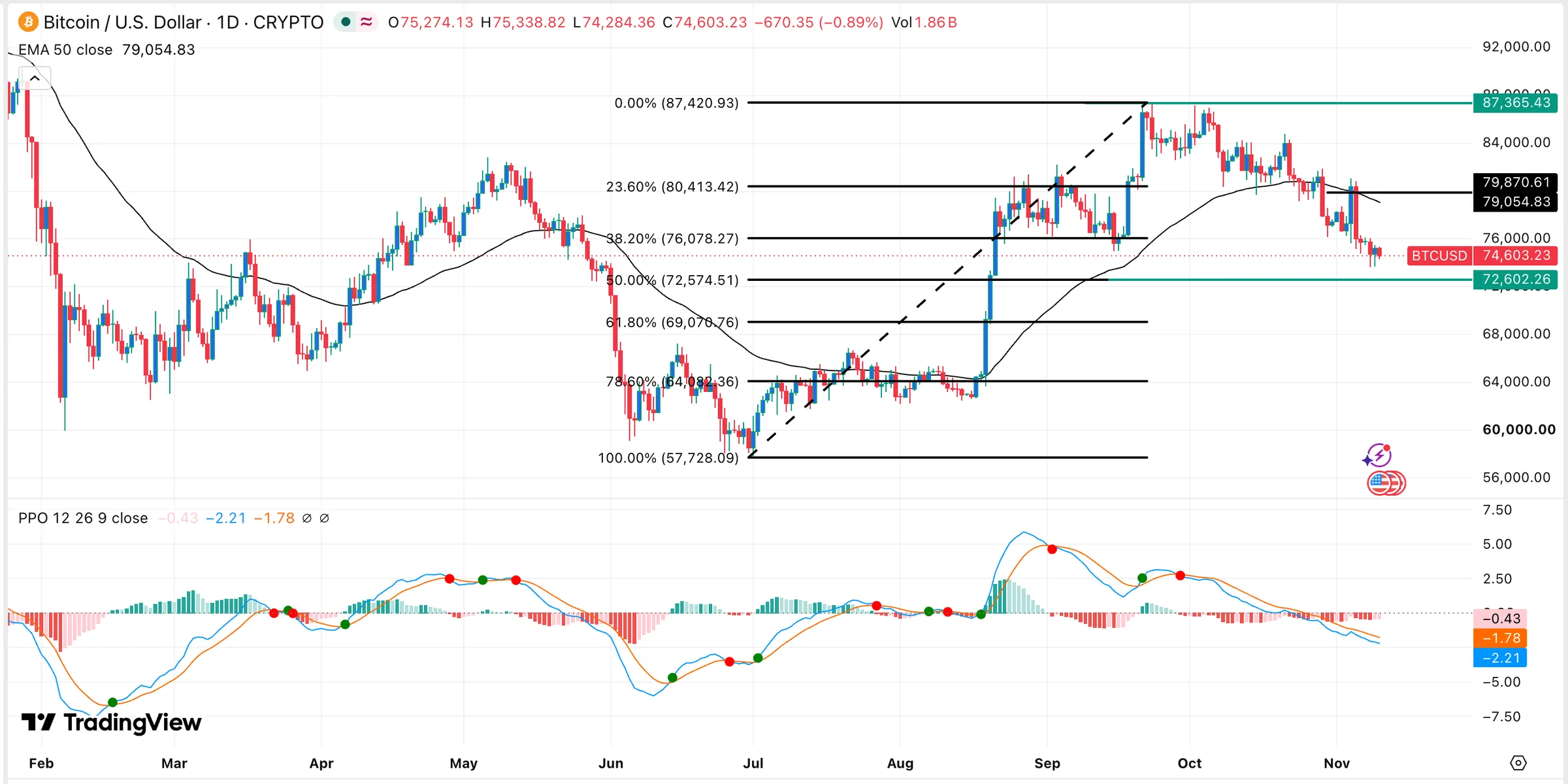
The daily chart shows that Bitcoin's price has declined over the past few weeks, falling from a high of $87,365 in September to the current $74,592. The coin has slumped below the 38.2% Fibonacci Retracement level.
Bitcoin has also fallen below the 50-day Exponential Moving Average (EMA), while the Percentage Price Oscillator (PPO) has moved below the zero line. As a result, there is a risk that Bitcoin continues to fall, potentially reaching the $72,600 support level, which coincides with the 50% retracement. A move above the $76,000 resistance level would invalidate the bearish outlook.
This article provides financial information, not investment advice. Bitcoin prices can fluctuate sharply, and technical forecasts remain uncertain. Readers should conduct independent research and consult qualified financial professionals before making investment decisions.
This article was originally published on The Market Periodical.

