Polymarket, Kalshi, and Myriad Converge on 74%-75% Odds of Fed Holding Rates Steady in September
Key Takeaways
- •Polymarket, Kalshi and Myriad are each assigning about a 74%-75% probability that the Fed will hold rates steady in September.
- •The aligned pricing across three independent prediction markets suggests broad trader agreement rather than a single market outlier.
- •A 74%-75% probability still leaves roughly a one-in-four chance of a different Fed decision.
- •Incoming inflation data, labor figures and Fed communication could move the odds before the September meeting.
- •Traders on these venues have also placed bets on other policy-related outcomes, including the Clarity Act not becoming law in 2026.
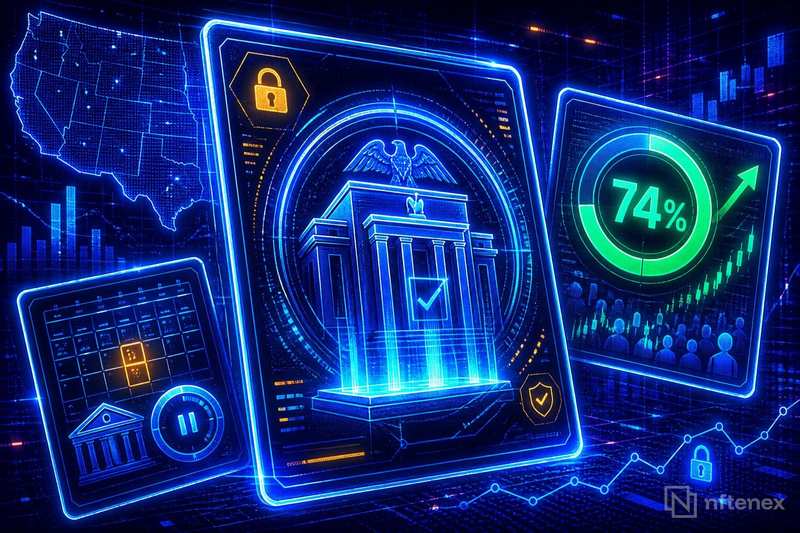
Three of the most closely watched prediction markets — Polymarket, Kalshi, and Myriad — have converged on odds of roughly 74%-75% that the Federal Reserve will hold interest rates steady in September, a rare cross-platform alignment indicating that traders broadly expect no change at the next Fed meeting.
What Polymarket, Kalshi, and Myriad Are Pricing
The core signal is agreement. Rather than one venue posting an outlier reading, all three markets sit inside the same 74%-75% band on the question of whether the Fed leaves rates unchanged, with Kalshi's September Fed decision contract among the actively traded venues. When independent order books land on the same number, the reading is harder to dismiss as an artifact of thin liquidity or a single large position. Myriad's market on the September rate question reflects the same lean toward no change.
The figure is a market-implied probability, not a certainty. A 74%-75% reading still leaves roughly a one-in-four chance of a different outcome, so the markets are describing a favored scenario rather than pricing a sure result — and one that can reprice as new data arrives. The convergence across three independent platforms strengthens the signal beyond what any single market reading could provide on its own, which is part of why these contracts are watched as a real-time gauge of shifting expectations ahead of the Fed's next meeting.
Traders active on these venues have also positioned on adjacent policy questions, including betting against the Clarity Act becoming law in 2026.
Why Traders Are Leaning Toward a September Hold
The positioning points to an expectation of no change rather than a cut or a hike. A hold thesis typically reflects a view that policymakers want more confirmation before adjusting policy, and analysts at Goldman Sachs have argued the Fed is unlikely to hike in September.
The Hold Case Versus Its Main Risk
The main risk to the hold scenario is a surprise in incoming data that forces the Fed's hand toward either a cut or a hike. Because the odds reflect current trader positioning, they can move quickly if that risk materializes.
The timing itself is fixed: the Fed's meeting schedule is published on the central bank's FOMC calendar, giving traders a hard date to price against. Growing interest in these contracts has coincided with wider industry moves into the prediction market sector, from Binance US pursuing a CFTC license to Fanatics acquiring a regulated prediction market exchange.
What Could Shift the Odds Before the September Decision
Prediction markets are dynamic and reprice as new information arrives. Incoming inflation figures, labor data, and Fed communication can all move rate expectations in the run-up to the meeting.
The cluster itself is the thing to watch. A move away from the 74%-75% band, in either direction, would signal that trader conviction is changing, and a divergence between the three platforms would become part of the story rather than a footnote to it.
For now, the consensus is a snapshot. The three venues agree today, but the reading is a live probability that will keep updating until the Fed actually decides.
Disclaimer: This article is for informational purposes only and does not constitute financial or investment advice. Cryptocurrency and digital asset markets carry significant risk. Always do your own research before making decisions.

