Federal Reserve Holds Rates Steady Amid Internal Dissent Under Warsh
Key Takeaways
- •The FOMC voted 9-3 to hold the federal funds rate at 3.5 to 3.75 percent, with three regional Fed presidents dissenting in favor of a quarter-point rate hike.
- •Chair Warsh has pared FOMC statements to roughly 130 words, a dramatic reduction from the 300-plus word statements issued under Jerome Powell, signaling a deliberate move away from forward guidance.
- •Long-dated Treasury yields rose sharply after the decision, with the 10-year note climbing 5 basis points to 4.657 percent and the 30-year bond surging 9 basis points to 5.193 percent, reflecting investor skepticism about the Fed's inflation commitment.
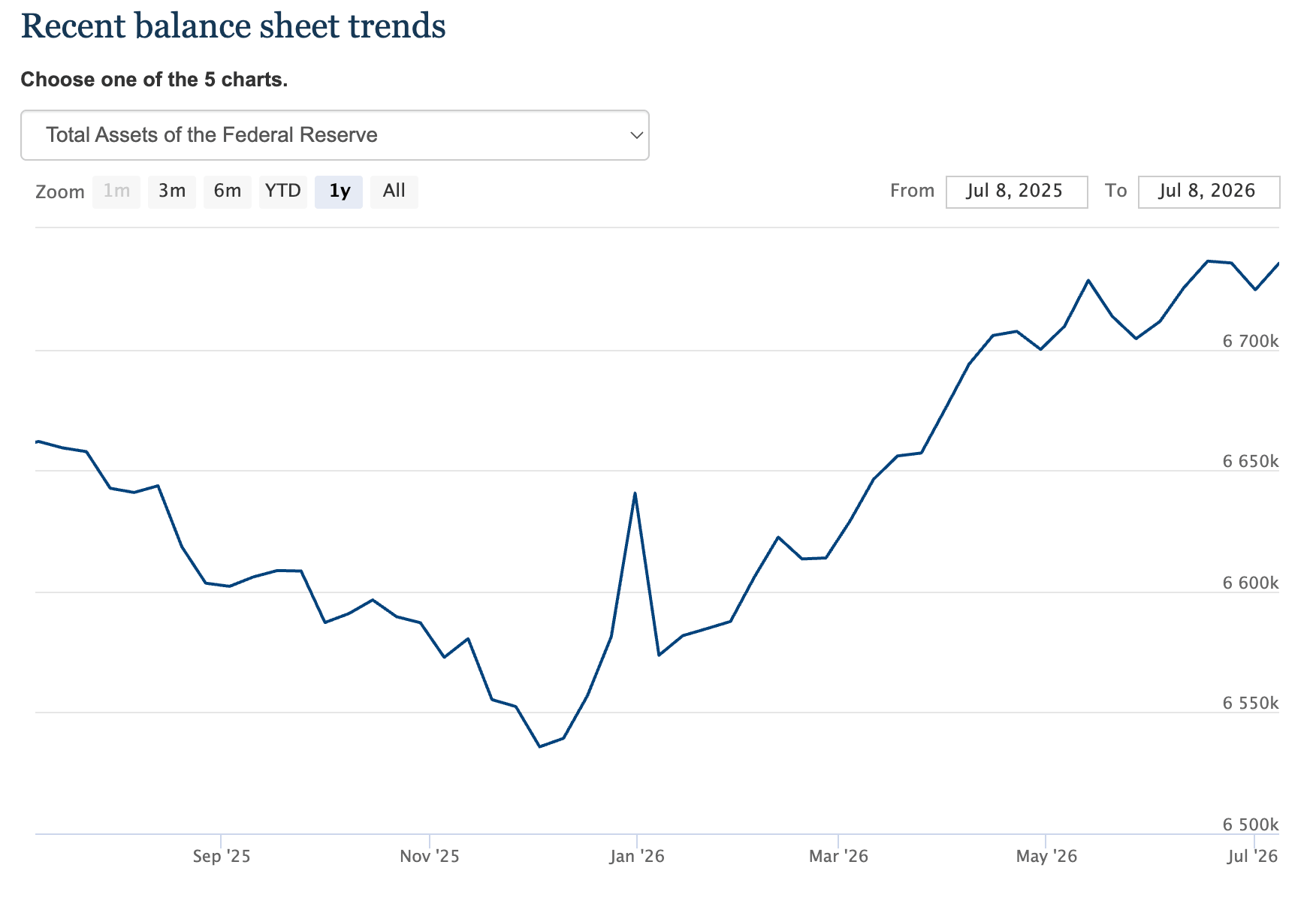
- •The Federal Reserve's balance sheet has grown from $6.54 trillion to $6.75 trillion since December 2025 through weekly Treasury bill purchases that effectively mirror quantitative easing despite being described as technical reserve management.
- •Warsh rejected labeling the rate hold a pause, instead characterizing it as a reassessment period and cautioning that inflation above target cannot be resolved quickly.
Federal Reserve Holds Rates Steady Amid Internal Dissent Under Warsh
The Federal Reserve, under the leadership of Chair Kevin Warsh, voted to hold the federal funds rate steady at between 3.5 and 3.75 percent following its July FOMC meeting. The decision, however, was far from unanimous, with three committee members breaking from the nine-person majority to advocate for a quarter-point rate increase. Three dissenting votes at a single FOMC meeting is relatively uncommon — in recent years, the committee has typically voted unanimously or with at most one or two dissents, making the breadth of disagreement under Warsh's leadership noteworthy.
Warsh characterized the internal debate as "a good family fight" — a description that captured the tension within the committee without producing a shift in policy. Cleveland Fed President Beth Hammack, Minneapolis Fed President Neel Kashkari, and Dallas Fed head Lorie Logan all voted in favor of raising rates.
The outcome underscores a central tension: the Federal Reserve continues to emphasize its commitment to combating inflation in rhetoric while holding its primary policy tool unchanged.
A Deliberate Shift Away from Forward Guidance
Warsh has signaled a sharp departure from the approach taken by his predecessor, Jerome Powell, by significantly reducing the level of "forward guidance" the central bank provides. Under Powell, FOMC statements routinely exceeded 300 words. The first statement issued under Warsh's leadership was pared down to just 130 words, a format that remained essentially unchanged in July.
"It's a bit shorter, a bit simpler and it dispenses with some older language," Warsh said of the first statement of his tenure. "That statement just gives you the facts, as best we can judge it."
The July FOMC statement was identical to June's except for the addition of vote details. Warsh defended the abbreviated format: "As before, the policy statement conveys just the facts. It's steering clear of forecasting, a choice we consider especially prudent at these uncertain times. Uncertainty, however, does not mean a lack of clarity."
At his inaugural press conference, Warsh said forward guidance was "not well suited for the current policy conjuncture." That approach reverses a practice honed over the post-2008 era, when the Fed increasingly used forward guidance as a primary tool to shape market expectations and manage the pace of economic recovery.
This deliberate opacity has created genuine market uncertainty. In the lead-up to the July decision, some analysts had forecast a rate hike — a reflection of how little the new Fed leadership has been willing to telegraph its intentions.
"I asked for a good family fight, and I got one," Warsh said during his post-meeting press conference. "Most of our discussion was on the big questions that matter to the conduct of monetary policy. We didn't sort of hide from them. We weren't scared of them. There was a lot more interaction between and among my colleagues. It was a real family fight."
The reduced transparency has drawn criticism from some corners. Capital Economics analysts described Warsh's responses as "vague," arguing they "make forecasting the Fed's next move even trickier than it already was."
Warsh remained undeterred. "I understand the desire for rolling forecasts and commentary from this committee, but for our part, we need to observe market reaction to developments direct and unfiltered," he said. "I want to stress, of course, that decisions by this committee matter a great deal, and where necessary and appropriate, we will not hesitate to act."
Inflation Rhetoric Without Policy Action
Despite holding rates steady, Warsh reiterated the Federal Reserve's commitment to its 2 percent inflation target — the benchmark the Fed formally adopted as its long-run goal in January 2012.
"You've heard this before, but we will deliver price stability," he stated.
He cautioned against expectations of a swift resolution. "We have no magic wand. This isn't something we're going to be able to carry out in days or weeks."
Warsh pushed back against characterizing the decision as a "pause," instead framing it as a period of reassessment.
"I would characterize what we did as a review of the big hard questions, and I'd characterize it as a view of what our own homework is to try to resolve those questions in the period ahead," he said.
He described the current moment as the "beginning of the story" rather than its conclusion. "We have begun a new chapter, and we understand that the five-plus years of inflation above target cannot be cured in nine weeks, or by a single month of modest price decreases," Warsh said. "This Fed will not waver. Our credibility rests on performing our duties and delivering on our responsibilities."
Bond Markets Signal Skepticism
Financial markets responded to the inaction with a sharp sell-off in long-dated Treasuries. The yield on the 10-year Treasury note rose 5 basis points to 4.657 percent, while the 30-year Treasury bond yield surged 9 basis points to 5.193 percent.
The move suggests investors have limited confidence in the central bank's willingness or ability to anchor inflation at its 2 percent target over the long run. As CNBC reported, market participants expressed the view that "we think you're going to keep short-term policy rates in check, and it's going to create a ton of inflation later."
Some analysts contend the United States is in the early stages of a secular bond bear market, with long-end yields likely to remain elevated regardless of the Fed's policy decisions.
Warsh has repeatedly stated in recent weeks that "inflation is a choice." FWDBOND chief economist Chris Rupkey argued that the Fed's July decision indicates which choice is being made.
"If inflation is a choice, the Federal Reserve meeting today shows no sign of taking steps to bring it under control with its primary monetary tool, which is interest rates," Rupkey said.
The disconnect between Warsh's inflation-fighting rhetoric and the reality of holding rates steady reflects the constraints imposed by what analysts have described as a "Debt Black Hole" — the mounting burden of global debt that makes aggressive rate increases economically perilous. The Fed faces a structural dilemma: raising rates aggressively enough to suppress inflation risks destabilizing the debt-laden economy, while keeping rates accommodative risks entrenching elevated price levels.
The Balance Sheet Continues to Expand
Even as Warsh talks tough on inflation, the Federal Reserve's balance sheet has resumed its upward trajectory — a development consistent with quantitative easing.
When the Fed began raising rates in 2023, it simultaneously launched quantitative tightening, gradually reducing the size of its balance sheet. The balance sheet bottomed at $6.54 trillion on December 1, 2025. At its October 2025 meeting, the FOMC announced that balance sheet reduction would conclude effective December 1.
At the December meeting, the committee announced it would purchase $40 million in Treasury Bills — short-term government securities maturing in one year or less — on Fridays. The FOMC indicated that purchases would "remain elevated for a few months" before being "significantly reduced."
Since then, the balance sheet has grown to $6.75 trillion. For context, the Fed's balance sheet peaked at approximately $9 trillion in 2022 following the pandemic-era asset purchase programs, meaning the current round of expansion begins from a balance sheet already reduced by roughly $2.5 trillion through QT.
No Federal Reserve official or mainstream commentator has used the term "quantitative easing" to describe these operations. If pressed, officials have characterized the activity as "reserve management" or "technical operations" designed to maintain the smooth functioning of the financial system's plumbing.
The practical effect, however, mirrors QE: the Fed is purchasing Treasury bills with newly created money, expanding the money supply and exerting downward pressure on short-term Treasury yields. The balance sheet is growing, liquidity is increasing, and risk asset valuations are receiving additional support — outcomes functionally identical to those produced by quantitative easing.
The expansion of the money supply is, by definition, inflationary — a fact that sits uneasily alongside Warsh's stated commitment to restoring price stability. Based on the central bank's actions rather than its words, the Federal Reserve under Warsh appears to be prioritizing the preservation of financial stability and debt sustainability over an aggressive assault on inflation.
Source: GoldSeek | Federal Reserve Press Release

