Fed Beige Book Puts AI Data Centers at the Heart of U.S. Economic Growth
Key Takeaways
- •The Fed's September 2 Beige Book repeatedly cited data centers and AI investment as important supports for U.S. demand while other economic segments slowed.
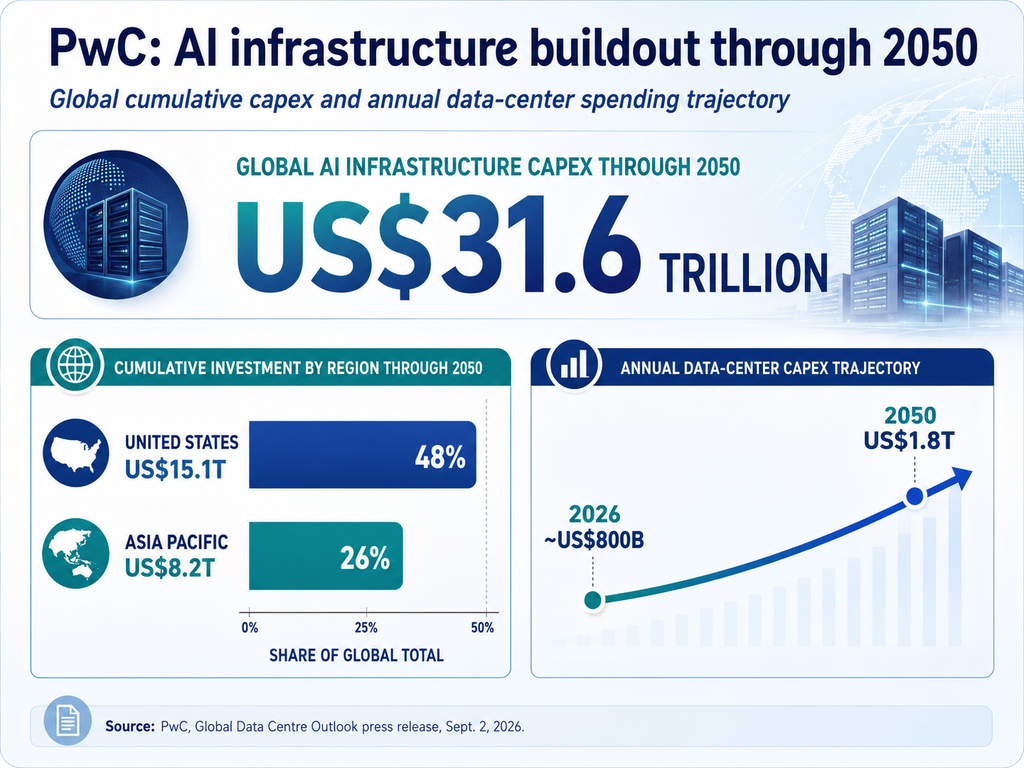
- •PwC projects global AI infrastructure capital expenditures of $31.6 trillion by 2050, with about $15.1 trillion expected in the United States and $8.2 trillion in Asia-Pacific.
- •One Chicago Fed contact said the construction sector would be in recession without data-center spending, underscoring the industry's dependence on the AI buildout.
- •PwC identifies the shortage of affordable, reliable, low-carbon electricity as the biggest constraint on AI infrastructure capital deployment.
- •Markets are pricing roughly a 65% probability of a Fed rate hike at the September 15-16 meeting, which could raise financing costs for the AI investment wave.
Investment in artificial intelligence has become an anchor for the world's largest economy, a trend now formally acknowledged by the Federal Reserve in its own assessment of regional economic activity.
According to the Beige Book published on September 2, the Fed reported that U.S. economic activity showed only a slight uptick through the end of August, while repeatedly emphasizing the importance of data centers and AI to overall demand as other segments of the economy slow. The Beige Book, compiled eight times a year from anecdotal reports gathered by the twelve regional Fed banks, feeds directly into Federal Open Market Committee deliberations, which gives its framing of AI investment particular weight for policymakers.
The significance extends well beyond Washington. Hyperscalers financing the data-center buildout, such as Amazon and Microsoft, are setting the global pace on AI capacity. If data-center construction spending is helping lift U.S. manufacturing and construction, investors have one more reason to view the AI surge as a broader economic phenomenon rather than a purely tech-sector trend.
What the Beige Book actually flagged
The report, which Reuters said includes qualitative readings from all twelve Federal Reserve regional banks, found only a minor increase in employment and a moderate rise in prices, based on information available through August 24. Businesses expressed caution, citing higher energy costs, policy uncertainty, and international conflicts.
Against that backdrop, AI-related activity stood out. The Fed noted both positive and negative effects of AI on labor demand, while manufacturing benefited from orders tied to data centers and defense. Non-residential construction was also increasingly concentrated on data-center-related projects.
One contact quoted in the Chicago Fed's district report captured the divide:
"Without data centers, construction would be in a recession."
The observation underscores how reliant parts of the construction industry have become on data-center expenditure — and how high the stakes would be if hyperscaler investment began to fall off.
The numbers behind the global buildout
The scale of the investment became clearer later the same week. According to PwC's Global Data Centre Outlook issued on September 2, global AI infrastructure capital expenditures will total $31.6 trillion by 2050, with annual data-center capex rising from roughly $800 billion in 2026 to $1.8 trillion in 2050.
Nearly half of that total — about $15.1 trillion — is projected to be invested in the United States, while the Asia-Pacific region is expected to capture $8.2 trillion, led by China and India. PwC highlights the lack of affordable, reliable, low-carbon electricity as the biggest constraint on where that capital can flow. That constraint has already turned power planning into a central issue for state regulators and grid operators across the U.S., with new data-center campuses competing for the same interconnection queues and generation capacity as other large industrial customers.
Wall Street is watching the same pressures. A Goldman Sachs Research report published on August 19 noted that rising hyperscaler spending, improved server and model performance, and local opposition to data-center development in the U.S. all raise questions about the durability of the current cycle.
Why the timing cuts both ways
The Beige Book arrives ahead of the Fed's September 15–16 meeting, with the rate outlook still unsettled. As of September 2, Reuters reported that markets were pricing roughly a 65% probability of a rate hike, versus 35% for another hold.
The shift followed Fed Chair Kevin Warsh's August 28 Jackson Hole remarks. Warsh did not commit to a hike but said policymakers would have "work to do" if underlying inflation failed to move clearly and quickly enough toward the 2% target.
"The Fed's predominant focus right now should be on prices."
This is where the AI boom becomes double-edged. Data-center spending is supporting construction and manufacturing, but it is also intensifying competition for electricity, materials, skilled labor, and capital. The Beige Book reported elevated input-price pressures in construction and manufacturing, particularly for energy, transportation, metals, and petrochemicals.
The scale is already visible in investment-bank forecasts. Morgan Stanley's March 2026 outlook projects roughly $2.9 trillion in global data-center construction costs through 2028 and estimates that AI-related investment could account for about 25% of U.S. GDP growth in 2026.
In previous coverage, Cryptopolitan reported that hyperscaler capital expenditure, per another Morgan Stanley report, could rise from $805 billion in 2026 to $1.1 trillion in 2027.
If the Fed continues to tighten amid this wave of investment, financing would become more expensive just as businesses, utilities, and governments scramble to secure the computing power, electricity, and infrastructure they need. That makes the September rate decision significant not only for American growth, but also for how quickly the global expansion of AI can continue. Beyond the meeting itself, the next Beige Book round and upcoming hyperscaler earnings disclosures will show whether the data-center demand flagged by Fed contacts continues to hold up as financing conditions shift.

