UK Crypto Field Expected to Shrink as FCA Opens Registration Gateway
Key Takeaways
- •The FCA began accepting crypto authorization applications on September 30, with the filing window open until February 28, 2027, and the full FSMA regime starting on October 25, 2027.
- •Firms that submit applications within the five-month window may keep operating while assessments are pending, while late filers face restrictions on new customers and non-applicants will be cut off from the UK market.
- •Authorizations do not transfer between regimes, meaning a MiCA license or a Money Laundering Regulations registration alone will not keep a firm within the UK perimeter.
- •Europe's MiCA transition ended with only 213 licensed entities, including just 16 of the world's 100 largest exchanges by volume, and Binance remains unlicensed after reportedly being denied a Greek MiCA license.
- •The FCA's approval rate under its earlier registration scheme was just 17% by August 2026 but improved to 56% over the last 12 months, though approval trends under the new authorization regime remain uncertain.
The United Kingdom's market regulator, the Financial Conduct Authority (FCA), began accepting crypto authorization applications on Wednesday, September 30, announcing the gateway opening in line with earlier guidance detailing the country's new regulatory regime.
From the opening date, firms will have a five-month window to continue operating in the UK, after which they will face a cutoff similar to the one that shut unlicensed businesses out of Europe when the transition period under the Markets in Crypto-Assets Regulation (MiCA) expired on July 1. For firms aiming to serve both regions, the UK process works as a second gate: authorization under one regime does not carry into the other, so a MiCA license by itself will not keep a platform inside the UK perimeter once the new rules take effect.
The European experience under MiCA illustrates how sharply such a cutoff can narrow the field. When its grace period ended, only 213 licensed entities cleared the bar, according to compliance firm Elliptic. As of September 28, CASP Tracker, which follows the official ESMA register, showed that of the world's 100 largest exchanges by volume, only 16 held a MiCA license.
What the FCA's regulatory window means for crypto firms
Dominic Cashman, director of authorization at the FCA, framed the gateway opening as a milestone. “Firms can now apply for authorisation and start preparing for regulation,” he said, adding that it gives the sector “clarity and legitimacy” and offers consumers protections that did not exist before now.
UK crypto businesses now have a proper channel to align with FCA recommendations on consumer protection, safeguarding client assets, market integrity and financial resilience. The regulator, however, was blunt that not every applicant will score a passing grade. For UK users, those protections will apply only where a firm has obtained authorization.
The FCA has a historical precedent of using its regulatory framework to thin out the field. Approvals were rare under the earlier version of the regulator's money-laundering registration scheme: only four firms received the all-clear out of 35 applications in the year to March 2024. By August 2026, 263 of 391 completed cases had ended in withdrawals, with only 17% ending as registrations.
Notably, the failure rate has eased significantly recently, with 13 of the 23 rulings over the last 12 months being registrations — a 56% approval rate. It remains to be seen whether that approval rate carries over once the FSMA authorization regime takes effect.
The registration timeline under the new UK crypto framework
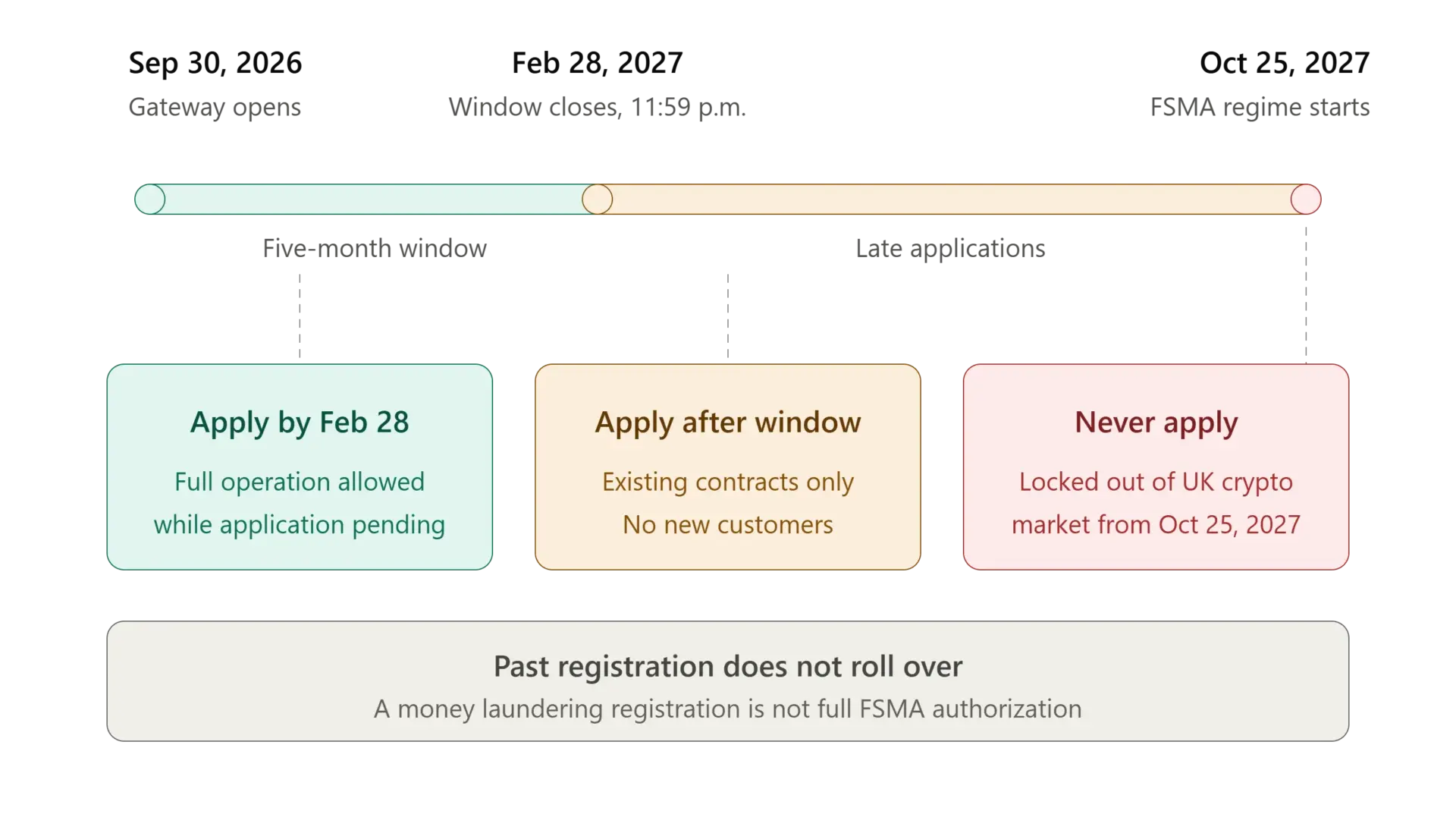
The registration gateway opened on September 30 and will remain open until February 28, 2027, at 11:59 p.m. The wider Financial Services and Markets Act regime will start on October 25, 2027.
Firms that do not submit an application within the five-month window will miss out on the exemption that allows them to operate in full pending a ruling on their application. Firms that file after the window will face restrictions on signing new customers or selling new business to current ones, and will be limited to servicing existing contracts. Those that do not apply at all will be cut off from the UK crypto market when the regime starts on October 25, 2027. Filing early preserves a firm's right to keep operating in full while the FCA assesses the application — a timing choice with direct consequences for market access.
The regulator has also addressed whether past registrations carry over into the regime, clarifying that a Money Laundering Regulations registration does not roll over into full FSMA authorization. The FCA laid out the in-scope activities, from stablecoin issuance to trading platforms, custody and staking, in guidance published September 16, when it also confirmed the gateway date alongside a £500 million UK money-laundering crackdown, as Cryptopolitan reported.
Which big crypto platforms will be pushed out of the UK?
Europe's cutoff shows how even a big name can still end up outside the perimeter. Binance, the largest exchange by volume, sits in CASP Tracker's “not licensed” column.
Cryptopolitan has previously reported that Binance missed the deadline to secure a European license, and AML Intelligence reported on September 28 that European Central Bank President Christine Lagarde helped talk Greece out of granting the exchange a MiCA license earlier this year, keeping it out of the bloc for now even as it continues serving European users.
Whether the UK's gateway narrows the field as sharply will depend on how many firms file credible applications before the February deadline — and how many decide the cost of full authorization is not worth staying. Signals worth tracking include the volume of applications filed before the February 28, 2027 cutoff, the approval rate once decisions under the new regime begin, and whether exchanges that missed out in Europe — Binance among them — apply for the UK instead.

