Europe's Busiest Ports Ranked: Which Move the Most Goods?
Key Takeaways
- •Rotterdam was the EU's busiest port in 2024 with 397.3 million tonnes of goods transported, ahead of Antwerp-Bruges at 243.7 million tonnes and Hamburg at 97 million tonnes.
- •EU ports handled around 3.4 billion tonnes of goods in 2024, roughly 26% of the global total, and nearly 90% of the EU's external freight trade travels by sea.
- •The Netherlands leads EU countries with 538.1 million tonnes handled across all its ports, ahead of Italy at 488.6 million tonnes and Spain at 486 million tonnes.
- •When candidate countries and EFTA members are counted, Turkey ranks second overall at 524.7 million tonnes and Norway eighth at 212.1 million tonnes.
- •In March 2026 the European Commission adopted two strategies to improve competitiveness, sustainability, security and resilience across ports, shipping and shipbuilding.
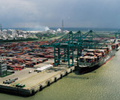
Sea shipping keeps Europe fed, fuelled and supplied — and this year, disruptions to shipping routes caused by the Iran war have thrust maritime transport into the headlines. Euronews examined the busiest ports in Europe by volume of goods transported.
Maritime transport plays a key role in moving goods. Globally, around 13 billion tonnes of traded goods were transported by sea in 2024. In the EU, ports handled around 3.4 billion tonnes of goods, corresponding to 26% of the global total. According to the EU Blue Economy Observatory, almost 90% of the EU's external freight trade is also carried by sea — a share that makes the performance and resilience of individual ports a direct factor in supply chains for food, energy and manufactured goods across the bloc.
Shipping consists mainly of two types: short sea shipping and deep sea shipping. Short sea shipping refers to transporting goods over relatively short distances by sea, whereas deep sea shipping covers longer, intercontinental routes across oceans. For the EU, short sea shipping does not only cover maritime transport within the bloc; it also includes candidate countries, Iceland, Norway, the Baltic Sea area, the Mediterranean Sea area and the Black Sea area.
Rotterdam and Antwerp-Bruges are the EU's busiest ports
As of 2024, two EU ports are by far the busiest when measured by total sea shipping, according to Eurostat. Rotterdam in the Netherlands leads the ranking, with 397.3 million tonnes of goods transported to and from the port. Antwerp-Bruges in Belgium follows, with 243.7 million tonnes of goods handled.
The scale of the top two reflects, in part, their position on the North Sea coast with access to inland waterway connections such as the Rhine–Scheldt delta, which links seaports to industrial and consumer hinterlands across Western Europe.
Hamburg ranks as the third-busiest port, but its volume is considerably lower than the top two; the German port handled 97 million tonnes of goods. After the leading pair, the total weight of goods transported falls gradually and the differences between ports are relatively small.
Spain's Algeciras is the fourth-busiest port, with 81.5 million tonnes, sitting at the Strait of Gibraltar on the shipping lane between the Atlantic and the Mediterranean. Amsterdam, another Dutch port, completes the top five at 78.8 million tonnes. France's busiest port, HAROPA (Le Havre and Rouen), ranks sixth in the EU, having handled 76.6 million tonnes of goods in 2024, with the Polish port of Gdansk following closely at 71 million tonnes. Another French port, Marseille, is also among the top 10 at 66 million tonnes, while Valencia handled 64.5 million tonnes.
Romania's Constanta is in the top 10
Constanta, in Romania, also makes the top 10, handling 57.6 million tonnes of goods. Its position on the Black Sea makes it a key gateway for trade connecting the EU with the Black Sea region and beyond.
Among the ports ranked 11th to 20th, the gross weight of goods transported by sea ranges from 36.8 million tonnes in Dunkerque, France, to 55.5 million tonnes in the Spanish port of Barcelona. The busiest Italian port is Trieste, at 53.5 million tonnes, followed by Genova at 47.4 million tonnes. Sines in Portugal is also among the top 20 busiest EU ports at 44.1 million tonnes, and Greece's Piraeus follows at 43.7 million tonnes. Apart from Hamburg, Bremerhaven is another busy German port, handling 42.5 million tonnes. Sweden's Göteborg is also in the top 20 at 38.5 million tonnes, and Zeeland Seaports is another Dutch port contributing to the Netherlands' strong position in the EU.
Dutch ports handle the most goods
Looking at countries by the gross weight of goods handled in all ports, the Netherlands leads the EU, with Dutch ports handling 538.1 million tonnes of goods. Although Italy has three ports in the top 20, the country ranks second at 488.6 million tonnes, very closely followed by Spain at 486 million tonnes. These three countries are well ahead of the rest: fourth-ranked Belgium handled 274.9 million tonnes of goods, while France handled 269.8 million tonnes, slightly less than Germany at 273.9 million tonnes. Greece, Sweden and Poland also handled more than 100 million tonnes of goods each.
Turkey ranks second with candidates included
When EU candidate countries and EFTA members are included, Turkey ranks second at 524.7 million tonnes, while Norway ranks eighth at 212.1 million tonnes.
The European Commission emphasises that "maritime transport has been a catalyst for economic development and prosperity throughout its history" in Europe. In March 2026, the Commission adopted two strategies to boost competitiveness, sustainability, security and resilience across the EU's wider waterborne sector, including ports, shipping and shipbuilding. How these strategies translate into investment and policy at the major ports listed above is a key question for the sector going forward.
Source: Euronews
