Euro Area Industrial Output Holds Flat in June
Key Takeaways
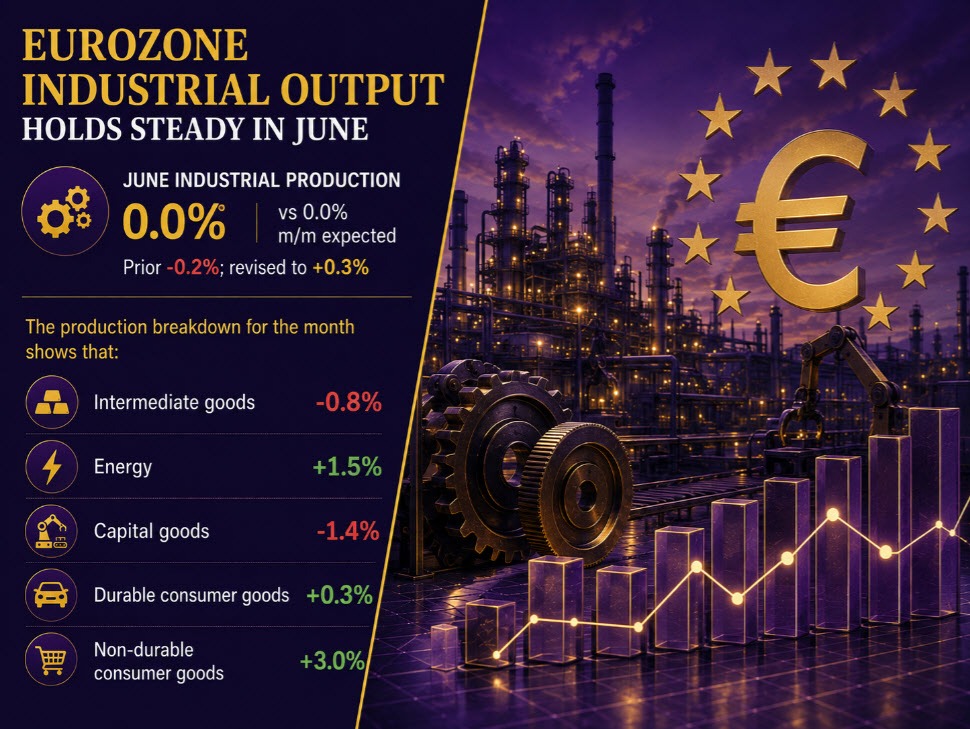
- •Euro area industrial production posted flat month-over-month growth of 0.0% in June 2026, in line with market forecasts.
- •The May industrial output reading was revised upward from a 0.2% contraction to a 0.3% expansion.
- •Energy production rose 1.5% and non-durable consumer goods increased 3.0%, while capital goods fell 1.4% and intermediate goods declined 0.8%.
- •Year-over-year industrial output grew a marginal 0.1%, underscoring tepid conditions across the manufacturing sector.
- •The June release is not expected to shift ECB policy expectations, with inflation data remaining the primary focus ahead of September.
Euro Area Industrial Output Holds Flat in June
Euro area industrial production remained unchanged in June 2026, posting a month-over-month reading of 0.0%, in line with market expectations. The May figure was revised higher from -0.2% to +0.3%.
Year-over-year, industrial production rose 0.1% compared to the same month in the prior year, indicating that overall conditions in the sector remain tepid at best. The stagnation aligns with a broader pattern of weak manufacturing activity across the currency bloc, where the sector has struggled to regain momentum following the energy-price shocks and tightening monetary conditions of recent years.
Production Breakdown
The monthly data presented a mixed picture across categories:
- Intermediate goods: -0.8%
- Energy: +1.5%
- Capital goods: -1.4%
- Durable consumer goods: +0.3%
- Non-durable consumer goods: +3.0%
Energy production and non-durable consumer goods posted gains, while capital goods and intermediate goods declined. The divergence between stronger non-durable consumer output and weaker capital goods production reflects different demand dynamics within the sector: consumer-facing categories have shown more resilience, while investment-linked capital goods output continues to lag, a trend consistent with subdued business investment sentiment across the region.
Outlook
Industrial production is widely regarded as a lagging indicator, and the June release is unlikely to alter the outlook for the euro area economy or the European Central Bank's (ECB) policy trajectory.
Inflation developments remain the primary focus for the euro area at this stage. Those trends are expected to be the driving factor influencing regional markets and any ECB pricing decisions ahead of September. Upcoming flash PMI readings and the August HICP inflation print will offer timelier signals on whether the euro area's modest industrial stabilization is accompanied by broader economic reacceleration or continued stagnation.

