ECB Data Shows European Firms Are Not Borrowing to Fund AI Investments
Key Takeaways
- •An ECB blog post based on the SAFE survey, published on October 2, found that euro area firms are funding AI investments largely without debt, in contrast to their heavily leveraged US counterparts.
- •The five largest US technology companies carry an estimated $1.65 trillion in hidden off-balance-sheet debt plus $1.35 trillion on their balance sheets, roughly an eightfold increase over four years, according to a Nikkei study cited by Fortune.
- •Hyperscalers and related companies such as Nvidia issued $225 billion in bonds in 2026, and Goldman Sachs projects hyperscaler debt will grow another 60% to a record $420 billion in 2027.
- •Investor demand for hyperscaler bonds has weakened, with orders per dollar falling below two times in July from nearly five times in February, according to Apollo Global's Torsten Slok.
- •Former ECB President Mario Draghi estimates the EU hosts under 5% of global AI compute capacity versus 75% in the United States, with the supply shortfall potentially widening to 14 gigawatts by 2030.
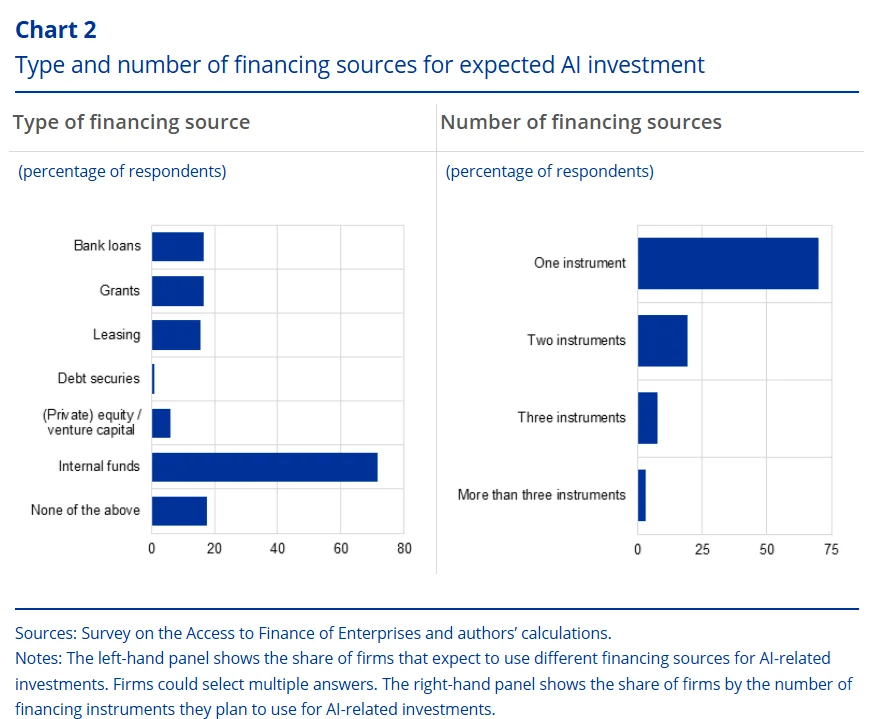
The European Central Bank has found that companies inside the euro area are financing their artificial intelligence investments without taking on debt at anything like the scale seen in the United States, where the AI infrastructure buildout rests on trillions of dollars in borrowed money.
The findings were laid out in an ECB blog post, “How firms plan to finance AI investment,” published on October 2 and based on data from the bank’s Survey on the Access to Finance of Enterprises (SAFE), a long-running Eurosystem survey of how firms across the bloc access finance.
The survey raises questions about whether observers should be concerned that euro area firms, which already spend far less on AI than their American counterparts, are also declining to close the gap by borrowing. The financing route matters because it shapes who absorbs the losses if AI returns disappoint — lenders in the case of borrowed money, companies’ own balance sheets in the case of internal funds.
America is funding its AI boom with borrowed money
The five largest US technology companies hold $1.65 trillion in hidden debt — obligations that do not appear directly on their balance sheets — and $1.35 trillion of debt on their balance sheets, according to a Nikkei study cited by Fortune. That figure represents a roughly eightfold jump in just four years.
A separate Moody’s estimate put off-balance-sheet deals at $1.2 trillion, with more than $820 billion of that total committed to data centers that are not even ready yet. Firms are also taking on debt to fund long-term obligations such as chips, servers, and leases with data-center operators.
Hyperscalers — the companies operating the world’s largest cloud and data-center networks — and related names such as Nvidia have issued $225 billion in bonds in 2026, per S&P Global, a 973.7% jump as of the middle of the year. That number is projected to be near $400 billion by the end of the year. Goldman Sachs expects hyperscaler debt to continue to grow by another 60% in 2027, projecting it to hit a new $420 billion record.
Funders are not as keen on AI debt as before
The scale of the borrowing has started to draw scrutiny in certain corners of Wall Street. As of September, the market for top-rated corporate credit from banks and industrials was gaining pace, while similar offerings from AI-linked issuers were moving in the opposite direction.
“We’re being very selective in terms of how we invest within hyperscaler debt,” Colby Stilson, head of fixed income at Brown Advisory in London, told Reuters.
Apollo Global’s Torsten Slok confirmed the scale of the shift in demand, reporting that investor orders per dollar of hyperscaler bonds had fallen below two times as of July, from nearly five times in February.
Europe still needs to make up computing ground
Europe’s reluctance to borrow runs headlong into its investment problem. Oxford Economics projects that US corporate spending on AI hardware and infrastructure will grow 40% in real terms between 2021 and the end of 2027, against just 12% for the euro area, according to figures reported by Cryptopolitan in August.
The Bank for International Settlements has warned that the US pace could end in an “investment bust,” but the lag still worries European economists.
Former ECB President Mario Draghi laid out the stakes in a Financial Times column in September, arguing that the European Union hosts under 5% of the world’s AI compute capacity, against 75% for the United States, and that the shortfall between demand and installed supply could widen to 14 gigawatts by 2030.
“Being cut off from AI, once the economy runs on it, would be more like being cut off from the US financial system. The effects would be catastrophic,” Draghi wrote. His proposed fix is for European firms to pool their buying power into contracts large enough to finance new data centers.
Future rounds of the SAFE survey will show whether euro area firms hold to that debt-light path, and how the continent responds to proposals like Draghi’s will help determine whether its computing gap narrows.

