EU Expands Belarus Crypto Ownership Ban to All MiCA Service Providers
Key Takeaways
- •The EU measure expands existing Belarus sanctions to cover any crypto-asset services classified under MiCA, not only wallet, account or custody services.
- •Belarusian nationals and residents will be barred from owning, controlling or governing covered EU-based crypto firms starting August 25.
- •The underlying legal act entered into force on July 24 under Council Decision (CFSP) 2026/1847.
- •The sanctions expansion follows the end of MiCA’s transition period on July 1, when unauthorized crypto firms were required to wind down or face enforcement.
- •The EU also extended transaction bans to 14 crypto-related platforms outside the bloc as part of its 21st sanctions package against Russia.
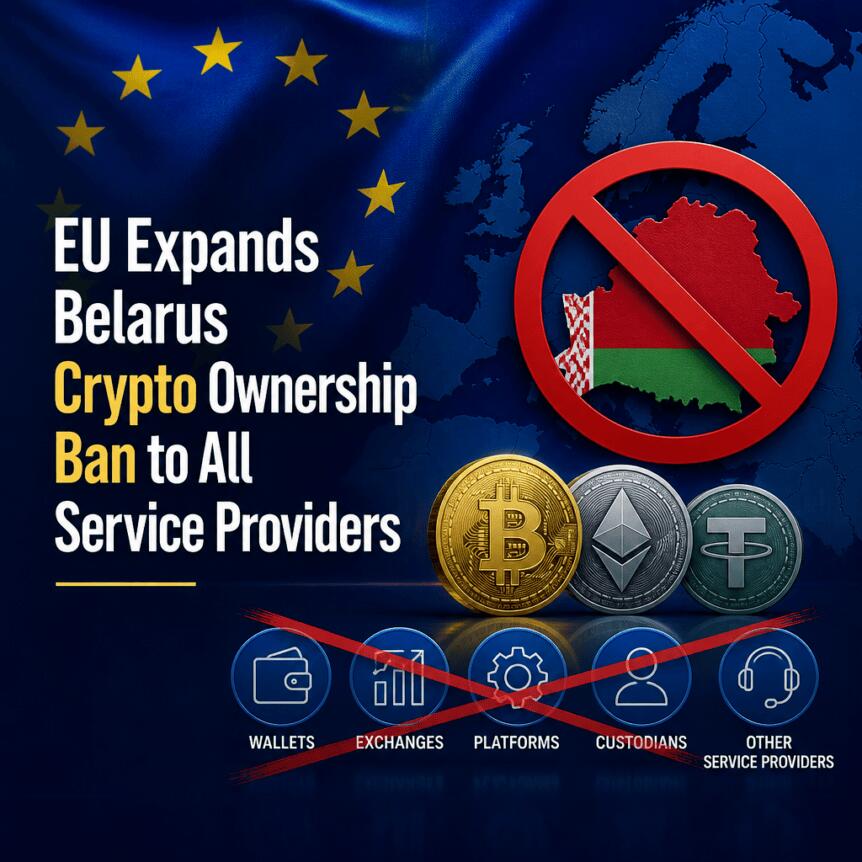
The European Union has tightened its crypto-related sanctions against Belarus by extending a prohibition on certain crypto roles and ownership interests to a broader range of service providers under the EU's MiCA (Markets in Crypto-Assets) framework.
Under Council Decision (CFSP) 2026/1847, adopted on Thursday, Belarusian nationals and residents will be barred from owning, controlling, or managing EU-based crypto exchanges and other MiCA-regulated crypto service entities starting August 25. The underlying legal instrument entered into force on July 24.
Scope of the Sanctions Amendment
Council Decision (CFSP) 2026/1847 amends the bloc's existing sanctions framework targeting Belarus. An earlier restriction applied only to companies providing crypto wallet, account, or custody services. The new measure broadens the scope to cover "any other crypto-asset services" falling within MiCA's regulatory categories.
From August 25, the prohibition extends to EU-based entities offering these services if they are subject to MiCA's defined service classifications. Under the amendment, Belarusian nationals and residents are barred from:
- Owning or controlling such an EU-based entity
- Holding positions on its governing body
MiCA's service categories include operating trading platforms, exchanging crypto assets, executing and transmitting client orders, placing crypto assets, providing transfers, and offering investment advice or portfolio management. The restriction is therefore not limited to custody or retail wallet services but extends to a wider set of operational roles involved in crypto market infrastructure and client-facing financial functions.
The legal act entered into force on July 24, while the expanded crypto provision specifically takes effect on August 25.
MiCA Transition Ends, Enforcement Pressure Rises
The sanctions expansion comes shortly after a major regulatory milestone: the end of MiCA's transition period on July 1. Cointelegraph previously reported that when the MiCA transition concluded, crypto companies lacking proper authorization were ordered to wind down or face enforcement actions.
This timing matters because sanctions targeting the ownership and governance of MiCA-regulated firms can directly affect corporate structures, board composition, and controlling interests of operators seeking to comply with EU authorization rules. With the transition window closed, the EU's approach shifts from temporary arrangements toward formal regulatory alignment, while simultaneously tightening sanctions rules that constrain who may hold ownership and management positions within regulated crypto businesses.
Wider EU Effort Targeting Russia-Linked Crypto Pathways
Beyond Belarus, the EU has been escalating efforts tied to Russia-related sanctions evasion through financial networks, including crypto. On Thursday, within its 21st sanctions package against Russia, the EU extended a transaction ban to 14 crypto-related service platforms outside the bloc. The package also introduced a mechanism intended to allow the EU to prohibit dealings with any foreign crypto provider used by Russia to evade sanctions.
The decision builds on an earlier June 11 proposal that targeted 11 crypto platforms. Taken together, these steps signal that the EU is deploying sanctions both as a direct tool—blocking specific providers or transactions—and as an indirect governance lever, restricting who may control or manage certain regulated entities.
Broader Sanctions Friction: UK Action and Platform-Linked Allegations
The EU's measures follow similar actions in other jurisdictions. On May 26, the UK sanctioned Huobi Global S.A., the Panamanian company behind HTX, alleging support for Russia-linked financial networks involving sanctioned entities A7 and Garantex. HTX denied wrongdoing and, in commentary shared with Cointelegraph, stated that regulatory compliance remains a top priority and that it adheres to the regulatory frameworks of the jurisdictions where it operates.
While the EU's new Belarus-focused amendment does not depend on those UK allegations, the parallel underscores a recurring pattern: regulators and sanctions bodies are increasingly focused on the operational role crypto platforms and related service providers can play in cross-border capital movement, whether through direct compliance frameworks or allegations of linkage to sanctioned networks.
Implications for EU-Regulated Crypto Firms
For operators inside the EU, the key risk is not only whether a service provider holds MiCA authorization, but also whether its ownership and governance structure could conflict with sanctions rules as expanded. Compliance teams should monitor the July 24 entry into force and the August 25 start date, and review board and controlling-interest arrangements to ensure alignment with both MiCA obligations and the evolving sanctions prohibitions.

