Ethereum Price Holds $2,250 as Hormuz Talks Face Key Conditions
Key Takeaways
- •Ethereum traded near $2,268 on Nov. 1, up roughly 1.19% over 24 hours after recovering above the $2,250 support level, with $2,400 to $2,450 identified as the key resistance zones.
- •Iranian Foreign Minister Abbas Araghchi said Qatari mediators are discussing a plan to reopen the Strait of Hormuz within two days instead of seven if Iran's conditions, including sanctions relief and access to frozen funds, are accepted.
- •U.S. spot Ethereum ETFs recorded $155.7 million in net outflows on Oct. 30, a fifth consecutive session of withdrawals, bringing net outflows over seven trading sessions to $537.6 million.
- •BlackRock's ETHA and Grayscale's ETH fund together drove about 71% of the Oct. 30 outflows, with withdrawals of $76.6 million and $34.1 million respectively.
- •ETH perpetual futures funding moved below zero, indicating cautious positioning among traders, while the Nov. 3 U.S. midterm elections add another potential source of market volatility.
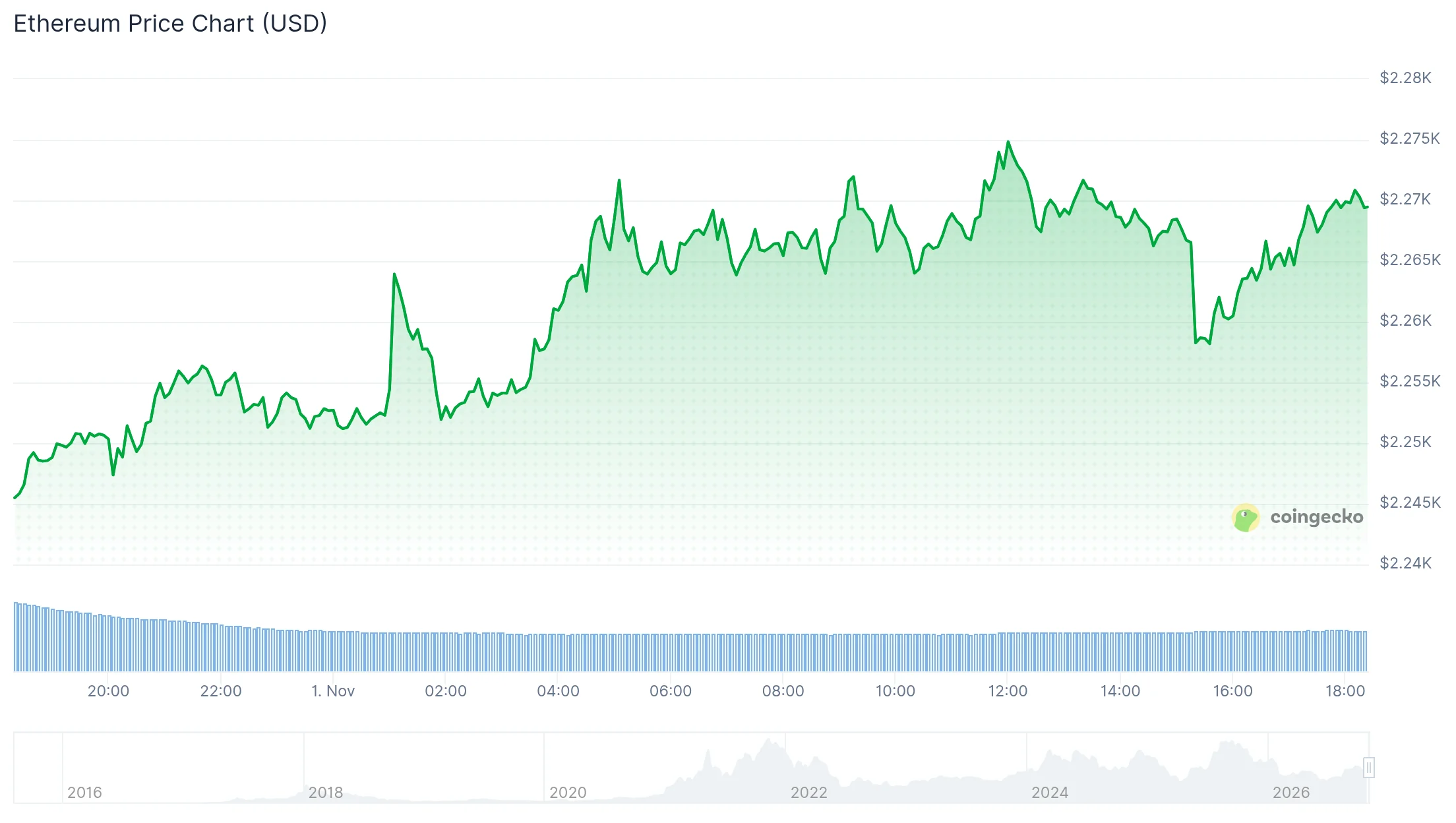
Ethereum traded near $2,268 on Nov. 1, up about 1.19% over 24 hours, as ETH recovered above the $2,250 level. The immediate support area remained around $2,250. The rebound came alongside discussions over reopening the Strait of Hormuz and continued withdrawals from U.S. spot Ethereum funds. Bitcoin traded around $77,812, while XRP held near $1.25. Negotiations over the strait had not yet produced a final agreement, while fund-flow data pointed to continued caution among ETF investors.
Iranian Foreign Minister Abbas Araghchi described a proposal that could reopen the waterway within two days if Iran's conditions are accepted, though the plan remains subject to agreement with Washington. Meanwhile, U.S. spot Ethereum ETFs recorded another day of net outflows, and the Ethereum price recovery still needs stronger buying demand and a steadier backdrop across global financial markets.
Conditional Strait of Hormuz Proposal in Focus
Araghchi said Qatari mediators were discussing a shorter implementation period for reopening the Strait of Hormuz. Tehran had offered to compress the process from seven days to two, provided its conditions were met. The proposed timetable would begin only after acceptance of the terms.
The demands include sanctions relief, fewer U.S. forces in the region, restored oil waivers and access to frozen Iranian funds. Reports also described Iranian demands over shipping routes agreed with Oman. Iran additionally called for ending regional hostilities, particularly Israeli attacks on Lebanon.
Araghchi said consultations were continuing without a final outcome. Until an agreement is reached, concerns over disrupted shipping and energy supplies remain in play. The strait is one of the world's most important energy chokepoints, with roughly a fifth of the world's oil passing through it.
BREAKING: Iran says talks are ongoing with Qatari mediators on a plan to reopen the Strait of Hormuz within 48 hours if the US accepts Iran's conditions. Iran's FM Abbas Araghchi has provided more details on Iran's conditions, which include: 1. Lift US sanctions imposed…
— Bull Theory (@BullTheoryio) November 1, 2026
A successful agreement could ease concerns over disrupted shipping and energy supplies, potentially improving appetite for riskier assets. A reopening could influence the Ethereum price by easing concerns over oil supplies and encouraging investors to take on more risk. The market response, however, would depend on both an actual agreement and renewed buying demand emerging alongside it.
Key Levels: $2,250 Support, $2,400–$2,450 Resistance
Attention remains fixed on $2,250 as the immediate support area, followed by $2,220 if that level fails. Price analysis identifies $2,400 and $2,450 as the resistance zones above. A stronger advance could bring $2,500 into view, while a loss of $2,220 would expose $2,100 and $2,050.
Holding above support would give buyers room to test those higher levels. However, the Ethereum price must attract sufficient demand to absorb selling near resistance. A political breakthrough could support that attempt, while stalled negotiations could leave the recovery vulnerable.
Ethereum ETFs Extend Outflow Streak as Funding Turns Negative
U.S. spot Ethereum ETFs — funds that hold ether directly and began trading in July 2024 — recorded $155.7 million in net withdrawals on Oct. 30, according to Farside Investors. It was the fifth consecutive session of net outflows for the funds.
BlackRock's ETHA accounted for $76.6 million of the daily total. Grayscale's ETH fund lost $34.1 million, while its separate ETHE fund recorded $21.5 million in withdrawals.
BlackRock's ETHA and Grayscale's ETH fund together accounted for $110.7 million of the daily net outflow. Their combined withdrawals represented approximately 71% of the total, concentrating the day's pressure in two U.S.-listed spot Ethereum products.
Across seven trading sessions, net outflows reached $537.6 million. That period included a small inflow on Oct. 23, followed by five straight negative sessions. The figures show that the brief price rebound had yet to coincide with a sustained return of ETF demand.
In the derivatives review, ETH funding moved below zero, indicating cautious positioning among traders. Negative funding rates mean traders holding short positions in perpetual futures markets pay those holding long positions. Even so, a short squeeze would still require a price trigger to materialize.
For the Ethereum price outlook, repeated redemptions leave an important source of investment demand under pressure. A shift toward consistent inflows would provide a clearer sign that fund investors were rebuilding exposure.
The Nov. 3 U.S. midterm elections, which will determine the composition of the next Congress, add another event for traders assessing policy expectations and broader financial market volatility. Price reactions could depend on election results alongside the Strait of Hormuz negotiations.
Source: Blockonomi

