Ethereum Price Holds Near $2,400 Despite ETF Outflows and Fed Rate Hike
Key Takeaways
- •Ethereum held steady near $2,400–$2,425 on Sept. 17 even as the Dow Jones dropped more than 700 points after the Federal Reserve raised rates by 25 basis points to a 3.75%–4% target range.
- •U.S. spot Ether ETFs saw more than $224 million in outflows on Wednesday after $141 million the previous day, led by BlackRock's ETHA with over $110 million and Fidelity's FETH with more than $55 million.
- •BitMine, the biggest Ethereum holder, is close to ending its buying program, having accumulated over 5.9 million ETH with fewer than 30,000 remaining toward its goal of owning 5% of circulating supply.
- •The CLARITY Act, which matters to Ethereum because its chain hosts major stablecoins such as USDT and USDC, failed a Senate procedural vote as Democrats cited ethical concerns linked to President Trump's reported $2.2 billion in crypto-related revenue.
- •Technical setups, including a bullish flag pattern, a golden cross of the 50-day and 200-day moving averages, and support above the 100-day moving average, point to a possible breakout toward the $3,000 resistance level.
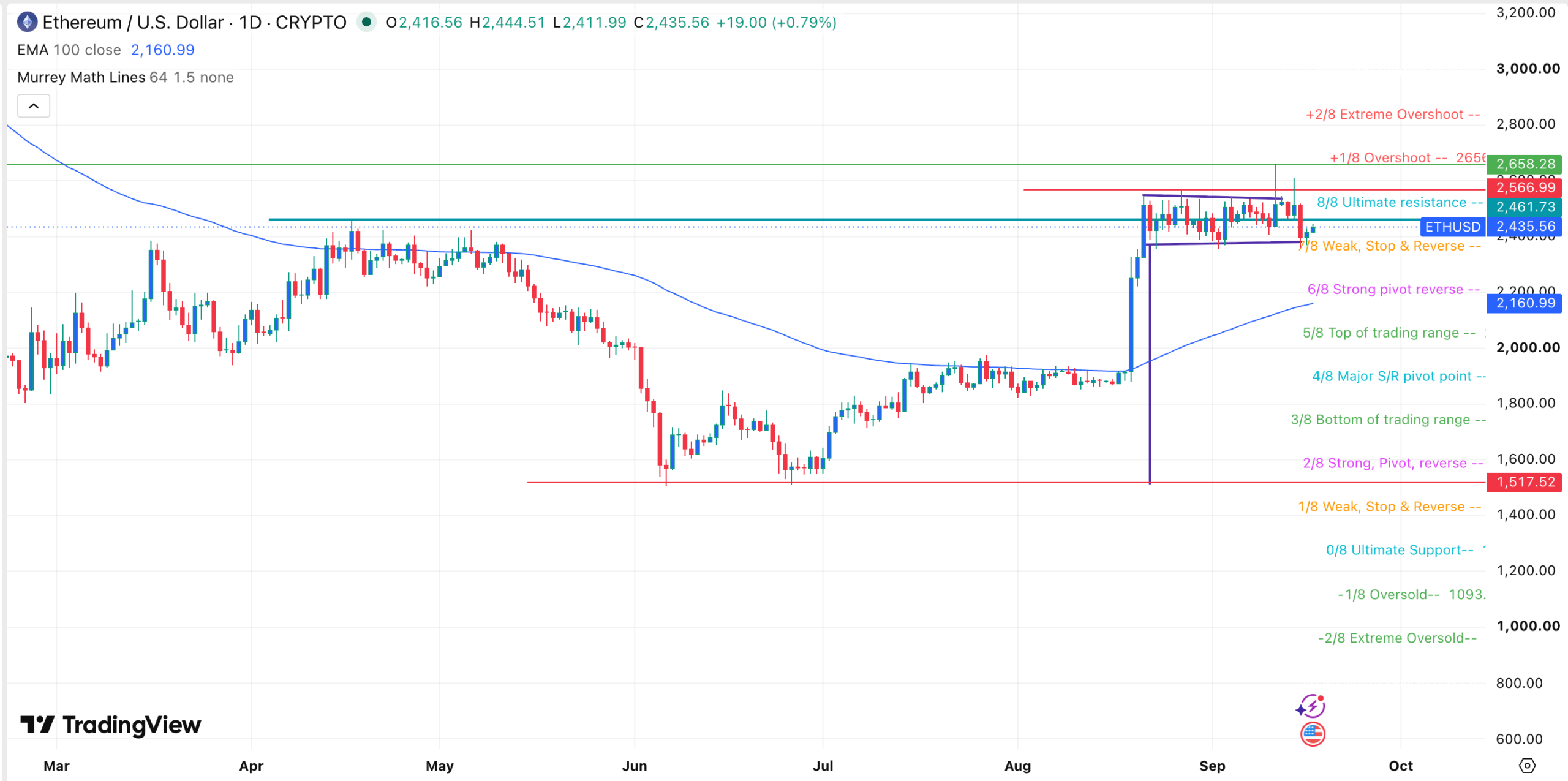
Ethereum held its ground on Sept. 17, trading around $2,400–$2,425 even as U.S. equities slumped and spot Ether ETFs recorded another round of heavy outflows following the Federal Reserve's decision to raise interest rates by 25 basis points.
The token has spent much of the past several weeks consolidating rather than extending its earlier rally, leaving traders to watch whether the current structure develops into another breakout or breaks lower under tighter monetary conditions.
Steady Trade After the Fed's Rate Hike
ETH moved sideways this week even after the U.S. stock market slumped in the wake of the Federal Reserve's rate decision. Officials raised rates by 0.25%, taking the target range to between 3.75% and 4%, with Kevin Warsh hinting that the central bank will hike again. Higher policy rates raise borrowing costs and tighten financial conditions — a backdrop investors weigh when allocating to risk-sensitive assets such as equities and crypto.
The Fed judged that, while the economy is performing relatively well, inflation remains a challenge. Recent data confirmed inflation has stayed above the 2% target for more than five years, a trend set to continue as energy prices climb. Brent and West Texas Intermediate (WTI) crude have both jumped above $100 this month, feeding into the inflation readings at the center of the Fed's policy debate.
Ethereum's price action after the rate decision was notable because the U.S. stock market dived, with the Dow Jones falling by more than 700 points.
Ether ETF Outflows Accelerate
American investors have started selling some of their ETH ETFs. Data show the funds experienced more than $224 million in outflows on Wednesday, following a loss of $141 million the day before. In total, these funds have added $85 million this year — far below the $1.85 billion they added last month. Because ETF flows reflect investor allocations into and out of the funds, they are widely tracked as a gauge of demand for the asset.
The outflows were spread across many products. BlackRock's ETHA ETF saw more than $110 million in outflows on Wednesday, while Fidelity's FETH lost over $55 million in assets the same day. Grayscale's ETHE, BlackRock's ETHB, VanEck's ETHV, and 21Shares' TETH each shed more than $10 million in assets on Thursday.
The withdrawals signal that investor demand is falling this week, possibly as some holders begin booking profits.
At the same time, BitMine, the biggest Ethereum holder, is about to end its ETH purchases. It has accumulated more than 5.9 million coins and has fewer than 30,000 left to buy in its goal of owning 5% of the coins in circulation. Once purchases end, one of the market's largest buyers will become a passive investor.
Ethereum also held steady despite a CLARITY Act setback in the U.S. Senate this week. Senators failed to pass the bill — a market-structure measure aimed at setting clearer regulatory boundaries for digital assets — in a procedural vote, with Democrats arguing that it did not go far enough to address their ethical concerns. Whether the legislation returns for another vote is a regulatory thread to watch.
Democrats added the ethical clauses after President Donald Trump announced he had made more than $2.2 billion in revenue last year, most of it from his crypto ventures, including World Liberty Financial and the TRUMP memecoin.
Ethereum is exposed to the bill because its chain powers some of the top players in the industry, including stablecoins such as USDT and USDC.
Bullish Patterns Form on the Daily Chart
The ongoing consolidation could be the calm before an eventual rebound. The chart has slowly formed a bullish flag pattern, a common continuation signal in technical analysis, with the coin currently sitting in the flag section.
Ethereum has also remained above its 100-day moving average, which coincides with the Strong, Pivot, Reverse line of the Murrey Math Lines tool, and has formed a golden cross — a crossover between the 50-day and 200-day moving averages.
Based on these setups, the technical picture points to a possible bullish breakout toward the key resistance level of $3,000.
This article is for informational purposes only and does not constitute financial or investment advice. Cryptocurrency investments involve risk, and technical patterns or analyst targets do not guarantee future price performance.

