Claude AI Projects Three Scenarios for a $10,000 Ethereum Investment by 2030
Key Takeaways
- •The Verus–Ethereum Bridge was exploited for approximately $7.54 million, marking the second attack on the same bridge contract in two months following an $11.5 million incident in May.
- •Spot Ethereum ETFs attracted roughly $37.5 million in the most recent session, bringing combined ETF holdings to nearly $10.48 billion after three consecutive days of positive inflows.
- •Swiss cantonal bank BancaStato launched regulated Ethereum trading using infrastructure from Sygnum and Avaloq, providing traditional banking clients direct access to ETH.
- •Grayscale plans to distribute Ethereum staking rewards as quarterly cash payments through its Ethereum Trust beginning around August 7.
- •Claude AI projected ETH could trade between $1,500 and over $20,000 by 2030 depending on adoption, regulation, and security outcomes.
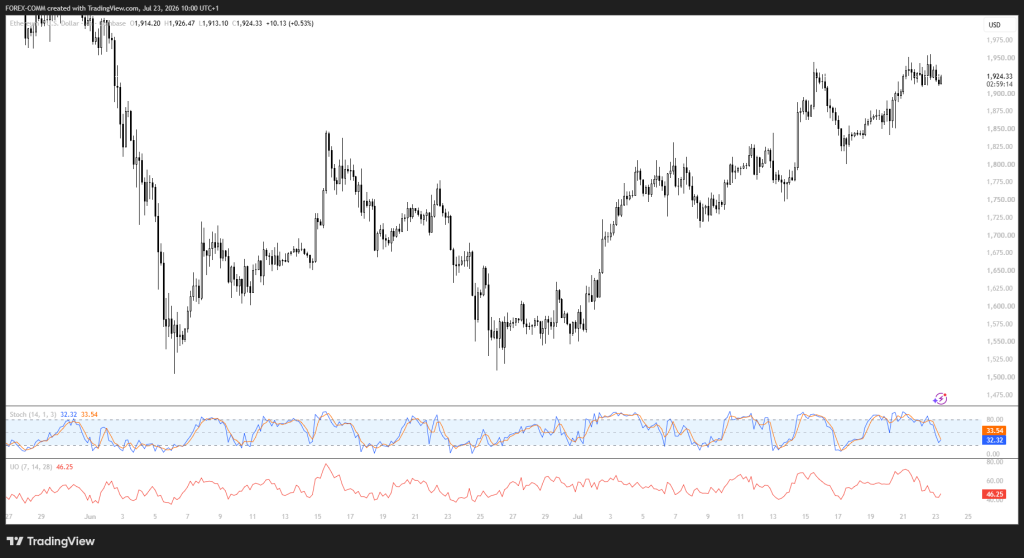
Ethereum is currently trading at $1,921.68 following a volatile session that saw daily trading volume decline by more than 20%. Market participants appear to be consolidating gains after a notable rally earlier in July. Despite the reduced activity, the ETH price has not fallen below the $1,900 support level, indicating that buyers continue to defend that threshold.
The market is caught between competing forces. On one side, institutional capital continues to flow into Ethereum through spot ETFs—investment vehicles that began trading in the United States in mid-2024 after SEC approval, opening regulated exposure to ETH for mainstream investors. Traditional banks are expanding ETH-related services, and Grayscale is preparing to introduce staking rewards for investors, building on Ethereum's September 2022 transition to a proof-of-stake consensus model that allows holders to earn yield by locking ETH to secure the network. On the other, the Verus–Ethereum Bridge has suffered its second exploit in two months, reigniting concerns about cross-chain security—a persistent vulnerability in decentralized finance, where bridges connecting separate blockchains have historically been among the most exploited categories of protocols, with incidents such as the $625 million Ronin Bridge hack in 2022 underscoring the systemic risk.
Against this backdrop, Claude AI was asked to project what a $10,000 investment in Ethereum at current prices could realistically be worth by 2030.
Verus–Ethereum Bridge Suffers Second Exploit in Two Months
Trading volume eased after reports emerged that the Verus–Ethereum Bridge was exploited for the second time in just two months. Blockchain security firm Blockaid reported that an attacker abused the bridge's import path to trigger unbacked Ethereum-side payouts, draining approximately $7.54 million in assets, including ETH, tBTC, USDC, USDT, EURC, MKR, and scrvUSD, before converting them into ETH.
Verus–Ethereum Bridge Suffers Second Exploit in Two Months, $7.54M Drained Blockaid detected a new exploit targeting the Verus–Ethereum Bridge, with an attacker abusing the bridge's import path to trigger unbacked Ethereum-side payouts and drain approximately $7.54 million in… pic.twitter.com/eNGo8EILT7 — Wu Blockchain (@WuBlockchain) July 23, 2026
The incident follows an $11.5 million exploit in May that targeted the same bridge contract and vulnerability. Although the majority of funds from the earlier attack were eventually returned under a white-hat agreement, the recurrence has raised renewed questions about the security of cross-chain infrastructure. Such events typically dampen short-term trading activity as investors await greater clarity.
Institutional Inflows and Banking Adoption
Despite the decline in overall trading volume, institutional capital continues to enter Ethereum through regulated vehicles. Spot Ethereum ETFs attracted approximately $37.5 million in the most recent session, marking three consecutive days of positive flows. Total ETF trading volume reached roughly $645 million, with combined holdings now approaching $10.48 billion in ETH. Over the past week, net inflows totaled approximately $105 million.
Traditional finance is also broadening access to Ethereum. Swiss cantonal bank BancaStato has launched regulated Ethereum trading through its existing banking platform, utilizing infrastructure from Sygnum and Avaloq. The service provides traditional banking clients with direct access to ETH via regulated channels.
Grayscale has also announced plans to distribute Ethereum staking rewards as quarterly cash payments through its Ethereum Trust, with distributions expected to begin around August 7.
Related coverage: Ethereum Price Pumps After CPI, But Nobody Is Talking About the Hidden Warning Signal
Ethereum's Evolving Role in Digital Finance
Market observers increasingly view Ethereum as more than a smart-contract platform. With stablecoins facilitating payments, real-world assets being tokenized, and AI-driven systems beginning to handle financial transactions, ETH is positioning itself as foundational settlement infrastructure for the broader digital economy. Ethereum currently hosts the majority of stablecoin circulation by value, and major financial institutions including BlackRock have begun issuing tokenized funds on-chain, trends that lend weight to the settlement-layer thesis.
Ethereum 1.0 was about apps, tokens, nfts, defi, and speculation. Ethereum 2.0 is about something bigger: settlement. if assets move onchain, if stablecoins keep growing, if institutions tokenize everything, and if AI agents need money rails, Ethereum becomes more than a… pic.twitter.com/Drtyp2c7Oc — Ethereum Daily (@ETH_Daily) July 23, 2026
Technical Outlook
Chart analysis indicates that buyers remain in control despite the day's reduced trading activity. ETH continues to trade above $1,900, preserving the pattern of higher highs and higher lows established since early July.
The Stochastic Oscillator has cooled to approximately 32–33, pulling back from overbought territory. The decline in volume may alleviate short-term pressure and create room for buyers to re-enter if sentiment improves.
The Ultimate Oscillator reads 46.25, placing it near neutral territory and suggesting a balance between buyers and sellers. As long as ETH holds above the $1,900 level, the broader technical structure remains upward-leaning.
Claude AI's 2030 Projections for a $10,000 Ethereum Investment
Claude AI outlined three scenarios for Ethereum's price trajectory through 2030:
Bear Case: If bridge hacks continue to erode trust, Layer 2 networks—scaling solutions such as Arbitrum, Optimism, and Base that process transactions off the Ethereum mainnet and periodically settle back to it—divert significant activity away from the Ethereum mainnet, and regulatory friction slows institutional participation, ETH could trade between $1,500 and $3,000. A $10,000 investment at current prices would then be worth approximately $7,800 to $15,600.
Base Case: If ETF inflows persist, banks expand their ETH product offerings, and Grayscale's staking model attracts additional institutional capital, ETH could reach $5,000 to $8,000. A $10,000 investment would translate to roughly $26,000 to $41,600.
Bull Case: If stablecoins, tokenized real-world assets, and AI-driven payment systems broadly adopt Ethereum as primary settlement infrastructure, ETH could trade between $12,000 and above $20,000. The same $10,000 investment could then be valued at $62,000 to over $104,000.
Source: CaptainAltCoin