Ethereum Active Addresses Climb to Five-Month High Amid ETF Inflows and Robinhood Chain Activity
Key Takeaways
- •Ethereum recorded 989,500 active addresses in a 24-hour window, the network's highest participation level since early March.
- •U.S. spot Ethereum ETFs drew approximately $245 million in net inflows during the first week of August, extending a five-week consecutive inflow streak.
- •Layer-two networks including Arbitrum, Optimism, and Base have substantially grown transaction throughput, at times processing more transactions than the Ethereum mainnet.
- •Major institutions such as BlackRock and Franklin Templeton have launched tokenized products on public blockchains, contributing to sustained smart contract interaction.
- •Ethereum's proof-of-stake consensus is supported by over one million validators worldwide, securing billions of dollars in value across the network.
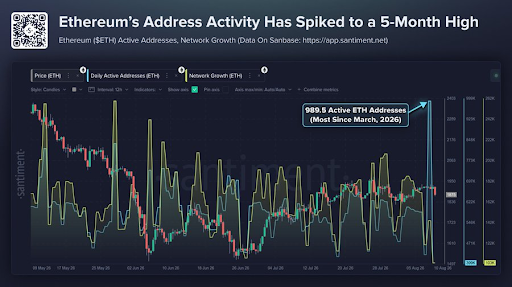
Ethereum recorded 989,500 active addresses in a single 24-hour period, marking the network's highest count since early March. According to on-chain analytics from Santiment, wallet activity surged while ETH traded steadily around $1,870. The growth signals rising daily usage of Ethereum's settlement layer, drawing attention from analysts monitoring the broader crypto market.
On-Chain Data Signals Rising Network Participation
Santiment's data tracks active network participation by counting unique wallet interactions over a given timeframe. Ethereum's active wallet addresses represent distinct cryptographic accounts transacting on the mainnet each day, offering institutional investors a measure of organic adoption volume beyond speculative trading.
The current spike in active addresses coincides with ETH holding near $1,870. Each token swap, lending deposit, or NFT mint requires base-layer validation and gas fees, meaning that a sharp increase in unique wallet interactions scales execution demand across thousands of decentralized applications simultaneously. Active address counts approaching the one-million mark place Ethereum in the upper range of its historical network participation bands, a level previously observed during periods of heightened DeFi and NFT market activity in 2021 and early 2024.
Historically, elevated network metrics have correlated with positive capital inflow trends in decentralized finance markets. Active wallet counts, combined with transfer tracking, provide a view into the blockchain's structural health.
Ecosystem Triggers Behind the Expansion
Activity from Robinhood Chain has contributed to increased Ethereum gas usage and application traffic. Millions of retail investors are engaging daily with secondary rollups and base-layer interfaces. Lower transaction execution fees have made it more accessible for traders to participate in decentralized protocols with greater frequency. Ethereum layer-two networks — including Arbitrum, Optimism, Base, and others — have collectively grown their transaction throughput substantially over the past year, periodically processing more transactions than the mainnet itself while periodically settling back to layer one.
Network activity has also resumed across stablecoins, real-world assets (RWAs), and tokenized assets. Major financial institutions, including BlackRock through its BUIDL tokenized fund and Franklin Templeton through its OnChain U.S. Government Money Fund, have launched tokenized products on public blockchains, contributing to sustained smart contract interaction. Continuous smart contract execution and on-chain state transitions remain essential for institutional-grade settlement systems, and overall throughput is reportedly higher than in many preceding months.
Ethereum's proof-of-stake consensus mechanism, supported by more than one million validators worldwide, underpins this activity. Validators lock up native ETH to propose blocks and validate state changes, securing billions of dollars in value. Layer-two scaling solutions return execution proofs to the layer-one framework, enabling off-chain application scalability without compromising mainnet security, decentralization, or consensus integrity.
Institutional Products and ETF Inflows
A significant factor contributing to the increase in network activity is renewed interest in U.S. spot Ethereum ETFs. During the first week of August, net inflows into these products reached approximately $245 million, extending a five-week consecutive inflow streak. The spot ETFs, which began trading in July 2024 following SEC approval, provide regulated exposure to ETH without requiring direct custody of the asset.
Institutional asset managers are using regulated investment vehicles to access native staking yields. This expanding capital allocation directly supports growth in organic ecosystem participation, generating consistent demand for ETH as the network's native gas token across various markets.
Core developers continue working on protocol scalability enhancements designed to handle increased transaction volumes, including the Pectra network upgrade roadmap. Meanwhile, traditional financial institutions are building asset tokenization frameworks on public ledger infrastructure.
Monitoring Ethereum active addresses remains a fundamental approach for assessing the long-term growth trajectory of the Web3 ecosystem.

