Eseandre Otomiewor Built a $100,000 Content Business Before Starting Over in the US
Key Takeaways
- •Otomiewor built an international freelance writing business from Nigeria, earning about $250,000 on Upwork and nearly $400,000 on his first Fiverr account, according to him.
- •JDI began after an X post seeking help with excess writing work and grew into a content agency that trained and paid more than 8,000 African writers over eight years.
- •He said JDI’s annual profit rose from about $100,000 before the pandemic to between $130,000 and $140,000 during its strongest pandemic-era period.
- •Otomiewor chose the University of Georgia’s Terry College of Business after receiving a fully funded offer and is pursuing a dual MBA and Master of Science in analytics.
- •After moving to the US on July 20, 2025, he handed JDI to another operator because student visa restrictions prevented him from legally running a side business.
Eseandre Otomiewor still remembers an alternate version of his life in which, by his own joking calculation, he might have become a billionaire.
The possibility began years ago, when a client on Fiverr offered to pay him in Bitcoin instead of cash. Otomiewor refused. He wanted dollars, not a volatile cryptocurrency that, at the time, many of his relatives, friends, and clients barely understood. It was not the only such offer. He said other clients later suggested the same payment arrangement, and he turned them down each time.
“I think [my] story should be [about] the man who should have been a billionaire [and] accepted Bitcoin; I said no,” he told TechCabal, laughing at himself. “In hindsight, maybe I would have a lot of money by now. But you know, we’re still good. When you’re where you are right now, it’s easy to look back—but it’s never easy.”
Otomiewor says that decision remains his biggest regret. It also offers a quick way to understand a career defined by uncomfortable bets: underpricing his freelance writing to build credibility, leaving a company that began with a single social media post, and eventually moving from a comfortable life in Lagos, Nigeria, to the United States.
He is now far from his early years as a freelancer. After receiving a fully funded scholarship, Otomiewor relocated to the US in 2025, where he is pursuing a dual master’s degree. His relocation places him among thousands of Nigerian professionals who have emigrated in recent years, a trend so widespread it earned the Yoruba nickname “Japa.” His work had crossed borders long before he did. From Nigeria, he built a client base across China and the US without having visited either country. He is now developing the next phase of his career from the United States.
Before migration, there was a market in Lagos
Otomiewor graduated from Delta State University in Abraka, southern Nigeria, in 2014 with a degree in international studies after his initial plan to study law “did not pan out.”
International studies was not his first choice, but he said it gave him “a much broader perspective to life, creating, and writing.” That foundation helped him build a freelance writing career that supported a comfortable life in Lagos before later taking him abroad.
His first job after university was at WuraTV, a US-based streaming platform owned by a Nigerian entrepreneur and focused on distributing Nigerian and African content to diaspora audiences. Otomiewor said the company viewed itself at the time as the leading competitor to New York-based BET.
He later moved into a business strategy role at Maliyo Games, a Nigerian independent game studio. The role sometimes took him outside the office. To promote Maliyo’s mobile game “Aboki Run,” Otomiewor said he went to Computer Village and Alaba International Market in Lagos, two of the city’s largest electronics and phone-repair hubs, and persuaded phone vendors to pre-install the game on customers’ phones before they left with newly bought or repaired devices.
According to Otomiewor, his manager at Maliyo Games doubted the plan and refused to allocate a budget for it. But he said the strategy worked well enough that the company’s founder eventually drove him to Alaba to watch the pitches directly and later tried to recruit him to another company.
“I’m not someone to just sit down and watch things happen,” Otomiewor said. “Sometimes you’ve got to try things that are not conventional to make a change.”
By December 2017, he had moved again, joining Digital Raves, a company that helped businesses expand into diaspora and Middle Eastern markets. That same month, almost as an afterthought, he opened an account on Fiverr, the global freelancing platform.
A tweet, 50 replies, and an agency he did not plan to start
Otomiewor had been writing since university, mostly producing academic papers for other students, and Fiverr seemed like a natural way to convert that skill into income. He did not expect demand to exceed his capacity so quickly.
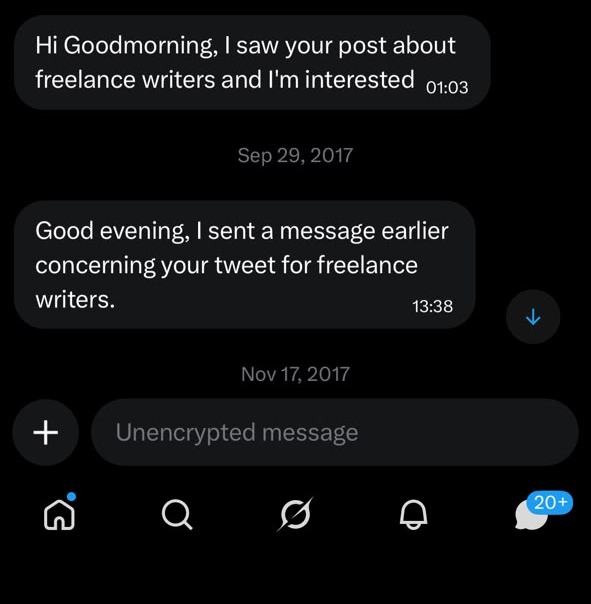
Client requests began arriving faster than he could fulfil them. One day, he posted what he described as an “innocent” message on X, asking whether anyone wanted to take some of the overflow work. He expected two or three responses. According to him, more than 50 people replied.
“It wasn’t pre-planned,” he said. “It was something that just happened and became very big.”
He called the business JDI, short for “Just Do It,” a phrase loosely inspired by Nike. What began as a way to outsource a few articles became a content agency that, over eight years, trained and paid more than 8,000 African writers, according to Otomiewor.
He said many former JDI writers later worked at Nigerian and international media organisations, while others secured roles at global companies, including Amazon.
Helping Nigerian writers reach overseas clients also exposed what Otomiewor considers one of the industry’s largest barriers.
“It was not a skill thing,” he said. “Nigerians here in the US, globally, have the same skill set. [But] we have to work ten times as hard as another person just to get the same opportunity.”
According to Otomiewor, Nigerian freelancers on platforms such as Fiverr were sometimes passed over in favour of equally qualified Western writers for reasons unrelated to the quality of their work. Nigeria ranks among the largest sources of freelancers on global gig platforms, but many of those platforms do not officially support payments to Nigerian accounts, forcing workers to rely on workarounds.
Competing internationally also required upfront costs: a virtual private network (VPN) to bypass geographic restrictions, an international payment solution, and a reliable laptop. Many aspiring freelancers could not afford those tools, he said.
Instead of charging prevailing Western rates from the beginning, Otomiewor deliberately priced his work lower to build credibility.
“If [it’s a gig] an American would charge $20 for, I’d charge $5,” he said. “Do not look at what someone in America or the UK earns. Ask yourself how you can build a reputation to scale.”
He said the approach paid off. Repeat customers became common, referrals brought in new clients, and the lower prices helped him establish a reputation before gradually raising his rates.
According to Otomiewor, his Upwork account generated about $250,000 in lifetime earnings. He said his first Fiverr account earned nearly $400,000 before it was permanently suspended after a mistake by one of the writers working under him. A second Fiverr account, he said, later generated an additional $27,000.
JDI also grew quickly. Before the COVID-19 pandemic, Otomiewor said the agency made about $100,000 in annual profit. As lockdowns pushed more businesses online and demand for content increased, he said weekly profit reached at least $3,000 during its strongest periods, raising annual profit by about 30% to between $130,000 and $140,000.
“Pandemic was a good time for me to reset,” Otomiewor said. “I know it was a bad time for a lot of people, and I don’t want to be insensitive, but we didn’t have issues at JDI. We scaled at that time.”
Leaving a content agency for the United States
Even as JDI expanded, Otomiewor continued to balance the agency with full-time employment and freelance work rather than choosing only one path.
After his daughter was born in 2019, he said fatherhood became his main priority while JDI provided financial support for the family. Outside employment became something he pursued “for the passion, not the money.” It was also during that period, he said, that he bought his first property in Lagos.
In 2022, Otomiewor returned to paid employment, joining Bluecap AI, a Canadian company, as a product marketer after being recruited through his Upwork profile. He said the salary was not the main attraction. He wanted to understand rapid advances in artificial intelligence before they reshaped marketing and content creation.
“Having access to AI at Bluecap was very important for me career-wise,” he said. “Because it showed me what was coming, [and] how to prepare for it.”
Otomiewor said that experience later became one reason he decided to pursue business school.
Around the same period, he also worked as Senior Manager for Market Intelligence and Product Strategy at BitForex, a China-based cryptocurrency exchange. According to him, he led a 15-person team across three countries and helped secure a $50 million strategic partnership that generated an additional $10 million in revenue.
In 2022, he also co-founded Edaki, a startup that has since shut down, with an India-based entrepreneur he met through an online founders’ community. Otomiewor said he saw a gap in African technology coverage, which he believed was heavily focused on payments companies such as Paystack and Flutterwave, while a larger opportunity remained in democratising access to startup investment for founders and first-time investors. At the time, attention in African tech was indeed concentrated on fintech, especially after Stripe’s acquisition of Paystack in 2020 underscored the commercial promise of payments infrastructure on the continent.
He said Edaki matched 30 early-stage startups with first-time investors, managed a $2 million portfolio, and built project management and marketing pipelines for 15 SMEs that increased conversion rates by 30%. He also said cross-functional growth work generated $10 million in annual revenue across the startups Edaki supported.
During this period, Otomiewor was diagnosed with cancer. He later beat cancer, but said the major health change pushed him to pursue many of his life goals sooner. One of those goals was returning to school.
“If I wanted to die, I wanted to read my name with an MBA [Master of Business Administration] at the end of it,” Otomiewor said.
While recovering, his first introduction to business came through a book. He later wanted a more formal education. He enrolled and was admitted to Rochester’s Simon Business School in New York and NYU Stern in New York, but chose the University of Georgia’s Terry College of Business in Georgia, all in the United States.
He said the decision was influenced by Terry College’s fully funded scholarship offer, its track record with Nigerian graduates, and its location in the American South.
“In Nigeria, at the time, I felt like I’d been living the Lagos dream,” Otomiewor said. “You have your own house, your own nice car. Technically, you could just coast through life. I just didn’t want to coast through life.”
He now has a full-tuition scholarship, the Terry Excellence Fellowship, and the National Black Fellow Scholarship. He is completing a dual MBA in strategy, marketing, and management, alongside a Master of Science in analytics.
Otomiewor flew to the United States on July 20, 2025. By then, the relocation was no longer the defining move of his career, but another chapter in one he had spent nearly a decade building.
The move forced a decision he had been able to avoid while managing several ventures from Lagos. Because visa restrictions on international students meant he could no longer legally operate a side business, he said he handed JDI to someone else to run full-time after nearly eight years.
He has since taken on new commitments. Alongside his coursework, he is three months into a project management internship at Peterbilt Motors, a company he noted makes trucks that are familiar on Nigerian roads, though its scale in the US was far larger than he had imagined.
According to Otomiewor, he is also building Aarin, a travel-focused venture shaped by his travel experiences through Lagos, Cape Town, the American South, and beyond.
“There are only things you can dream of based on your environment and your experience,” he said. “I could only dream of creating a company that would change how people see the world because of how I’ve seen the world myself.”
For Otomiewor, migration has provided access to a different calibre of network than the one he had in Lagos. He said it also gave him mobility credibility, allowing him to travel farther and hold investment conversations that were harder to have in his home city.
“It doesn’t matter if you want to stay back in Nigeria. If you want to travel, that’s okay too,” he said. “But it’s always good to see the world, because it changes how you think, what you think is possible, and how you approach solving problems.”
The internet helped Otomiewor build a global career without leaving Lagos. His relocation to one of his preferred countries is now extending that career further.

