EPIRA at 25: Assessing More Lights, Fewer Blackouts, Fewer Subsidies, and Lower Prices
Key Takeaways
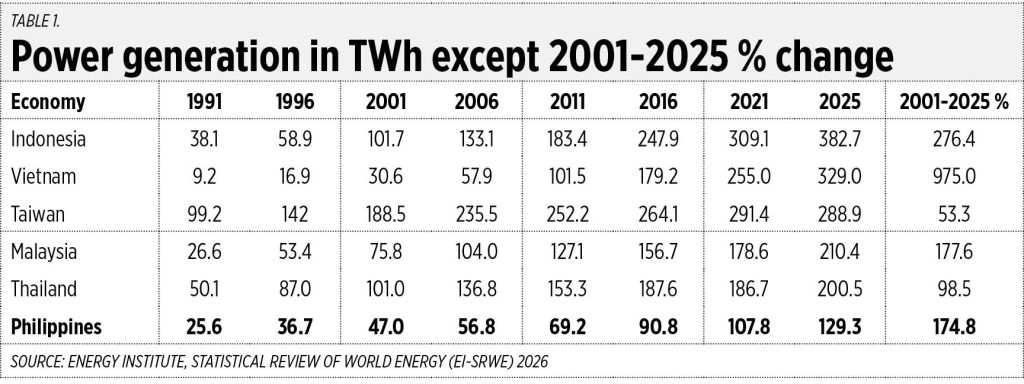
- •Philippine power generation increased 175% from 47 TWh in 2001 to 129.3 TWh in 2025, outpacing Thailand and Taiwan over the same period.
- •Oil-based plants' share of total generation dropped from 21% in 2001 to 0.5% in 2024, the largest decline among the six countries compared.
- •Privatization efforts since around 2005 generated P960 billion for the government, with P523 billion of proceeds going to NPC debt principal amortization.
- •Privatized hydro plants showed efficiency gains: Magat rose from 360 MW to 380 MW, and Ambuklao expanded from 75 MW to 112.5 MW.
- •Excluding post-2001 charges such as ancillary services, UCME, and FIT-All, residential rates of P11.57/kWh would be below the inflation-adjusted 2001 equivalent of P12.40/kWh.
On Sept. 3, I attended the launch of the Department of Energy's book, EPIRA at 25: 25 Years of Power Reform in the Philippines. The volume commemorates the Electric Power Industry Reform Act (EPIRA) of 2001, also known as RA 9136, which turned 25 years old this year. EPIRA was passed amid the fiscal crisis of the state-run National Power Corp. and mandated the restructuring of the power industry into four sectors — generation, transmission, distribution, and supply — along with the privatization of NPC assets and the creation of a wholesale electricity spot market (WESM).
The book's contents were discussed with Energy Undersecretary Rowena Guevarra, who also moderated a panel discussion featuring Energy Secretary Sharon Garin, Energy Regulatory Commission (ERC) Chairman Nino Juan, Independent Electricity Market Operator of the Philippines (IEMOP) President Robin Descanzo, National Electrification Administration (NEA) Administrator Antonio Almeda, and Nicole Kranz, head of Germany's International Climate Initiative (IKI), which supported the book's publication.
So, after 25 years, has EPIRA improved the electricity situation in the Philippines? To answer this question, I assessed five metrics and sub-questions:
1.) Was there a substantial increase in power generation?
2.) Was there a shift from expensive oil to cheaper non-oil electricity sources?
3.) Were taxpayers unburdened from the fiscal bleeding of the National Power Corp. (NPC)?
4.) Were there efficiency gains from the privatization of power generation assets?
5.) Are electricity rates cheaper now than pre-EPIRA?
1. Substantial increase in power generation: Yes.
Philippine power generation rose substantially, from 47 terawatt-hours (TWh) in 2001 to 129.3 TWh in 2025 — a 175% increase over 24 years. This outpaces the 98% increase recorded by Thailand and the 53% increase in Taiwan over the same period, and is similar to Malaysia's 178% increase (see Table 1). The growth reflects both population and economic expansion over the period, during which the Philippines ranked among the faster-growing economies in Southeast Asia.
2. Shift from oil to non-oil sources: Yes.
The share of oil-based plants in total generation fell from 21% in 2001 to just 0.5% in 2024, a decline of 20.4 percentage points — the largest among the six countries compared (see Table 2).
For historical context: oil accounted for 50% of total generation in 1985, when the Bataan nuclear power plant was not allowed to operate and was then officially killed in 1986 with no alternative offered. By 1991, oil's share in power generation remained at 50%, and daily blackouts occurred nationwide. In 1992, the government took the desperate measure of entering take-or-pay contracts with independent power producers (IPPs), which delivered even more oil plants. By 1996, blackouts had declined, but oil still made up 50% of total power generation.
3. Unburdening taxpayers from NPC's fiscal bleeding: Yes.
Prior to EPIRA, the NPC was the single biggest budget deficit generator in the Philippines year after year. Its liabilities reached P831 billion in 2001 and peaked at P1.2 trillion in 2003 as contractual obligations were fully recognized. Following a series of privatization efforts that began around 2005, the government generated P960 billion as of March this year.
Breaking this down: the privatization of NPC power plants generated P218 billion; the privatization of NPC contracts through the IPP Administrators (IPPAs) framework brought in P449 billion in revenue; and the privatization of the transmission concession generated P260 billion.
The IPPAs framework transferred the offtake position — "the right and obligation to take the output of the plant, dispatch into the market or into bilateral arrangements and pay the developer under the contract terms," as explained in the book.
The transmission assets themselves were not privatized; they remain owned by the government through the National Transmission Corp. (Transco). What was transferred was the transmission concession — the National Grid Corp. of the Philippines (NGCP) paid an upfront concession fee of P223 billion, plus a balance of P37 billion to be paid in the future, to the Power Sector Assets and Liabilities Management Corp. (PSALM). NGCP also pays operational revenues to Transco, which the latter uses for its regular operations.
The bulk of privatization proceeds — P523 billion out of P897 billion collected as of last March — went to debt service (principal amortization) of NPC debts. Another P301 billion covered interest expenses or lease obligations, and P58 billion went to debt prepayment (see Table 3).
4. Efficiency gains from privatized generation assets: Yes.
Two examples illustrate this. First, the Magat hydroelectric power plant (HEPP), whose original installed capacity was 360 megawatts (MW), reached 380 MW after its privatization in 2007. Second, the Ambuklao HEPP, with an original capacity of 75 MW, expanded to 112.5 MW — an increase of 37.5 MW achieved without raising the height of the dam. Both plants are owned by SN Power (Norway) – Aboitiz Power (SNAP). Norway is among the most sophisticated hydropower producers in the world.
5. Cheaper electricity rates than pre-EPIRA: Yes.
Until June 2001, when EPIRA was enacted, Meralco's average residential rate was P4.87 per kilowatt-hour (kWh). After EPIRA, a mandated P0.30/kWh reduction for residential users took effect starting August 2001. Under EPIRA, rates are unbundled so that consumers can see the separate cost components — generation, transmission, distribution, taxes, and other charges — on their bills.
In today's prices, the 2001 rate of P4.87/kWh is equivalent to P12.40/kWh. Meralco's residential rate in February this year, before the Iran war started, was P13.17/kWh. However, current prices include charges that did not exist in 2001 or even a decade later — such as the ancillary service (AS) charge of around P1/kWh within the transmission charge, the universal charge for missionary electrification (UCME) of P0.27/kWh, and the feed-in tariff allowance (FIT-All) of P0.21/kWh, which increased to P0.34/kWh starting last August.
Removing those items alone (P1 AS + P0.12 VAT on AS + P0.27 UCME + P0.21 FIT-All = P1.60), residential customers would have paid only P11.57/kWh (P13.17 minus P1.60) — lower than the inflation-adjusted P12.40/kWh of 2001.
Conclusion
Looking at EPIRA at 25: Are there more lights, fewer blackouts, fewer subsidies, and lower prices? Yes — hands down. EPIRA does not need a major overhaul. What needs a major overhaul is the Renewable Energy Act of 2008 (RA 9513), which contains many provisions that favor renewable energy and promote cronyism in the sector. Readers tracking the next phase of Philippine power policy will be watching how Congress and the ERC treat proposed amendments to RA 9513, the implementation of rising FIT-All and ancillary charges, and whether the targeted supply buildout materializes in the coming years.
The real energy transition the country should aspire to is not a move toward renewable energy, but the transition from energy poverty to energy abundance. The Philippines should target increasing its power supply from 129 TWh in 2025 to 170 TWh by 2030 — an increase of 8 TWh per year versus the current 5 TWh per year — and further to 220 TWh by 2035, or 10 TWh per year starting 2030.
The country should be building more coal and gas plants, such as the approved and committed coal plant project in Atimonan, a 1,200-MW super-critical plant in Quezon Province. It should also pursue nuclear plants soon to ensure sustained large annual increases in power supply — a step toward Philippine energy abundance.
Bienvenido S. Oplas, Jr. is the president of Bienvenido S. Oplas, Jr. Research Consultancy Services, and Minimal Government Thinkers. He is an international fellow of the Tholos Foundation.
Email: minimalgovernment@gmail.com
