Electra/Persona at the National Theatre review: A dull mash-up of Sophocles and Bergman
Key Takeaways
- •Electra/Persona at the National Theatre's Lyttelton Theatre received a two-star review combining Sophocles' Electra with Bergman's film Persona.
- •Cate Blanchett and Nina Hoss alternate the roles of Electra and Clytemnestra each night, decided by an audience member's coin toss, a device borrowed from Danny Boyle's 2011 Frankenstein production.
- •The second act adapts Bergman's Persona, with Blanchett as a silent actress and Hoss as her talkative nurse, accompanied by live black-and-white close-up video projected onto a large screen.
- •The reviewer praised the production's visual artistry, including dry-ice clouds and smoke effects, but found the abstract exchanges dull and the mash-up's meaning unclear.
- •Blanchett and Hoss received louder applause for the pre-show coin toss than for the performance itself at the curtain call.
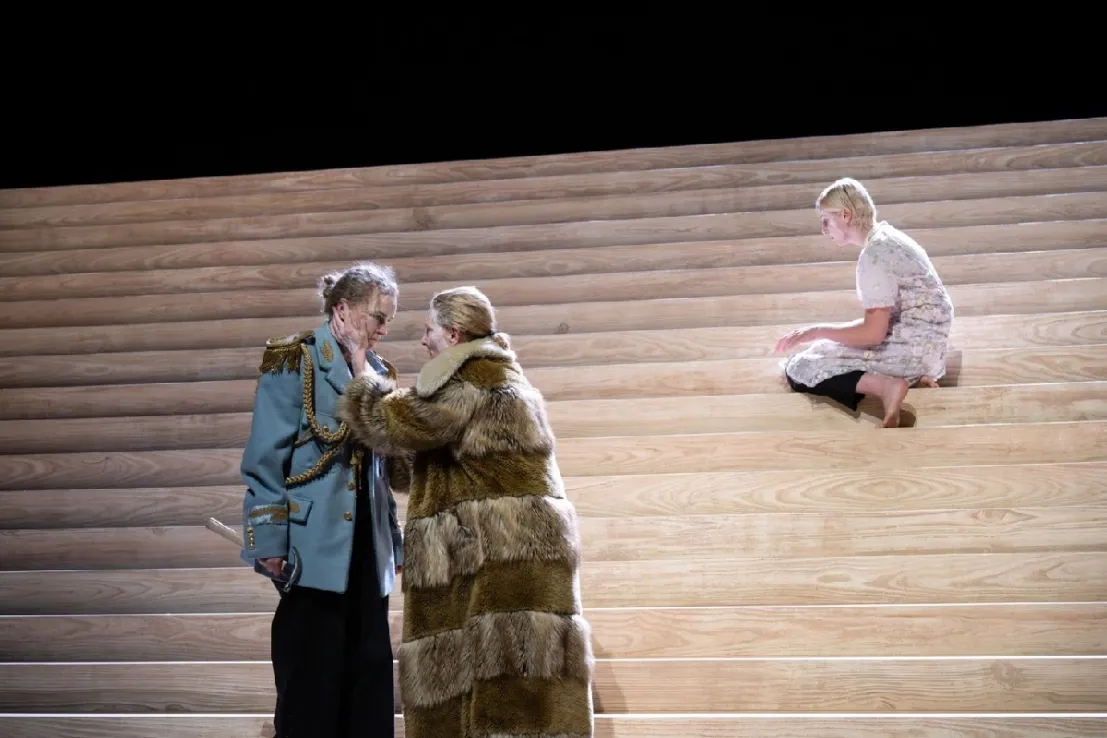
Electra/Persona | National Theatre (Lyttelton) | ★★☆☆☆
The most generous thing that can be said of Cate Blanchett's new play Electra/Persona is that it improves on the last Electra this reviewer saw (spelled with a 'k' on that occasion). Last year, Ms Marvel star Brie Larson took the lead in Sophocles' tragedy, singing and yelling through a baffling series of one-sided conversations while robotic arms sprayed her and the rest of the cast with black paint. That production was described as "ambitiously avant garde yet utterly inscrutable" — and much the same criticism applies here.
This time, Blanchett and Nina Hoss (who appeared together in the film Tar) play the angry young Electra and her mother Clytemnestra. Borrowing a device from Danny Boyle's 2011 production of Frankenstein, in which Benedict Cumberbatch and Jonny Lee Miller alternated the roles of doctor and monster, Blanchett and Hoss have an audience member flip a coin each night. On this occasion it came up tails: Blanchett played Electra.
Like the Brie Larson production, Electra/Persona unfolds on a big, stark, empty stage — here given over entirely to a vertiginous flight of stairs. The greatest tension of the evening was the fear that one of the performers might turn an ankle tottering up and down them.
The first act retells the story of Electra and Clytemnestra, which runs, coincidentally, in parallel to the events of Christopher Nolan's record-breaking box-office smash The Odyssey. (Greek myth is having a moment on screen and stage alike: Blanchett herself is among the starry ensemble Nolan has assembled for his Homeric epic.) Electra is angry that her mother murdered her father Agamemnon in his bathtub on the day he returned victorious from the Trojan war. In fairness, Clytemnestra was angry that Agamemnon had sacrificed one of their daughters in exchange for fair winds to carry his fleet to Troy — bound to cause something of a domestic. The pair bicker, reconcile, and force each other to reenact the murders of their loved ones, but it is all strangely dull. Blanchett brings a sinewy, feline magnetism, yet even her star power cannot illuminate these dense, abstract exchanges.
As the title suggests, the production is not solely a retelling of Electra: it is also a spin on Ingmar Bergman's 1966 film Persona, in which an actor playing the Greek princess suffers a breakdown and becomes mute mid-performance. Bergman's original — in which a stage actress famously falls silent mid-performance and is cared for by a talkative nurse — is widely regarded as one of the most influential art-house films of the twentieth century, so the comparisons it invites are unforgiving. Blanchett thus becomes the silent actor Elisabet Vogler and Hoss her loquacious nurse. This act also introduces live video, with high-definition black-and-white footage beamed onto a huge screen lowered onto the stage. Blanchett's face in extreme close-up as she hides beneath a fur coat. Blanchett's face in extreme close-up as she reclines on a beach. Blanchett's face in extreme close-up as she sits beside a campfire. It is essentially all Cate Blanchett's face, narrated by a chatty nurse.
The production is at least visually arresting, filled with moments of exceptional artistry. Dry-ice machines create small clouds that hang in the air; during the murder of Aegisthus, Electra spits viscous, blood-red liquid over him; smoke tumbles down the steps like a slow-motion river.
The second act does capture some of the surreal, dreamlike quality of Bergman's masterpiece — but only some. In the end, the frustrations outweigh the appreciation. It remains unclear why audiences are presented with this strange mash-up of a classic Greek text and a classic modern film. What exactly is it trying to say? That in a patriarchal society, women are still pitted against one another? That grief is so powerful a force it spans millennia?
Electra/Persona is a long and plodding journey without any particular destination, albeit one with moments of real beauty along the way. It is telling, perhaps, that Blanchett and Hoss received a bigger round of applause when they appeared at the start to flip the coin than they did after the curtain came down.
Source: City AM
