edgeX Lands on Arc: 7×24 FX Perpetuals, the Yen Market, and Native USDC Settlement
Key Takeaways
- •edgeX plans to launch on the Arc mainnet on September 16, 2026 as a day-one partner, following a September 3, 2026 announcement.
- •The planned launch includes 24/7 FX perpetuals starting with the Japanese yen and more than 150 perpetual markets spanning US equities, commodities, and crypto.
- •All announced markets are intended to use native USDC as the margin and settlement asset, which also serves as Arc's gas token.
- •Circle Ventures is an investor in edgeX, and the two have previously collaborated on native USDC issuance and a CCTP integration on EDGE Chain.
- •The announcement covers planned scope rather than verified product details, so traders must confirm contract specifications, regional access, and launch status through official channels.
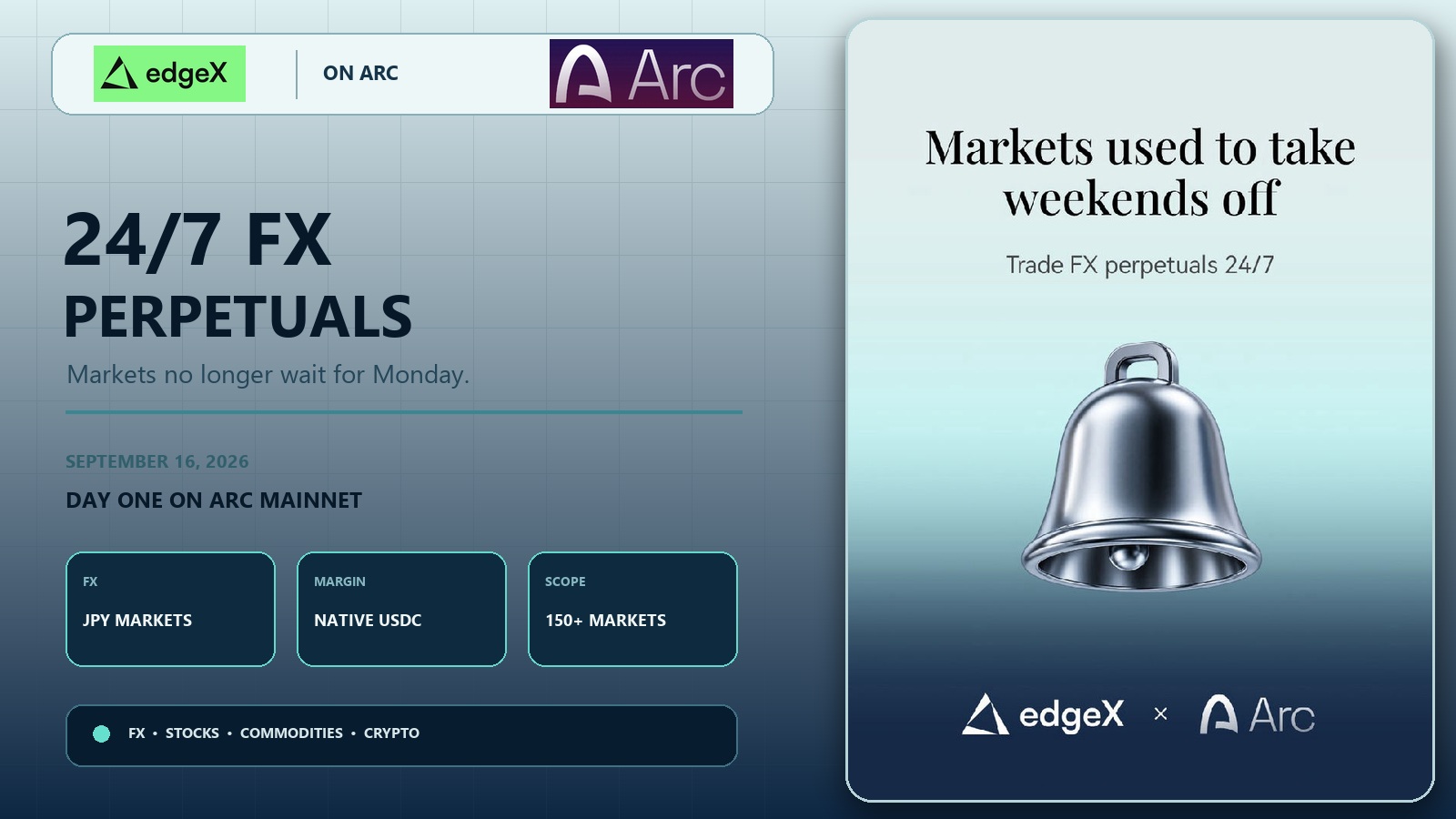
edgeX's planned launch on Arc brings market structures familiar from crypto—FX perpetuals, continuous trading, order books, and USDC margin—into the foreign exchange arena. The opportunity lies in access outside banking market hours. The test is whether pricing, liquidity, funding rates, and liquidation remain reliable when the underlying FX market is thin or closed.
Arc and edgeX announced the integration on September 3, 2026. Information is accurate as of that date. The Arc mainnet and edgeX's deployment are both scheduled for September 16, 2026, so traders must verify product availability, specifications, supported regions, and launch status before using the platform.
Quick answers
edgeX on Arc is an announced day-one market-layer integration on the Arc mainnet. According to the launch materials provided, the plan combines FX perpetuals (initially focused on the Japanese yen) with more than 150 perpetual markets covering US equities, commodities, and crypto. All announced markets are expected to use native USDC as the margin and settlement asset.
The strategic significance goes beyond adding one more chain to an exchange. Arc is designed around stablecoin-native finance, USDC-paid gas, and fast deterministic settlement. edgeX provides the trading venue and the order book layer. If the launch generates durable liquidity, it will demonstrate how dollar margin, global macro exposure, and continuous on-chain trading can converge on the same settlement rail.
The announcement defines scope, not trading rules
Arc's official X post stated that edgeX plans to launch around-the-clock perpetuals from day one, including FX and more than 150 announced markets spanning equities, commodities, and crypto, and explicitly identified native USDC as the margin and settlement asset.
https://x.com/arc/status/2095315841885905136
edgeX's X post emphasized the product points: "7×24 FX perpetuals," September 16, and the Arc mainnet. Together, the two posts
confirm the direction and planned timing, but they do not provide a complete rulebook for the contracts.
https://x.com/edgeX_exchange/status/2095315978015924332
Separating confirmed scope from launch-day reality
A market count does not reveal which pairs will open first, how much depth each market will carry, or who will be able to use them. Before trading, confirm the exact contracts, quotation conventions, indexes, tick sizes, minimum order sizes, fees, funding-rate arrangements, leverage, margin tiers, liquidation processes, withdrawal channels, and jurisdictional terms.
"Day one" should also be verified in production. A phased rollout or restricted markets are not necessarily failures, but readers should not interpret forward-looking statements to mean every announced feature is live.
| Announcement claim | Confirmed direction | To verify on launch day |
|---|---|---|
| 7×24 FX perpetuals | Continuous FX derivatives planned | Open pairs, maintenance rules, and regional access |
| 150+ markets | Cross-asset scope announced | Actual instruments, depth, and specifications |
| Native USDC | Margin and settlement intended in USDC | Deposit channels, margin rules, fees, and withdrawals |
| September 16 | Mainnet and deployment share the same planned date | Production status and any phased restrictions |
FX perpetuals trade exposure, not currency delivery
FX perpetuals track a reference price for a currency, with no fixed expiry. Traders can take long or short exposure while keeping margin on-platform, without delivering yen or dollars through bank accounts. Positions are marked to an index or mark price and can be held indefinitely as long as margin requirements are met.
Funding rates tether perpetuals to their reference price
Because the contracts do not expire into delivery, a funding-rate mechanism transfers value between long and short positions to discourage persistent divergence. A trader can be right on direction and still lose expected gains if funding remains persistently expensive. The funding formula, interval, caps, and settlement times should therefore be built into trading logic.
The last-traded price shown does not necessarily determine liquidation. Platforms typically use a mark price designed to resist manipulation. Traders need to know which price drives unrealized PnL, margin calculations, and forced reductions.
Order books make bids, offers, and executable depth visible, but the top of book does not represent the whole market. Check slippage at intended size, how quickly quotes replenish after fills, and whether market makers stay active during volatility and off-hours.
The yen tests the value and risk of around-the-clock FX
The yen ties together monetary policy, global financing, interest-rate differentials, trade, and risk sentiment. Bank of Japan decisions, Japanese economic data, US Treasury yields, intervention signals, or geopolitical news can all move yen exposure beyond a single region's trading hours.
Weekend price discovery can become fragile
Perpetuals that stay open around the clock let traders react when traditional spot markets are thin or closed. That access is useful, but the perpetual may temporarily become the primary venue reflecting new information. When deeper traditional liquidity returns, spreads can widen, market makers can scale back, and prices can gap.
During these periods, index design matters enormously. Traders should know which sources feed the calculation, how stale data is handled, whether outliers are filtered, and what happens over holidays. A robust methodology has a clear answer for when reference-market data is partially unavailable.
Quotation conventions matter just as much. USD/JPY and JPY/USD move inversely in numerical terms. The interface should clearly show the pair, contract multiplier, settlement unit, and what a long position means. Never infer direction from the word "yen" alone.
Native USDC simplifies margin, not risk
Arc positions USDC as its network fee asset, and edgeX plans to use native USDC for margin and settlement. This alignment can remove the need to hold a second, volatile token just to pay gas, and keeps deposits, trading equity, realized PnL, and withdrawals all in dollar-denominated units.
Circle describes USDC as redeemable 1:1 for US dollars and backed by highly liquid cash and cash-equivalent assets. This issuer framework underpins the settlement asset, but it does not guarantee the safety or performance of the exchange, its contracts, or leveraged positions.
Fast settlement is only one layer
Arc's documentation states that it achieves deterministic finality within one second. Fast, irreversible settlement helps deposits, withdrawals, margin
updates, and risk handling. Execution, however, also depends on edgeX's order book, matching and risk engines, price feeds, interface, and liquidity providers.
A trade can settle correctly on-chain while the trader receives poor execution. A deep order book can be nullified by an unavailable deposit channel or delayed withdrawals. Chain and platform performance must be assessed together.
Circle's CCTP can move native USDC between supported networks via a burn-and-mint mechanism. Traders should use only channels documented as live for Arc, and confirm fees, completion stages, and recovery steps, rather than assuming earlier EDGE Chain integrations apply automatically.
Liquidity determines whether 7×24 is useful
Platform uptime does not equal continuously executable liquidity. FX participation typically shifts across Asian, European, and US sessions, and drops around weekends and holidays. On-chain markets can stay open, but their spreads and depth can change materially.
Read volume together with spreads and depth
Volume alone may reflect incentives, rapid turnover by a few accounts, or day-one curiosity. More valuable evidence includes two-sided depth at realistic size, limited slippage, quote replenishment after fills, balanced participation, returning users, and reliable deposits and withdrawals.
Funding rates and open interest add context. Persistently one-sided funding may reveal crowded positioning or weak tethering to the reference price. Large open interest only matters if liquidation and insurance systems can absorb stress without chaotic loss allocation.
Continuous trading still needs interruption rules
"7×24" does not mean every component runs without maintenance or degradation. Traders should know whether the platform can enter cancel-only mode, pause new orders, halt a specific market, or delay deposits and withdrawals while existing positions keep moving. The rulebook should explain how funding rates, mark prices, stops, and liquidations behave in each state.
Status communication is part of execution quality. A public incident channel should state affected services, start times, current mode, and recovery steps. Traders also need a way to cancel risk independently if the main interface fails, such as a documented API or alternative access path. Without these controls, continuous availability can increase risk—keeping leveraged positions active at moments when users cannot manage them.
| Metric | Positive signal | Warning signal |
|---|---|---|
| Spreads | Stable at realistic size across sessions | Tight top-of-book quotes with thin depth behind |
| Depth | Two-sided liquidity replenished after fills | Quotes vanish during volatility |
| Funding rates | Responsive without dominating expected returns | Persistently extreme or unexplained swings |
| Index and mark price | Transparent, resilient source methodology | Stale off-hours data or unexplained divergence |
| Operations | Predictable funding and withdrawal status | Delays with unclear recovery |
| Retention | Activity persists after launch hype fades | Volume collapses when incentives shrink |
Margin and liquidation define downside risk
USDC margin clarifies the unit of margin, not the size of risk. Leverage magnifies small FX moves, fees, funding rates, and slippage. Before opening positions, traders should understand initial margin, maintenance margin, maximum leverage, isolated or cross mode, portfolio offsetting, and liquidation fees.
Model the exit before the entry
Liquidation begins when account equity no longer meets the maintenance margin requirement. The platform may partially reduce or fully close positions. Its insurance fund or backstop process determines how remaining losses are handled. These rules matter most during gaps, shallow order books, and oracle outages.
Cross mode can improve margin efficiency but lets one position consume equity supporting another. Isolated mode contains exposure but may be liquidated earlier because it cannot draw on broader account funds. Neither is inherently better; the choice should match how the trader controls losses.
Use limit orders when execution price matters, but understand they may not fill. Use reduce-only controls when an exit order must never open a position in the opposite direction. Verify stop-loss behavior, price bands, circuit breakers, maintenance windows, API limits, and the platform's incident process.
| Risk layer | Question before trading | Evidence needed |
|---|---|---|
| Contract | What exactly does a long position track? | Pair convention, multiplier, index, mark price |
| Cost of carry | How much could funding cost over the holding period? | Formula, interval, caps, historical behavior |
| Execution | Can intended size enter and exit smoothly? | Spreads, depth, slippage, order controls |
| Liquidation | When and how is exposure cut? | Margin tiers, fees, insurance, loss allocation |
| Operations | Can margin move when needed? | Supported channels, wallet flow, withdrawal status |
| Access | Is this user permitted to use the market? | Current product and jurisdictional terms |
Judge the launch by market-infrastructure standards
The launch succeeds only if different types of participants keep returning: market makers quoting both sides, arbitrageurs aligning prices, directional traders taking risk, hedgers paying to shift exposure. More than 150 instruments only matter if a useful subset of them forms reliable markets.
For Arc, edgeX is a test of whether a stablecoin-native chain can support active financial markets, not just payments. For edgeX, Arc provides a settlement layer whose fee asset matches the platform's planned margin. The strategic fit is clear; the production economics remain unproven.
Track spreads, depth, funding rates, open interest, liquidation events, index behavior, channel reliability, withdrawals, and activity across regional sessions. Compare the first week against the following months. Sustained usage after incentives and publicity fade says more than the highest market count or total volume.
Investor summary
edgeX on Arc combines continuous FX access, recognizable yen macro exposure, order books, and native USDC margin. Each benefit carries a corresponding dependency: off-hours access requires resilient pricing, leverage requires transparent liquidation, and unified margin requires reliable chain and platform operations.
The decisive evidence will come from execution quality and repeated behavior. Investors should look past announced instruments toward two-sided depth, funding-rate stability, reliable deposits and withdrawals, risk controls, and sustained participation across sessions.
Final point
This integration is a credible test of around-the-clock, stablecoin-settled macro markets. It becomes usable infrastructure only if traders can understand the contracts, obtain fair execution, manage leverage, and move USDC reliably under both normal and stressed conditions. Those facts emerge after launch, not in the announcement.
edgeX joins Arc as a day-one partner
Markets have always followed the money. Today, the money is moving on-chain.
edgeX is scheduled to launch on the Arc mainnet on September 16, 2026, bringing new FX perpetuals to Arc's native FX engine, along with 150+ markets covering equities, commodities, and crypto. All markets will use native USDC for margin and settlement.
The launch builds on edgeX's long-standing relationship with Circle. Circle Ventures is an investor in edgeX, and the two teams have previously collaborated on native USDC issuance and a CCTP integration on EDGE Chain. Arc is a natural next step for edgeX's global around-the-clock markets, running on a USDC-native settlement layer.
Day-one launch
- On-chain FX perpetuals, starting with the Japanese yen, built on Arc's native FX engine.
- 150+ perpetual markets covering US equities, commodities, and crypto, all margined and settled in native USDC.
What edgeX is exploring next
- Additional FX pairs prioritized by liquidity and demand.
- FX spot markets, starting with USDC against non-USD stablecoins.
- Non-USD stablecoins as margin, letting traders hold, hedge, and trade without converting back to dollars.
Arc is designed as a 7×24 economic operating system for internet-native money, with USDC-paid gas, institutional-grade settlement, and a native FX engine. edgeX supplies the market layer: an order-book exchange now scaling its 7×24 equities, commodities, and crypto markets into FX.
Every trade on edgeX supports USDC's broader role as the settlement currency of internet-native finance, while giving USDC holders direct access to global markets.
FAQ
What is edgeX on Arc?
edgeX plans to launch on the Arc mainnet as a day-one partner on September 16, 2026. Arc's announcement states that the planned deployment includes around-the-clock FX perpetuals and more than 150 markets covering equities, commodities, and crypto, using native USDC for margin and settlement.
What did Arc and edgeX announce on X?
Arc announced the day-one integration, around-the-clock perpetuals, the scope of more than 150 planned markets, and native USDC margin and settlement. edgeX announced 7×24 FX perpetuals launching September 16 on the Arc mainnet.
Why start with yen perpetuals?
The yen ties the platform to one of the world's major funding and macro currencies. It offers a useful test of around-the-clock price discovery, especially when policy or geopolitical news breaks outside the most liquid traditional sessions.
How do FX perpetuals work?
They provide long or short exposure to an FX reference price, with no fixed expiry and no physical currency delivery. The platform must use indexes, mark prices, margin rules, and typically a funding-rate mechanism to manage the relationship between the perpetual and its reference market.
Why does native USDC settlement matter?
USDC serves both as the announced margin and settlement unit and as the asset for paying Arc network fees. This can simplify margining and bookkeeping, but it does not eliminate market, liquidation, smart-contract, stablecoin, or operational risk.
Does 7×24 mean liquidity is always the same?
No. A platform can stay continuously open, but spreads, depth, funding rates, and price quality will vary across regional sessions, weekends, holidays, and volatility events.
Are all 150+ markets guaranteed to launch on September 16?
Arc's post describes a planned launch scope. Traders should verify the markets actually open, their specifications, and availability through official product channels on or after launch day.
