Nearly 10% of Euro-Area Stablecoin Holders Carry €10,000 or More, ECB Survey Shows
Key Takeaways
- •An ECB Economic Bulletin box published on November 11 estimates that close to 10% of stablecoin owners in the euro area hold €10,000 or more, drawing on experimental modules of the Consumer Expectations Survey fielded in August and November 2025 across the 11 largest euro-area countries.
- •The ECB judges current stablecoin exposures to pose limited risk to financial stability because they are a small share of consumers' financial assets on average, while flagging that runs, spillovers from liquidating dollar reserves, and currency substitution would grow if use broadened beyond crypto trading.
- •Dollar-referenced tokens dominate euro-area holdings, with 17% of crypto-owning respondents holding USDT and 12% holding USDC versus 10% for euro-denominated EURC, and hypothetical scenarios show a stronger euro plus a market discount could erase almost 12% of a €10,000 position even with the dollar peg intact.
- •The survey does not capture the purpose of stablecoin holdings or the other assets held by high-balance households, so the €10,000 figure identifies who is exposed rather than how severely, a household-level question the data leaves unanswered.
- •A Banca d'Italia mystery-shopping exercise that sent 200 USDC from Italy to five other countries found no systematic cost advantage over conventional remittance channels, with end-to-end times ranging from under 20 minutes to one or two business days.
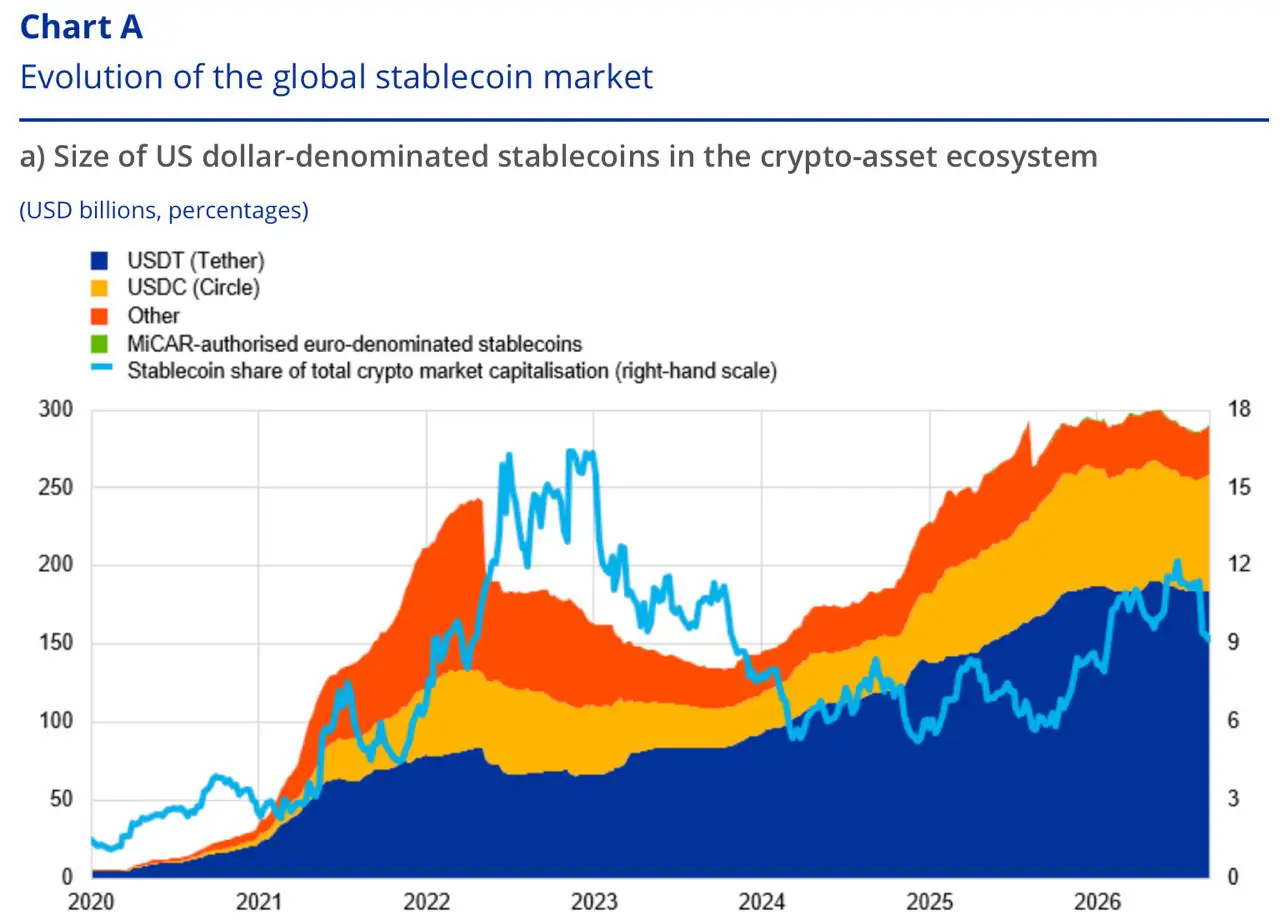
Close to 10% of stablecoin owners in the euro area are estimated to hold €10,000 or more, according to a box published in the European Central Bank's Economic Bulletin on November 11. The findings rest on experimental modules of the ECB's Consumer Expectations Survey, conducted in August and November 2025 across the 11 largest euro-area countries.
The ECB's headline conclusion is that current exposures pose limited risk to financial stability. On average, stablecoins are a small slice of consumers' financial assets and sit alongside other crypto holdings. The same box, however, contains a figure that averages hide: a cohort of owners with five-figure balances, most of it denominated in dollar tokens. System-level risk and household-level risk are different questions, and the second is the harder one to answer from this data.
What the Survey Measured, and How
In August 2025, 13% of respondents said they or someone in their household owned crypto-assets, up from 9.8% in November 2024. Five percent reported owning stablecoins — more than a third of all crypto owners.
The amounts came from a separate module fielded in November. Respondents with any crypto investment were asked whether their holdings were mostly stablecoins or mostly other tokens, on a five-point scale. The ECB converted those answers into weights of 0, 0.25, 0.5, 0.75 or 1 and applied them to each respondent's self-reported crypto investment. The result is an estimate, not a reported balance.
That estimate is skewed toward small amounts, yet close to 10% of stablecoin owners were calculated to hold €10,000 or more. The ECB calls this a “substantial range” and flags the obvious weaknesses: an experimental questionnaire design, small samples — the composition figures rest on 1,286 crypto-owning respondents — and the chance that people under-report assets they consider sensitive.
Two things the survey does not capture matter for everything that follows. It does not ask what the tokens are for. And while it reports average stablecoin shares of financial assets across all owners, it does not show the other assets held by the specific households at the top of the distribution.
€10,000 Is Half of One Household and 5% of Another
Two households each hold €10,000 in stablecoins. One has €20,000 in total financial assets; the other has €200,000. The first has half its liquid wealth in a token, the second a twentieth. The ECB's figure counts both once, in the same bucket.
Purpose changes the picture as much as proportion. A balance earmarked for next month's rent and a balance parked between crypto trades carry the same number but not the same consequences if conversion is delayed. For the first household, a stalled withdrawal is a missed payment; for the second, an inconvenience.
The survey says nothing about either variable, so the €10,000 figure is a count of exposures, not a measure of them. And because the ECB finds that dollar-referenced tokens dominate euro-area holdings, there is a second layer the euro figure conceals.
The Peg Can Hold While the Euros Shrink
Among respondents with crypto, 17% held USDT and 12% held USDC, against 10% for the euro-denominated EURC. For most of this cohort, the money is denominated in dollars and spent in euros.
A dollar token can trade at exactly $1 for a year and still buy fewer euros in December than it did in January. The box illustrates what happens to a €10,000 position in dollar tokens under four hypothetical conditions, including the one the prose rarely mentions: a stronger euro and a market discount at the same time. The values are hypothetical, not observed prices — euro value equals tokens multiplied by the dollar price, divided by dollars per euro, rounded to the nearest euro, before fees and taxes.
The last scenario is the one worth sitting with. Neither event on its own is dramatic, yet together they take almost 12% off a position whose issuer never missed a redemption. A deposit account in euros would have lost nothing. The reverse also applies: a weaker euro would lift the euro value of the same tokens, which is the position of someone saving for a dollar invoice rather than a euro bill.
The discount scenarios describe what a seller gets on an exchange. They say nothing about what an eligible holder is owed by the issuer, and that distinction decides how much of the exercise applies to any given household.
The Route From Token to Euros
A joint factsheet from the EU supervisory authorities explains that an e-money token authorised under MiCA gives its holder a right to redeem in the referenced currency. Which protections apply depends on the token and the provider.
Circle's EU white paper for USDC shows what that looks like in practice: EEA holders have a dollar redemption claim, subject to Circle's procedures, and the token sits outside the EU deposit-guarantee and investor-compensation schemes. A holder with that claim can redeem at par; a holder who instead sells on an exchange takes whatever the market pays. Both then still have to turn dollars into euros.
Where the balance sits adds a step before either option. Tokens on an exchange can be sold or withdrawn only when the platform allows it. Tokens in a self-custodied wallet depend on the holder keeping the keys and sending a valid transfer.
Timing matters for the USDT share in particular. The survey was taken in August 2025; since the MiCA transition period ended on July 1, 2026, licensed EU exchanges no longer list USDT, which Tether did not seek to authorise. Holding it remains legal, but a euro-area owner who kept it now has to sell on a decentralised or non-EU venue, or hold it in self-custody, before any conversion to euros can begin.
How those bottlenecks play out when holders actually try to leave is the subject of a separate Coindoo analysis on stablecoin cash-out access, prompted by a Fed official's doubts about the same promise.
Does the Payments Case Hold Up?
The ECB itself raises the possibility that some of this money is for payments rather than trading. Foreign-born respondents were 2.1 percentage points more likely to hold stablecoins than domestic consumers after controlling for other characteristics, a pattern the box describes as consistent with cross-border payments or remittances. It is a correlation in a survey that does not ask about use, and the ECB presents it as no more than that.
The one direct test cited in the box is a mystery-shopping exercise published by Banca d'Italia in July. Researchers sent 200 USDC along corridors linking Italy with five other countries, using selected providers and mainly the Ethereum network, with Japan handled separately. They found no systematic cost advantage over conventional remittance channels, and end-to-end times ranged from under 20 minutes to one or two business days depending on how the money was loaded and withdrawn.
For the family on the receiving end, the comparison that counts is local currency in hand, after conversion and waiting. The blockchain transfer is the quick middle leg of a journey that starts and ends in bank accounts and exchange desks, and the Italian test suggests those legs are where the time and cost sit.
What the Box Leaves Open
The ECB lists three vulnerabilities it says would grow if stablecoin use broadened beyond crypto trading: runs and de-pegging, spillovers from liquidating dollar reserves, and currency substitution away from the euro. Those are system-level concerns, and the ECB is explicit that the EU's MiCA framework reduces many of them.
The household-level question is narrower and remains unanswered by this data. The survey can now count the euro-area owners holding €10,000 or more in tokens. It cannot say whether that balance is discretionary trading money or the only buffer a household has — and until it can, the headline number describes who is exposed, not how badly.
Source: Coindoo

