DPWH’s 2027 Budget Proposal Raises Questions Over Project Priorities
Key Takeaways
- •The Road sector would receive the largest infrastructure share at 38.5%, followed by the Convergence and Special Support Program at 27.4%.
- •Flood Management is allocated P103.45 billion for fewer than 300 projects, compared with more than 1,800 projects in the previous year’s expenditure program.
- •DPWH’s proposed P9.97 billion allocation for flood-control work in Metro Manila exceeds the Metropolitan Manila Development Authority’s P3.9 billion budget despite the MMDA’s designated primary responsibility.
- •Santiago recommends reducing tertiary-road and right-of-way allocations and transferring water and sewerage projects to the Local Water Utilities Administration.
- •He proposes using multi-purpose buildings as classrooms when needed and requiring local governments to finance facilities that fall within their responsibilities.
The Department of Public Works and Highways (DPWH) is seeking P643.95 billion in funding for 2027, about 26.8% less than its proposal from the previous year.
Infrastructure accounts for approximately 89% of the total, or P572.92 billion, divided among six program categories. The Road sector, covering networks and bridges, receives the largest share at 38.5%, followed by the Convergence and Special Support Program (CSSP) at 27.4%. Flood Management ranks third at 18%, a reduction that infrastructure and transportation specialist Rene S. Santiago considers understandable because the agency has yet to complete flood-control master plans for most of the country’s 18 major river basins with large drainage areas.
Santiago describes the overall proposal as credible and justifiable. He particularly points to the Flood Management program, which contains fewer than 300 projects, compared with more than 1,800 in the previous year’s National Expenditure Program (NEP). The proposed 2027 allocation is P103.45 billion, equivalent to 44% of the 2026 allocation and about 25% of this year’s General Appropriations Act (GAA).
He identifies the division of responsibility for flood-control management in the National Capital Region as a continuing concern. Under Executive Order No. 52, s1986, the Metropolitan Manila Development Authority (MMDA) should by now have assumed primary responsibility. However, the DPWH’s proposed allocation for the region, at approximately P9.97 billion, is larger than the MMDA’s P3.9 billion.
Santiago says the proposed P76.5 billion allocation for Asset Preservation should be the last area considered for cuts because such projects typically generate the highest economic returns.
Scrutiny of the CSSP
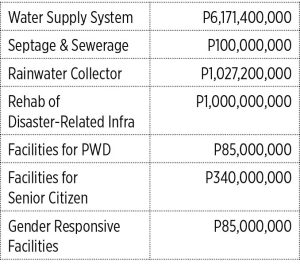
The Capital Outlay component of the CSSP, which is seeking P157.3 billion, warrants closer examination, according to Santiago. Although the amount is below the historical average of P350 billion, he cites a previous warning from former DPWH Secretary Rogelio Singson, who described the program as “suspicious.”
Santiago argues that the program’s final four items resemble blank checks because their scopes are vague and their projects are local in nature, making them more appropriate for local government units (LGUs). He also says water-supply and sewerage projects fall under the mandate of the Local Water Utilities Administration (LWUA), while rainwater collectors belong under flood-management programs.
Network development and right-of-way allocations
Under the Network Development Program, tertiary roads are allocated P741.6 million, with an additional P1.63 billion for right of way. Santiago recommends deleting or substantially reducing these allocations.
He notes that LGUs are expected to receive P1.55 trillion in transfers in 2027, consistent with the Local Government Code and the National Road Strategy. In his view, road alignments can increase land values and may benefit private interests more than public mobility.
Multi-purpose buildings
Santiago also identifies the P40.97 billion allocation for multi-purpose buildings nationwide as the most conspicuous item requiring review. He characterizes these as local projects that provide district-level recognition rather than national priorities.
Although eliminating the projects could be politically difficult, he proposes that they carry a general condition requiring nearby public schools to receive first use of the buildings. This would allow the facilities to serve as classrooms and help address the chronic shortage of education infrastructure.
Proposed budget changes
Santiago concludes that the CSSP, in its current form, is a collection of projects with misaligned priorities. He says national funds should not finance local vanity projects or duplicate the mandates of other agencies. The competing demands within the proposal mean that congressional review will focus not only on the total amount, but also on which projects properly belong in the national infrastructure budget.
His proposed measures are to:
- Trim tertiary-road and right-of-way allocations.
- Reassign water and sewerage projects to LWUA.
- Redirect multi-purpose buildings toward alleviating classroom shortages.
- Require LGUs to shoulder local facilities.
“The DPWH is saddled with many little things that LGUs can do better,” Santiago writes, adding that Congress can help by reshaping the 2027 budget.
Rene S. Santiago is an infrastructure and transportation development specialist with a Bachelor of Science degree in Civil Engineering, a Master of Engineering degree, and more than 50 years of professional experience. He is a member of the Foundation for Economic Freedom (FEF), a fellow of the Philippine Institute of Civil Engineers (PICE), and a past president of the Transportation Science Society of the Philippines (TSSP). The views expressed do not necessarily reflect the official positions of FEF, PICE, or TSSP.
Original source: BusinessWorld

