DPK Chief Pushes Constitutional Revision, Leaves Scope of Presidential Term Change Open
Key Takeaways
- •DPK leader Kim Min-seok said the ruling party will pursue constitutional revision, including changes to the presidential system, with the scope determined by public consensus.
- •President Lee Jae Myung has advocated replacing the single five-year presidential term with a four-year term system permitting additional service, arguing it strengthens accountability.
- •The opposition People Power Party opposes the push, questioning whether Lee intends to run for president again after he declined to pledge otherwise.
- •Constitutional amendment requires two-thirds approval in the National Assembly and majority support in a national referendum, making bipartisan cooperation necessary.
- •Kim also proposed broader reforms, including police reform, changes to parliamentary negotiating bloc rules, and strengthening Korea's independent defense capabilities.
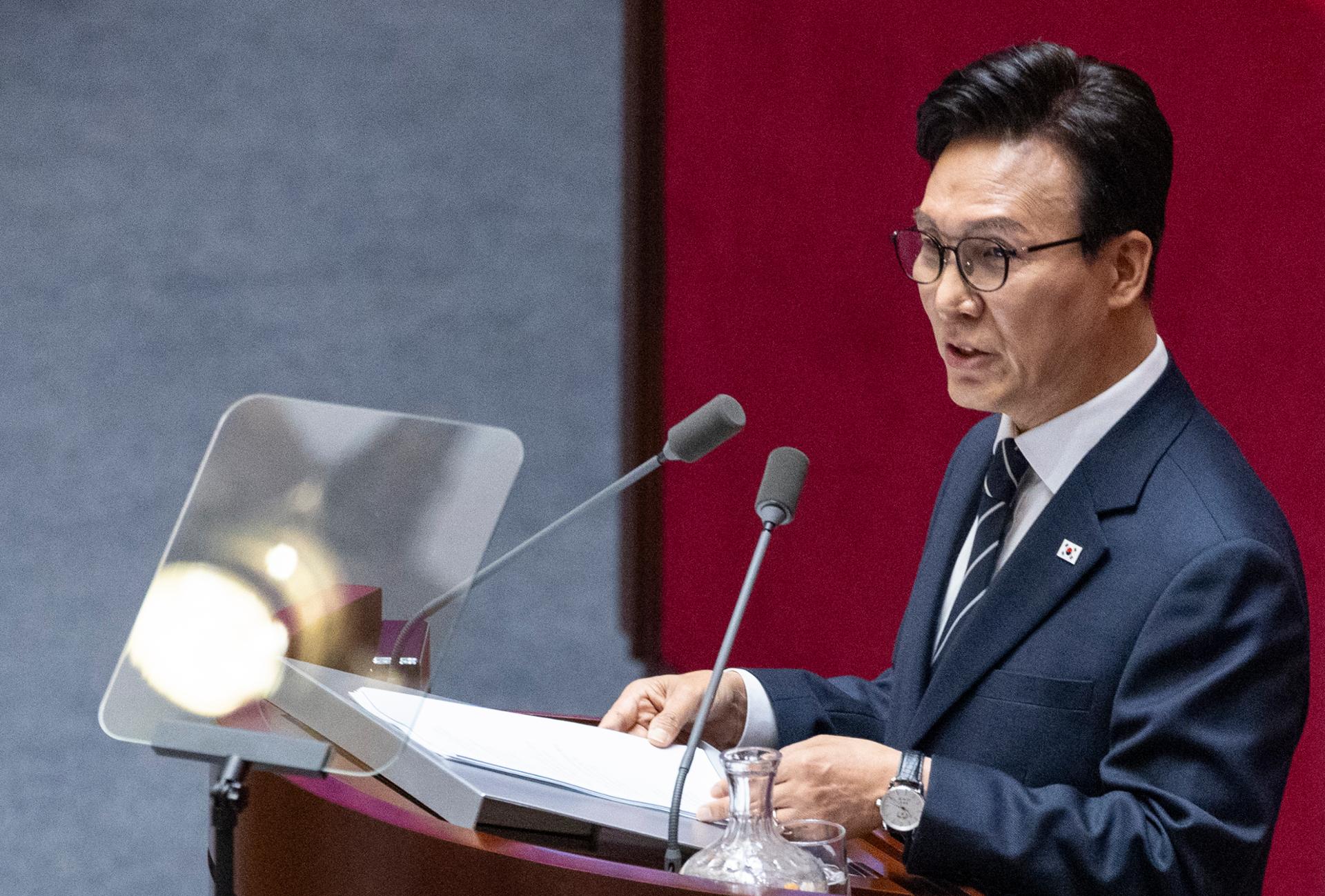
Ruling Democratic Party of Korea (DPK) leader Kim Min-seok said Monday that his party will push for constitutional revision, including changes to Korea's presidential system, returning the politically sensitive issue of presidential terms to the center of national debate.
Kim stopped short of endorsing a specific model, saying the scope of any change to the power structure should ultimately be determined through public consensus.
"We will pursue constitutional revision that is realistically achievable, reflecting changes in the times and the demands of the people while respecting the procedural principles of the Constitution and the law," Kim said in his first parliamentary floor speech since becoming party leader, delivered during a plenary session of the National Assembly in Seoul.
"Including the May 18 Gwangju Democratic Uprising and the Busan-Masan Democratic Protests in the preamble to the Constitution would be the starting point," he said. "As for changes to the power structure, we should go as far as the public wants."
His remarks come as President Lee Jae Myung has called for changing the current single five-year presidential term to a system allowing a president to serve more than one four-year term. The single five-year term was codified in the current Constitution, adopted in 1987 amid the pro-democracy movement that ended decades of military-backed authoritarian rule, and was designed in part to prevent the concentration of power in one leader.
Lee said Aug. 14 that introducing either a four-year system allowing nonconsecutive terms or one permitting consecutive terms has long been his position. He said such a change would allow voters to evaluate a president midway through an eight-year maximum tenure and strengthen political accountability.
The issue has drawn strong opposition from the main opposition People Power Party (PPP), which has questioned whether Lee is seeking to leave open the possibility of running for president again.
The dispute resurfaced last week after Lee reportedly declined to give a direct answer when civic group representatives asked him to pledge not to seek another term as part of efforts to build support for constitutional revision.
On Saturday, PPP spokesperson Cho Yong-sool accused Lee of fueling suspicions over his intentions by refusing to say the "four simple words" that he would not seek another term.
Kim's reference to going "as far as the public wants" leaves open how far the DPK intends to pursue changes to the presidential system. Any amendment to the Constitution requires support from two-thirds of the National Assembly followed by a majority approval in a national referendum, meaning bipartisan cooperation is effectively a prerequisite for revision to succeed.
Kim also called on the PPP to join the constitutional revision effort, pointing to the legacy of former President Kim Young-sam, whose portrait hangs at the party's headquarters.
"The PPP, which displays a portrait of President Kim Young-sam, who punished Chun Doo-hwan and Roh Tae-woo, dismantled the Hanahoe military clique and made May 18 part of the identity of the civilian government, will eventually have to make a choice," Kim said. "I hope it will complete its historical reflection and join us on the path toward constitutional revision."
Beyond constitutional questions, Kim laid out a broader political reform agenda, including easing the requirements for parties to form parliamentary negotiating blocs and a proposal to mix lawmakers' seats in the National Assembly chamber rather than grouping them by party.
He also pledged police reform following the government's plan to overhaul the prosecution, saying checks were needed on what he described as the police's growing investigative power.
On security, Kim called for strengthening Korea's independent defense capabilities to prepare for possible shifts in U.S.-North Korea relations. He also said Seoul should consider whether North Korea's "two-state" doctrine could be used to advance peaceful coexistence, despite disagreeing with Pyongyang's approach.
Source: The Korea Times
