Dollar Faces Growing headwinds as Fed Rate Path Comes Under Question
Key Takeaways
- •Fed Chair Kevin Warsh has emphasized restoring price stability rather than yielding to political pressure for lower rates, keeping US yields elevated and supporting the dollar.
- •The July FOMC meeting marked the first notable shift in narrative, as Warsh declined to explicitly prepare markets for another rate hike, softening tightening expectations.
- •Ongoing disruptions to shipping through the Strait of Hormuz, which handles roughly a fifth of global petroleum consumption, continue to sustain energy prices and short-term inflation risks.
- •A durable US-Iran agreement that reopens the Strait could disproportionately benefit the euro area by lowering energy import costs, given Europe's heavier reliance on imported energy compared to the US.
- •EUR/USD is consolidating between 1.1500 and 1.1560 and trading just below a descending trendline connecting highs from late January 2026 with those from April and May.
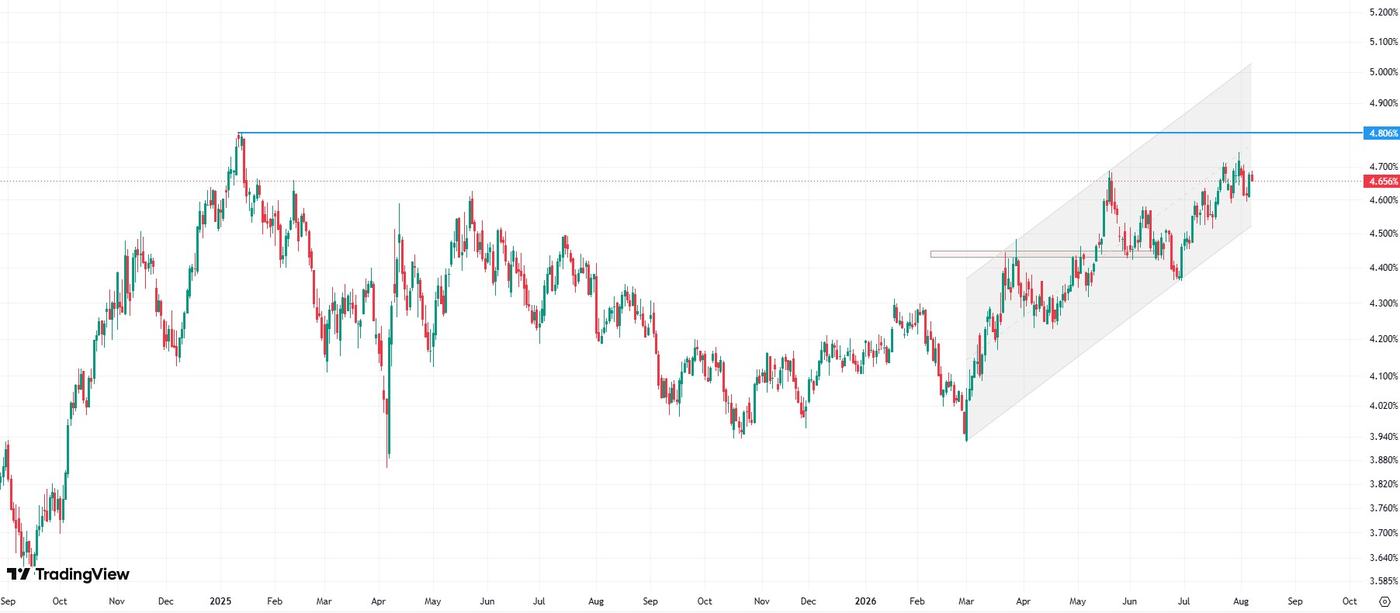
The US dollar has drawn support in recent weeks from elevated Treasury yields and market expectations that the Federal Reserve may not have concluded its inflation fight. Investors continue to assign some probability to an additional rate hike. Yet this pricing could prove difficult to sustain if Middle East tensions ease and inflationary pressures moderate, setting the stage for a potential narrowing of the dollar's advantage over the euro.
A downward reassessment of the Fed's expected policy trajectory represents one of the principal medium-term risks for the dollar. Interest rate differentials between the US and the euro area have been a core driver of EUR/USD valuation in recent years, meaning even modest shifts in relative policy expectations can materially influence the exchange rate.
Fed Expectations Still Lend Support
The dollar's recent strength is driven primarily by monetary policy expectations. When Kevin Warsh assumed the role of Fed Chair, there were concerns he might face pressure from Donald Trump, who has repeatedly advocated for lower interest rates. That scenario has not materialised. Warsh has consistently stressed the importance of restoring price stability, and with inflation still elevated, investors continue to see room for further tightening. This has kept US yields relatively high and underpinned the currency.
US real yields — adjusted for inflation expectations — have been a particularly important anchor for dollar demand, as they influence capital flows into dollar-denominated assets from global investors seeking positive returns.
The July FOMC Meeting Shifted the Narrative
The July FOMC meeting introduced the first tangible signs of uncertainty. Warsh did not use the occasion to explicitly prepare markets for another hike. His reluctance to deliver clear forward guidance softened expectations of imminent tightening, though it did not eliminate them entirely.
This stance elevates the importance of incoming economic data. Inflation, employment, and wage growth figures will increasingly shape how investors judge the Fed's next move. Markets typically look to Core PCE inflation, the Fed's preferred gauge, alongside monthly payrolls and average hourly earnings as key inputs for pricing the policy path. Strong data could rapidly restore expectations of a further hike, while softer readings could produce the opposite effect and weigh on the dollar.
Middle East Tensions Persist as an Inflation Risk
Developments in the Middle East form another critical element of the monetary policy outlook. Disruptions to shipping through the Strait of Hormuz continue to buoy energy prices and generate additional short-term inflation risks. The Strait is one of the world's most important oil transit chokepoints, handling roughly a fifth of global petroleum consumption, making any disruption there systemically relevant for commodity markets.
A durable agreement between the US and Iran could alter this backdrop materially. A reopening of the Strait and a reduction in geopolitical risk would likely push oil prices lower, in turn undermining one of the key rationales for maintaining an exceptionally restrictive US monetary policy stance.
Lower Energy Prices Would Disproportionately Benefit the Euro Area
De-escalation could carry particular significance for Europe. The euro area remains heavily reliant on imported energy, whereas the US holds a far stronger position thanks to its domestic energy production. Europe's energy import dependence was sharply highlighted during the 2022 energy crisis, which exposed the vulnerability of economies that must purchase oil and gas in global markets often priced in dollars.
Reduced oil and gas prices would lower Europe's import costs, brighten the outlook for businesses and households, and bolster economic activity. On this basis, the euro could stand to gain more than the dollar from a lasting geopolitical improvement.
There is, however, a monetary policy trade-off. Lower energy prices would also ease inflationary pressure in the euro area, potentially weakening expectations of further ECB tightening and capping some of the single currency's upside.
Are Markets Too Hawkish on the Fed?
The central question is whether current pricing of the US rate path has become overly aggressive. Investors are effectively pairing expectations of meaningfully lower inflation in the quarters ahead with the possibility of additional Fed tightening — two assumptions that may prove difficult to reconcile over time.
If US inflation continues trending toward the Fed's target and energy prices decline, the justification for another rate increase would weaken considerably. Warsh's relatively constructive view on the disinflationary effects of productivity gains, including those tied to artificial intelligence, could further reinforce this argument. The idea that AI-driven productivity improvements could suppress cost pressures is still debated among economists, but it has gained traction as a medium-term consideration in policy discussions.
Could EUR/USD Grind Higher?
Over the coming quarters, the primary risk for the dollar is a reassessment of the expected Fed policy path. Markets could gradually transition from pricing additional tightening to anticipating a prolonged pause and, eventually, renewed rate cuts.
Such a shift would erode the dollar's interest-rate advantage and open room for EUR/USD to climb. However, the euro's upside may remain gradual, as declining European inflation could simultaneously lead investors to price a more accommodative ECB. The relative pace at which the Fed and ECB adjust their respective stances will likely determine how much ground the pair can cover.
Technical Outlook for EUR/USD
From a technical standpoint, EUR/USD sits at a notable juncture. After the sharp gains recorded in late July, the pair is consolidating in a short-term range between 1.1500 and 1.1560. The exchange rate is also trading just below a descending trendline that connects the highs from late January 2026 with those recorded in April and May.

