Bitcoin and Gold Rally as $40 Trillion U.S. Debt Crisis Weighs on the Dollar
Key Takeaways
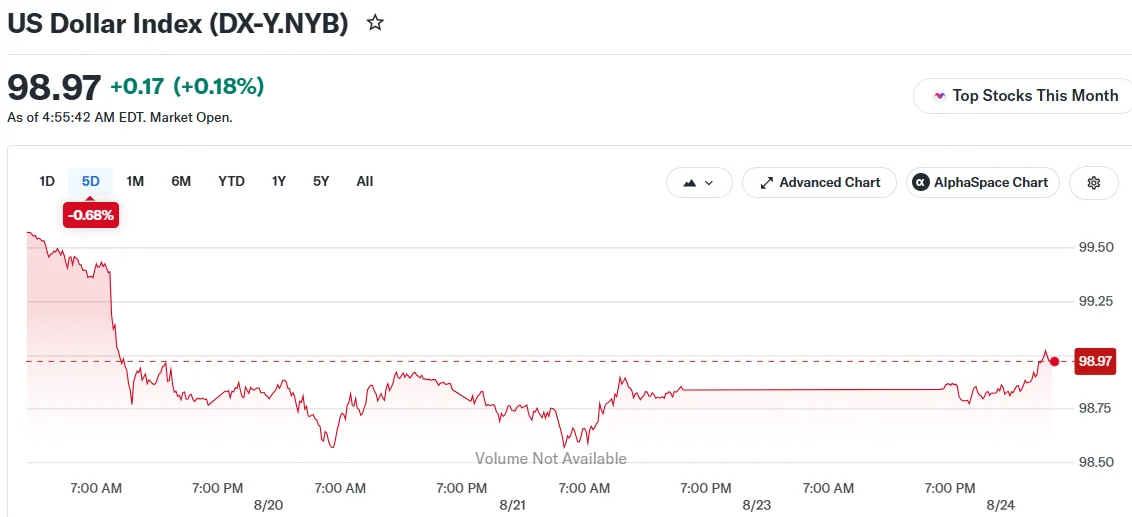
- •The U.S. Dollar Index fell to roughly 98.88, its weakest level since mid-May, after declining almost 1% over the preceding week.
- •U.S. federal debt has exceeded $40 trillion, more than the country's annual economic output, while the yearly budget deficit approaches $1.8 trillion.
- •The Treasury Department expanded its buyback program for longer-dated bonds to $4 billion per session, a move that initially reduced yields but unsettled traders concerned about active market intervention.
- •The dollar posted its steepest weekly decline against bitcoin in nearly three and a half years as investors rotated into gold and bitcoin on currency debasement concerns.
- •The U.S. imposed 50% tariffs on roughly $20 billion of Canadian exports, and Canada confirmed matching retaliatory duties to take effect on September 8.
Key Highlights
- The U.S. Dollar Index dropped to roughly 98.88, its weakest position since mid-May
- The Treasury Department expanded long-term bond buyback operations to $4 billion per session, triggering market concerns
- Federal government debt surpassed the $40 trillion threshold, with the annual deficit approaching $1.8 trillion
- Canada's currency declined after the U.S. imposed new 50% tariffs on roughly $20 billion worth of Canadian imports
- Alternative assets including bitcoin and gold posted strong gains as investors rotated away from traditional U.S. holdings
The U.S. dollar held near multi-month lows on Monday. The U.S. Dollar Index, which tracks the currency against a basket of major trading partners including the euro, yen and pound, traded at roughly 98.88, close to levels not seen since mid-May, after the benchmark currency measure declined almost 1% over the preceding week.
The slide reflects mounting investor anxiety over the fiscal health of the United States government. The national debt has now crossed the $40 trillion milestone, a sum exceeding the country's entire annual economic output, while the annual budget shortfall approaches $1.8 trillion. Net interest payments on the debt have climbed to rank alongside defense spending among the largest categories of federal outlays, keeping fiscal questions at the center of market debate.
During the previous week, the Treasury Department announced plans to expand its buyback program for longer-dated bonds, increasing operations to $4 billion per session. Treasury launched regular buybacks in 2024, its first sustained repurchase program in more than two decades, as a liquidity-support tool for the world's largest government bond market. Officials positioned the expansion as a measure to enhance market functioning and ease stress on longer-duration interest rates, where heavy issuance of new debt has concentrated investor concern.
Although bond yields initially declined following the announcement, the decision to intervene actively in markets created unease among traders. Market observers suggest the Treasury's actions may be producing unintended consequences.
"The more Bessent tries to push back, the more markets will push against him," said Marc Ostwald, chief economist at ADM Investor Services International. He added that the situation is pushing investors toward gold and bitcoin over fears of currency debasement.
Alternative Assets Rally Amid Dollar Decline
Against bitcoin, the dollar recorded its steepest weekly decline in close to three and a half years. Gold prices have similarly advanced as market participants pursue options beyond U.S. dollar-denominated investments, extending a multi-year run that has coincided with sustained central bank buying of the metal. Bitcoin, whose protocol caps total supply at 21 million coins, is frequently framed by its advocates as "digital gold" because of that fixed issuance — the same debasement concern Ostwald described.
According to Ostwald, portfolio managers are actively seeking diversification beyond government bonds issued by G7 nations, motivated by concerns that fiscal imbalances remain unchecked. Debt burdens have also risen across most advanced economies since the pandemic, narrowing the menu of traditional safe assets.
The euro changed hands at $1.1665, positioned near the three-month peak reached during the prior week. The British pound remained close to a six-month high at $1.3628. Meanwhile, China's yuan traded near its strongest level against the dollar in three and a half years.
Trade Disputes and Global Tensions Mount
The Canadian dollar came under selling pressure after Washington imposed 50% tariffs on roughly $20 billion of Canadian exports amid failed bilateral negotiations, the latest escalation in a series of tit-for-tat trade measures between the two countries this year. Ottawa responded by confirming matching retaliatory duties scheduled to take effect on September 8.
Market participants also anticipated announcements from U.S. Treasury Secretary Scott Bessent regarding Iran sanctions scheduled for Monday. Bessent had previously indicated plans to implement "the toughest sanctions in history" targeting Iran, with speculation centering on potential Chinese exposure.
Oil prices declined by more than $1 per barrel in advance of the sanctions announcement as traders secured gains, although geopolitical risks surrounding the Strait of Hormuz continued to loom. The chokepoint carries roughly a fifth of global oil consumption, which keeps it a focal point for energy markets.
Federal Reserve Chair Kevin Warsh is scheduled to deliver remarks at Jackson Hole on Friday. The Kansas City Fed's annual Wyoming symposium has historically served as a stage for signaling shifts in Fed policy thinking, and market observers will scrutinize his commentary for perspectives on monetary policy direction or the Treasury's buyback initiative. Bank of Japan Deputy Governor Ryozo Himino addresses markets on Thursday, with analysts monitoring for indications regarding the trajectory of Japanese interest rate adjustments. Japan is the largest foreign holder of U.S. Treasuries, so Japanese yield trends and investor demand carry particular weight for the long-dated U.S. bonds at the center of the buyback debate.
Nvidia's quarterly earnings report is also expected this week, introducing additional volatility to global market sentiment. The chipmaker has alternated with other technology giants as the world's most valuable listed company, and its results are widely read as a gauge of global spending on artificial intelligence.

