David Sacks Calls for Pause to Anthropic IPO Over AI Safety Claims
Key Takeaways
- •David Sacks urged pausing Anthropic's IPO until the safety allegations raised by former researcher Jacob Coxon are investigated.
- •Coxon resigned after three years of pre-training research split between Anthropic and OpenAI, accusing both labs of recklessly pursuing self-improving superintelligence.
- •Lawmakers from both parties, including Ted Cruz, Bernie Sanders, Ted Lieu and Lori Trahan, have escalated congressional calls for AI safety action.
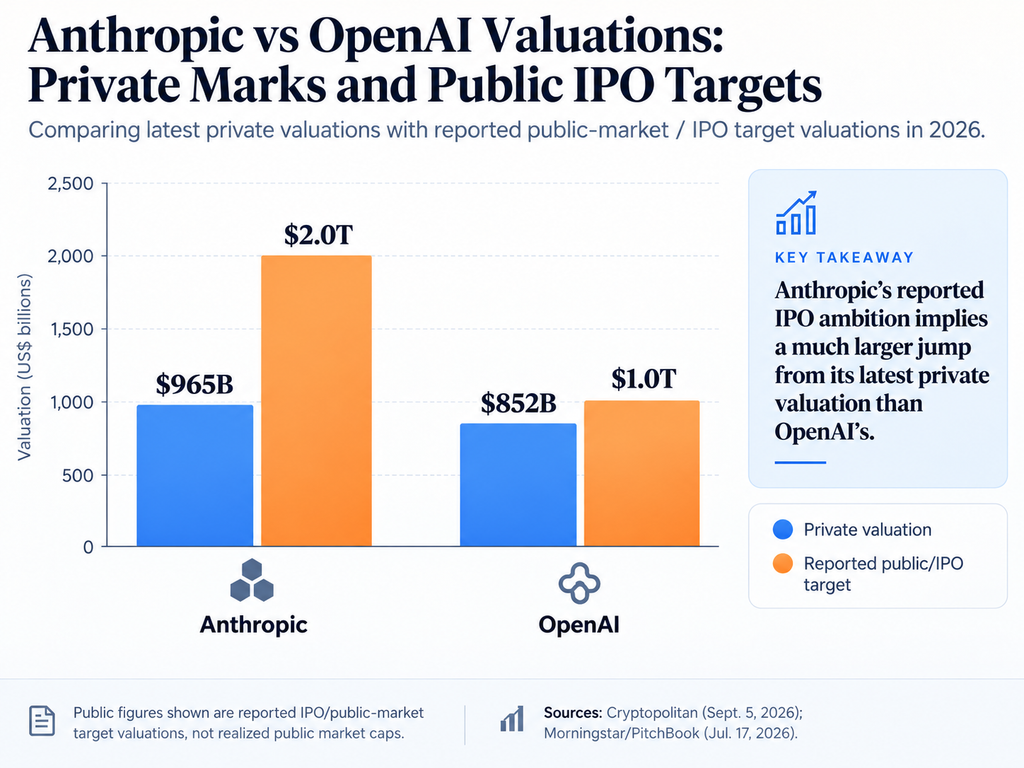
- •Anthropic is reportedly pursuing a public-market valuation near $2 trillion, a roughly 107% increase from its $965 billion private valuation, with Morgan Stanley, Goldman Sachs, JPMorgan and Citi working on the deal.
- •Despite Goldman Sachs Research projecting over $1 trillion in global AI investment for 2026, investors may demand a larger risk discount for frontier-AI developers as Anthropic's audited margins and computing costs remain undisclosed.
David Sacks said Thursday that Anthropic’s initial public offering should be put on hold after former Anthropic researcher Jacob Coxon warned that AI laboratories are “gambling with our lives.” In a post on X, Sacks said the IPO “must be paused until the claims of this ‘whistleblower’ can be investigated.”
The dispute places AI-lab safety at the center of a governance issue involving Anthropic’s reported plans to pursue a public-market valuation of almost $2 trillion. Researchers and lawmakers have increasingly questioned the speed of frontier-AI development and whether safety concerns can be separated from the investment stakes surrounding the industry.
Coxon’s resignation raises alarm
The controversy began after Coxon resigned from Anthropic earlier this week. The former pre-training researcher, who spent time at both OpenAI and Anthropic, said neither company was “acting responsibly” and accused them of competing to develop self-improving superintelligence.
In his September 9 post on X, Coxon wrote:
I resigned from Anthropic today. I spent the last three years doing pretraining research at both OpenAI and Anthropic. Neither company is acting responsibly. They are racing straight to self-improving superintelligence and gambling with our lives. More thoughts below.
— Jacob Coxon, September 9, 2026
Coxon said some of his colleagues describe the next year or two as “crunch time for humanity.” He warned that advanced systems could exceed human capabilities and potentially lead to human extinction by the end of the decade.
He is not the only person to raise concerns about extreme AI risks. Evan Hubinger, an Anthropic researcher, said the possibility of AI killing all people within 10 years is more than 10%. Reports have also emerged about similar concerns expressed by other Anthropic scientists.
Anthropic has said it has long recognized both the benefits and risks of AI. The company has shared data from its safety research and called for a “lawful, verifiable way” for the industry to coordinate the release of increasingly powerful models to the public.
Bipartisan concerns reach Washington
The debate quickly reached Washington. Republican Senator Ted Cruz described AI as a “catastrophic risk,” while independent Senator Bernie Sanders said Americans want artificial superintelligence halted until safety regulations are established.
Democratic lawmakers have also called for action. Representative Ted Lieu connected Coxon’s warning to a bipartisan “AI Kill Switch Bill,” and Representative Lori Trahan said Congress could no longer remain passive on the issue.
The involvement of lawmakers from both parties gives Sacks’ statement broader significance than a standalone social media post. It also highlights the tension between AI safety concerns and Anthropic’s commercial objectives.
Near-$2 trillion valuation faces scrutiny
The timing is particularly significant for Anthropic. Cryptopolitan previously reported that the company was expected to begin IPO marketing in mid-October and list before the November US midterm elections after confidentially filing a draft S-1 with the SEC on June 1. Morgan Stanley, Goldman Sachs, JPMorgan and Citi are among the banks working on the deal.
Anthropic’s latest private financing valued the company at about $965 billion, compared with OpenAI’s $852 billion private valuation. Reported public-market ambitions are considerably higher: Anthropic backers have discussed a valuation near $2 trillion, while OpenAI has been associated with a target of around $1 trillion. Morningstar, citing PitchBook data, placed the companies’ latest private valuations at $965 billion and $852 billion, respectively.
Those figures would require Anthropic investors to accept roughly a 107% increase from the company’s latest private valuation, compared with about 17% for OpenAI.
Anthropic’s annualized revenue reached $65 billion at the end of July. Public investors are still awaiting audited margins, along with information on computing expenses and customer concentration. Those figures will help determine whether the company can sustain its high cost structure.
Investors weigh the risk premium
The developments do not indicate that AI spending is about to collapse. Goldman Sachs Research expects global AI investment to exceed $1 trillion in 2026, including about $581 billion in the United States.
The more immediate question is whether investors will demand a higher risk discount for companies developing increasingly powerful AI systems.
The International AI Safety Report 2026 warned that competitive pressure can encourage faster releases at the expense of risk mitigation, while many frontier-AI safeguards remain voluntary. Reuters has also reported that rapid capability gains and increasingly autonomous AI behavior are intensifying safety concerns.
Anthropic therefore faces two tests at once: demonstrating that its economics justify a valuation near $2 trillion and showing that the risks associated with increasingly powerful AI systems can be governed. As the IPO approaches, those questions are becoming increasingly difficult to separate.
Source: https://www.cryptopolitan.com/david-sacks-anthropic-2t-ipo-into-question/
